Steroid Eye Risk Calculator
Your Steroid Eye Health Risk Assessment
Based on the American Academy of Ophthalmology guidelines, this tool calculates your risk of steroid-induced eye complications. Results are estimates only - consult your doctor for medical advice.
1. Steroid Type
2. Duration of Use
3. Risk Factors
Your Personal Risk Assessment
When you’re on long-term steroids-whether it’s pills for arthritis, inhalers for asthma, or eye drops for uveitis-you’re probably focused on how well they’re working. But there’s a quiet threat hiding in plain sight: your eyes. Steroid-induced cataracts and steroid glaucoma aren’t rare side effects. They’re common, often silent, and can steal your vision before you even notice something’s wrong.
How Steroids Damage Your Eyes
Steroids don’t just calm inflammation. They also mess with the delicate balance inside your eye. For cataracts, the problem starts in the lens. The steroid molecules bind to proteins in the back of the lens, forming abnormal clumps that scatter light. That’s why steroid-induced cataracts are almost always posterior subcapsular-they form right behind the lens, where they blur your vision fast. Unlike age-related cataracts that creep in over years, these can turn your world hazy in just a few weeks. For glaucoma, steroids clog the eye’s drainage system. Normally, fluid flows out through a mesh-like channel called the trabecular meshwork. Steroids make this mesh stiff and less efficient. Fluid builds up. Pressure rises. And if that pressure stays high too long, it crushes the optic nerve. The scary part? You won’t feel it. Glaucoma doesn’t hurt. Not until it’s too late.Who’s at Risk-and How Fast?
Not everyone reacts the same way. About 30% of people are “steroid responders”-their eye pressure jumps when they use steroids. Among people with a family history of glaucoma, that number climbs to over 90%. And here’s what most people don’t realize: you don’t need to be a glaucoma patient to get steroid glaucoma. Nearly 35% of cases happen in people with zero prior eye history. Timing matters. If you’re using steroid eye drops, damage can start in as little as two to four weeks. Oral steroids take longer-usually a few months-but they still pose a serious threat. A study from Savaglio Vision found that after four months of continuous steroid use, the risk of posterior capsular opacification (a type of cataract) spikes sharply. And it’s not just eye drops. Even inhaled steroids for COPD or oral prednisone for autoimmune conditions can trigger these problems.What the Numbers Don’t Tell You
The data shows that steroid-induced eye pressure rises by less than 5 mmHg in two-thirds of users. That sounds minor. But for someone already at risk, even a 6 mmHg jump can be enough to start damaging the optic nerve. In 5% of cases, pressure spikes over 15 mmHg-enough to cause permanent harm in months. And here’s the kicker: steroid glaucoma is often reversible-if caught early. Stop the steroid, and pressure usually drops back down. But if the nerve is already damaged, that’s it. No recovery. No second chances. That’s why timing isn’t just important-it’s everything.Who’s Most at Risk?
Some groups are walking into danger without knowing it:- People with a family history of glaucoma
- Those with pre-existing high eye pressure (even if untreated)
- Patients who’ve had cataract surgery-steroids are commonly prescribed after, and up to 90% of glaucoma patients become steroid responders
- Children and young adults on long-term steroids for asthma, eczema, or Crohn’s disease
- Anyone using steroid eye drops for more than 2 weeks
How to Protect Your Vision
The good news? These complications are almost always preventable. You don’t need to stop your steroids. You just need to monitor your eyes like your life depends on it-because it does. Here’s what the American Academy of Ophthalmology and NIH recommend:- Baseline eye exam before starting steroids-measure your eye pressure and check your lens clarity.
- First follow-up at two weeks after starting treatment.
- Every 4-6 weeks for the first three months.
- Every six months if your pressure stays normal.
What to Watch For
Symptoms don’t always show up early. But when they do, here’s what to look for:- Blurry vision that doesn’t clear up
- Seeing halos around lights-especially at night
- Colors looking faded or washed out
- Difficulty seeing in dim light
- Loss of side vision (tunnel vision)-a late sign of glaucoma
- Eye redness or pain (rare with steroid glaucoma, but possible)
Alternatives and Safer Options
Sometimes, you don’t need steroids at all. Newer anti-inflammatory eye drops like loteprednol etabonate were designed to reduce eye pressure spikes. A 2024 JAMA Ophthalmology study showed they cause significantly less IOP elevation than traditional steroids like prednisolone. For systemic conditions, doctors are increasingly turning to non-steroid options: biologics for autoimmune diseases, antihistamines for allergies, or immunomodulators for chronic inflammation. Ask your doctor: “Is there a safer alternative?”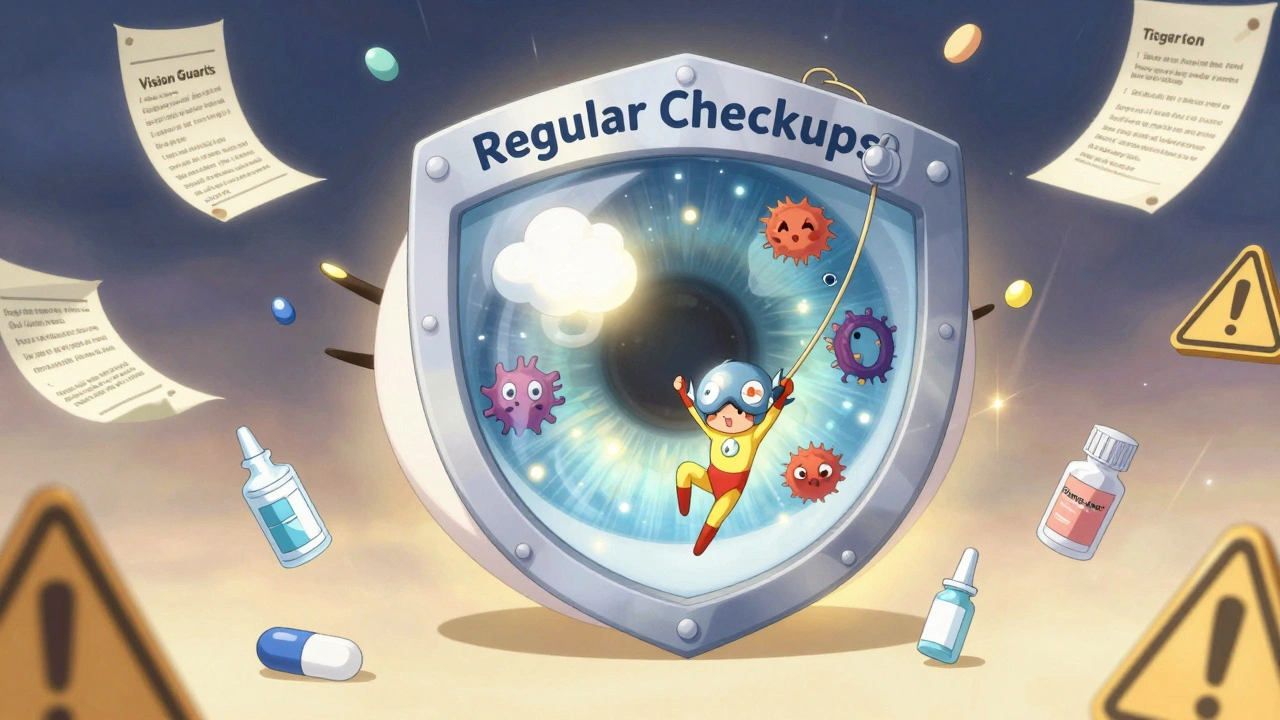
The Big Problem: No One’s Talking About It
Here’s the broken part of the system: only 42% of primary care doctors routinely refer patients on long-term steroids for eye exams. That’s not negligence-it’s ignorance. Most doctors know steroids cause stomach issues or weight gain. Few know they can blind you. If you’re prescribed steroids for more than two weeks, take charge. Ask your doctor: “Do I need an eye exam?” If they say no, ask for a referral to an ophthalmologist. Bring this information with you. You’re not being difficult-you’re being smart.What Happens If You Ignore It?
One Healthgrades review says it all: “I didn’t realize my steroid eye drops for uveitis were causing glaucoma until I lost peripheral vision-now I need multiple daily eye drops permanently.” Steroid-induced glaucoma isn’t curable. Once the optic nerve is damaged, it doesn’t heal. You’ll spend the rest of your life on eye drops, maybe even surgery. And even then, you might lose more vision. Cataracts from steroids? They can be removed. But surgery is more complicated if you also have glaucoma. And you’ll still need lifelong pressure monitoring.The Bottom Line
Steroids save lives. But they can also take your sight-if you’re not careful. The risk isn’t theoretical. It’s measurable. It’s documented. It’s happening right now to people who thought they were just taking their medicine. You don’t have to choose between treating your condition and protecting your vision. You just need to be informed. Get checked before you start. Get checked while you’re on it. And never assume you’re safe because you feel fine. Your eyes don’t warn you. But you can warn yourself.Can steroid eye drops cause glaucoma even if I don’t have a history of it?
Yes. Nearly 35% of steroid-induced glaucoma cases occur in people with no prior eye disease. Even if you’ve never had high eye pressure or glaucoma, long-term use of steroid eye drops can trigger it. The risk starts as early as two weeks after beginning treatment.
How long does it take for steroids to cause cataracts?
Steroid-induced cataracts can develop in as little as 2-4 weeks with topical eye drops. With oral or inhaled steroids, it usually takes a few months. These cataracts form faster than age-related ones and are harder to treat because they’re located in the back of the lens, directly blocking vision.
Is steroid-induced glaucoma reversible?
Yes-if caught early. Stopping the steroid often brings eye pressure back to normal. But if the optic nerve is already damaged, the vision loss is permanent. That’s why regular eye pressure checks are critical. Waiting for symptoms means it’s too late.
Should I stop taking steroids if I’m worried about my eyes?
Never stop steroids without talking to your doctor. Abruptly stopping can cause serious health problems. Instead, get your eyes checked and ask if there’s a safer alternative. Your doctor can adjust your treatment plan without risking your overall health.
Are there steroid alternatives that are safer for the eyes?
Yes. Newer eye drops like loteprednol etabonate cause significantly less eye pressure rise than older steroids like prednisolone. For systemic conditions, biologics and immunomodulators are often safer long-term options. Ask your doctor if a lower-risk alternative is right for you.
How often should I get my eyes checked while on steroids?
Baseline exam before starting, then at 2 weeks, every 4-6 weeks for the first 3 months, and every 6 months after that if pressure is normal. If you’re on steroids for more than 4 weeks, this schedule is non-negotiable. Many people skip follow-ups-don’t be one of them.
Can children develop steroid-induced eye problems?
Yes. Children on long-term steroids for asthma, eczema, or autoimmune diseases are at risk. Their eyes are more sensitive, and damage can progress quickly. Parents should insist on baseline and regular eye exams if their child is on steroids for more than 2 weeks.
Do all steroid medications affect the eyes the same way?
No. Topical eye drops carry the highest and fastest risk because they’re applied directly to the eye. Oral and inhaled steroids take longer to cause damage but still pose serious threats. Injectable steroids can also raise eye pressure, especially if used frequently. The route of administration changes the timeline, but not the risk.



Francine Phillips
December 2, 2025 AT 11:37Just started steroid eye drops for my uveitis and now I’m terrified to even blink. Thanks for the wake up call I guess.
Katherine Gianelli
December 4, 2025 AT 01:22Wow this hit me right in the feels. My mom lost partial vision from steroid drops after her cataract surgery and no one warned her. She’s been through hell. Please, if you’re on steroids-get checked. Your eyes don’t scream, they just fade. Don’t wait until it’s too late. You’re not being dramatic, you’re being brave.
Joykrishna Banerjee
December 4, 2025 AT 09:12Typical American medical negligence. In India, we have mandatory IOP screening protocols for steroid users since the 90s. Your ‘guidelines’ are a joke. Also, ‘loteprednol etabonate’? You think your fancy brand names make you sound smart? It’s still a glucocorticoid receptor agonist. The mechanism hasn’t changed. Stop marketing fear with buzzwords.
Myson Jones
December 5, 2025 AT 06:33Thank you for sharing this. I’ve been on prednisone for lupus for 18 months and had no idea my blurry vision was linked. My optometrist didn’t mention it either. I’ll be scheduling my eye exam tomorrow. You’ve done a great service here.
parth pandya
December 6, 2025 AT 16:21u shud get ur eyes checkd every 4-6 wks if on steroids for more than 4 wks. i did this after my asthma flare and caught high iop early. doc put me on brimonidine and saved my sight. dont wait till u see halos. its alrdy late. #eyehealth #steroidrisks
Albert Essel
December 8, 2025 AT 02:31There is a critical gap between clinical knowledge and patient awareness. This post does an excellent job of translating complex ophthalmic pathology into actionable advice. The data on steroid responders, particularly in non-glaucoma populations, is underutilized in primary care. I hope this reaches clinicians who prescribe these medications routinely.
Charles Moore
December 8, 2025 AT 21:15I’ve seen too many people suffer because they trusted their doctor to tell them everything. But doctors are rushed, overloaded, and sometimes just don’t know. I’m not blaming them-I’m saying we need to be our own advocates. If you’re on steroids longer than two weeks, walk into your eye doctor’s office with this article. Don’t ask permission. Just do it. You owe it to your future self.
Gavin Boyne
December 9, 2025 AT 10:23Oh wow, so steroids can blind you? Shocking. Next you’ll tell me that smoking causes lung cancer or that eating sugar leads to diabetes. What’s next, gravity is real? I’m sure the FDA is just sitting on this information while laughing at us. /s
But seriously-this is important. And yeah, I’m the guy who reads the fine print. You’re welcome, world.
Rashi Taliyan
December 9, 2025 AT 21:56My 10-year-old has been on inhaled steroids for asthma since she was 4. I didn’t know this could happen. I cried when I read this. I’m taking her to the ophthalmologist next week. I didn’t even know to ask. Thank you for making me feel like a good mom for once. This is life-changing info.
Kara Bysterbusch
December 10, 2025 AT 06:31This is not merely informative-it is a public health imperative. The absence of standardized ophthalmic screening protocols for patients on long-term systemic or topical corticosteroids represents a systemic failure in preventive medicine. The fact that only 42% of primary care providers refer for baseline eye exams is not an oversight-it is negligence masked as inertia. This article should be required reading for every prescriber of corticosteroids, and every patient who receives them. Vision is not replaceable. Prevention is not optional.
Rashmin Patel
December 10, 2025 AT 22:56OMG I just realized I’ve been using steroid eye drops for 3 months for my dry eyes and I never got checked 😭 I thought it was just my screen time! I’m so mad at myself but also so grateful I found this. I just booked my appointment and I’m sending this link to my whole family. My mom’s on prednisone for RA and my brother’s on inhalers for allergies-everyone needs to know this. I’m not gonna let anyone I love go blind because no one told them. 🙏👁️🗨️ #EyeHealthIsLife #SteroidAwareness