
When someone starts hearing voices that aren’t there, or becomes convinced that strangers are watching them, it’s not just paranoia-it could be the early stages of psychosis. Many people don’t recognize these signs until it’s too late. But the truth is, psychosis doesn’t come out of nowhere. It creeps in slowly, often masked as stress, laziness, or moodiness. By the time someone is diagnosed, they may have already lost months-or even years-of their life to untreated symptoms. The good news? If caught early, recovery isn’t just possible-it’s likely.
What Does Early Psychosis Really Look Like?
Psychosis isn’t a diagnosis. It’s a symptom. It can show up in schizophrenia, bipolar disorder, severe depression, or even after heavy drug use or extreme trauma. But before full-blown hallucinations or delusions appear, there are subtle warning signs. These aren’t dramatic movie moments. They’re quiet changes that families often ignore.Look for a sudden drop in grades or job performance. Studies show this happens in 78% of first-episode cases. It’s not just laziness. The person might sit for hours staring at a textbook, unable to focus. Or they miss work shifts without explanation. Their thoughts feel foggy. They forget what they were saying mid-sentence. Conversations become hard to follow-not because they’re rude, but because their brain is struggling to organize information.
Social withdrawal is another big red flag. Someone who used to hang out with friends might start skipping gatherings, turning down calls, or spending all day alone in their room. They might become suspicious of people they’ve known for years. A simple comment like “You look tired” might be interpreted as a coded threat. They might believe TV shows are sending them messages or that neighbors are spying on them through the walls.
Changes in personal hygiene are common too. In 52% of cases, people stop showering regularly, wearing clean clothes, or brushing their teeth. It’s not defiance. Their motivation, energy, and sense of self-care are drained. Sleep patterns shift dramatically-sleeping 14 hours a day one week, then staying awake for 48 hours the next.
Emotional shifts are confusing. Someone might laugh at something sad, cry over nothing, or show no emotion at all. They might seem angry for no reason, or suddenly terrified of ordinary things like elevators or crowds. These aren’t just mood swings. They’re signs the brain’s emotional control system is misfiring.
And here’s the most important detail: in the early stages, many people know something’s wrong. They might say, “I think I’m losing my mind,” or “I don’t feel like myself anymore.” That’s a crucial window. Once psychosis fully develops, that insight often disappears. That’s why early detection saves lives.
Why Timing Matters More Than You Think
The longer psychosis goes untreated, the harder it is to recover. On average, people in the U.S. wait 74 weeks-almost two years-before getting help. During that time, the brain changes. Neural pathways that handle thinking, memory, and emotion become less flexible. Each additional month without treatment increases recovery time by 5-7% and cuts the chance of returning to work or school by 3.2%.This isn’t theoretical. A landmark study called RAISE showed that people who got treatment within the first year of symptoms were 60% more likely to recover fully than those who waited. They held jobs. Went back to college. Rebuilt relationships. They didn’t end up in long-term hospital care.
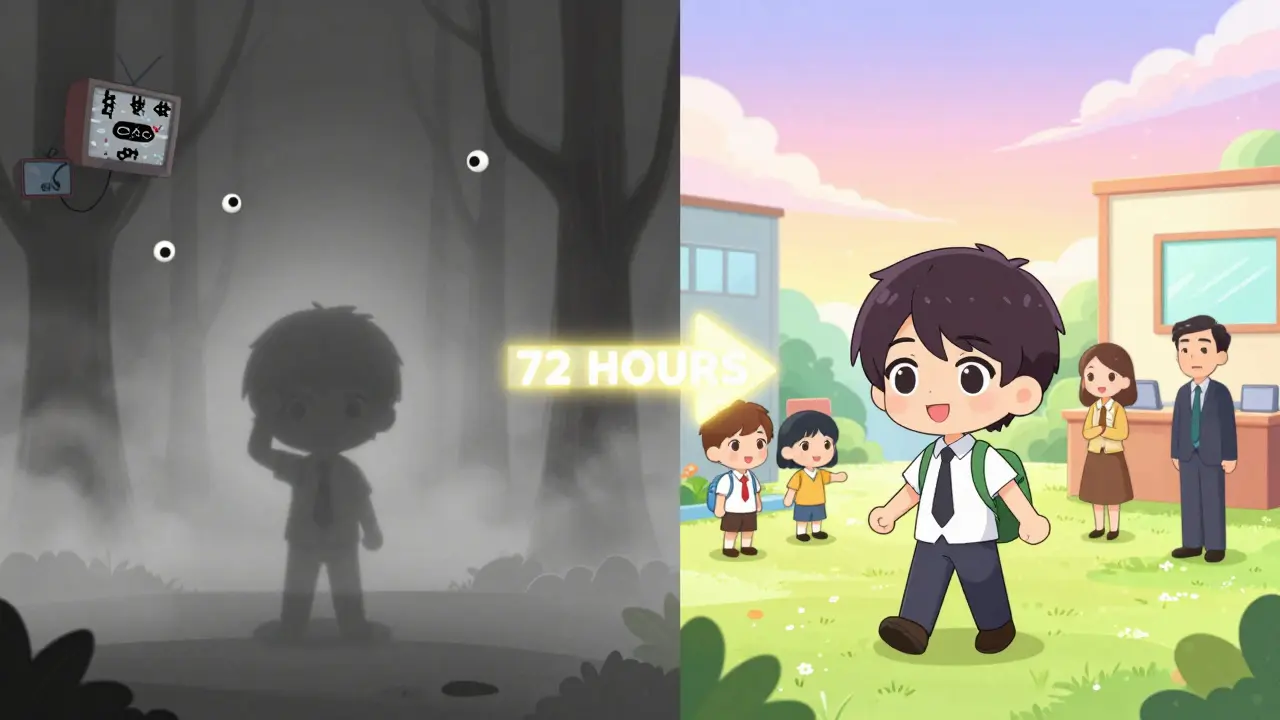
That’s why experts call the first 72 hours after symptoms appear the “golden hour.” Not because it’s a race against death-but because early action prevents long-term damage. The goal isn’t just to stop hallucinations. It’s to protect a person’s future.
What Is Coordinated Specialty Care (CSC)?
Coordinated Specialty Care (CSC) is the most effective treatment for first-episode psychosis. It’s not just medication. It’s a full team working together-psychiatrists, therapists, case managers, peer specialists, and family educators-all focused on one thing: helping the person rebuild their life.CSC has five core parts:
- Case management: A case manager visits the person at home, helps them get to appointments, applies for benefits, and checks in weekly. The ratio is no more than 10 clients per staff member-so no one falls through the cracks.
- Family education: Families aren’t bystanders. They get 12-20 weekly 90-minute sessions to learn about psychosis, how to respond to symptoms, and how to avoid triggering stress. This reduces conflict and increases support.
- Individual therapy: Cognitive Behavioral Therapy for psychosis (CBTp) helps people understand their experiences without judgment. Instead of saying “That’s not real,” therapists help them ask: “What else could this mean?” This reduces fear and builds coping skills.
- Employment and education support: Over 80% of CSC participants return to school or work within three months. Job coaches help them find roles that fit their energy levels. Tutors help with schoolwork. No one is told to “just get a job.” They’re given the tools to succeed.
- Medication management: Antipsychotic meds are used, but carefully. Doctors start at 25-50% of the normal adult dose and increase slowly. Side effects like weight gain or drowsiness are monitored closely. The goal isn’t to numb the person-it’s to stabilize them so they can engage in life.
Studies show CSC leads to 58% greater improvement in symptoms, 42% better daily functioning, and 35% higher treatment retention than standard care. People on CSC are 45% less likely to be hospitalized. And for every $1 spent on CSC, society saves $17.50 in emergency care and lost productivity.

How Do You Get Help?
If you notice these signs in someone you care about, don’t wait. Don’t assume they’ll grow out of it. Don’t blame stress or teenage rebellion. Take action.Start with a screening tool called the Prodromal Questionnaire (PQ-16). It’s free, quick, and used by clinics nationwide. A score of 8 or higher means a full clinical assessment is needed.
Then, find a CSC program. In the U.S., there are now 347 certified programs across 48 states. Many are connected to university hospitals or community mental health centers. You can search for one through the National Alliance on Mental Illness (NAMI) or the Substance Abuse and Mental Health Services Administration (SAMHSA) website.
Primary care doctors, school counselors, and even urgent care clinics can make referrals. If you’re unsure where to start, call your state’s mental health hotline. Most states have a 24/7 crisis line that can connect you to the right service.
And if you’re in a rural area? Telehealth is helping. Nearly 38% of CSC programs now offer virtual therapy and medication management. It’s not perfect-but it’s better than nothing.
What Happens If You Don’t Get Help?
Without early intervention, psychosis often leads to a cycle of crisis: emergency room visits, involuntary hospitalizations, job loss, homelessness, and long-term disability. One in three people with untreated psychosis will develop chronic schizophrenia. That’s not inevitable.But even worse than the symptoms is the stigma. Families feel ashamed. Schools push students out. Employers fire them. And the person themselves feels broken. They believe they’re a burden. That’s why CSC doesn’t just treat symptoms-it rebuilds identity. It says: “You’re not your illness. You’re still you. And we’re here to help you get back.”
What’s Changing in Psychosis Care?
The field is moving fast. In 2023, the National Institute of Mental Health launched EPINET, a national network tracking outcomes across 200+ CSC programs. Early results show 63% of participants achieve symptom remission within a year.Researchers are also testing blood tests to predict psychosis before it fully develops. A 2022 study identified 12 biomarkers that can predict transition to psychosis with 82% accuracy. This could one day mean screening teens during routine checkups.
And there’s a push to fix disparities. Black Americans wait, on average, 2.4 times longer for treatment than white Americans. New studies are now testing CSC models specifically designed for communities of color, with culturally trained staff and community outreach.
By 2027, federal law will require all Medicaid-funded programs to offer CSC. That’s a big step. But right now, only 42% of people with first-episode psychosis get CSC within the critical two-year window. That’s the gap we need to close.
What You Can Do Right Now
If you’re worried about yourself or someone else:- Write down the changes you’ve noticed-when they started, how often they happen, what triggers them.
- Don’t wait for a “diagnosis.” If you see three or more early signs, reach out to a mental health provider.
- Ask: “Do you have a Coordinated Specialty Care program nearby?”
- If you’re a parent, teacher, or coach: Talk to your school or community center about screening programs. Early detection saves futures.
Psychosis isn’t a life sentence. It’s a medical event-like a heart attack, but for the brain. And just like with a heart attack, the sooner you act, the better the outcome. There’s no shame in asking for help. There’s only loss in waiting.



Amelia Williams
January 23, 2026 AT 19:48My cousin went through this last year-no one noticed until she stopped answering texts and started talking to the TV. We found a CSC program through NAMI, and honestly? It saved her. She’s back in college, working part-time, even started painting again. It’s not magic, but it’s real. Early help isn’t just good-it’s life-changing.
People think psychosis means ‘crazy,’ but it’s more like a brain glitch. Like a software update gone wrong. You don’t ignore a blue screen-you reboot. Same here.
Stop waiting for a crisis. If you see three signs, pick up the phone. No shame. No delay.
Josh McEvoy
January 24, 2026 AT 17:33bro i swear my roommate was doing all this last semester and we just thought he was ‘going through a phase’ 😭
now he’s on meds and going to therapy and actually smiling again. why do we wait until someone’s on the edge??
also why is no one talking about how weird it is that we only care when it’s ‘bad enough’?? 🤦♂️
Sawyer Vitela
January 25, 2026 AT 04:1574 weeks average delay? That’s criminal. The system is broken. CSC works, but only 42% get it. Why? Funding. Stigma. Incompetence. Fix the system, not just the symptoms.
Tommy Sandri
January 26, 2026 AT 22:16The data presented here is compelling and aligns with current clinical literature. The emphasis on coordinated specialty care as a paradigm shift in early psychosis intervention is both evidence-based and ethically imperative. The economic return on investment-$17.50 saved per dollar spent-should compel policymakers to prioritize expansion of these programs nationwide.
Shanta Blank
January 28, 2026 AT 06:41Let’s be real-this isn’t just about ‘early detection.’ It’s about how society treats people who don’t fit the mold. We ignore the quiet ones until they scream. We label them ‘weird’ before we ask ‘what’s hurting you?’
And don’t get me started on how Black and Brown kids get locked up instead of linked to care. This isn’t mental health-it’s a racial justice issue wrapped in a clinical report.
Sushrita Chakraborty
January 28, 2026 AT 08:31While the article is comprehensive and well-referenced, I would like to emphasize the importance of cultural adaptation in Coordinated Specialty Care. In many South Asian communities, psychosis is often interpreted through spiritual or familial lenses. Without culturally competent peer specialists, families may resist medical intervention-even when it’s lifesaving. Training must include not just clinical skills, but cultural humility.
Himanshu Singh
January 29, 2026 AT 21:08It’s funny how we treat the brain like it’s separate from the rest of the body. We’d never say ‘just snap out of it’ to someone with a broken leg. But when the mind hurts, we whisper, ‘maybe they’re just lazy.’
This isn’t weakness. It’s biology. And healing? It’s not about fixing someone. It’s about walking beside them until they remember who they are.
Tiffany Wagner
January 31, 2026 AT 05:43my mom saw the signs in me before i did... i didn't want help at first but she kept showing me the info about csc... now i'm in a program and i finally feel like me again. thanks mom