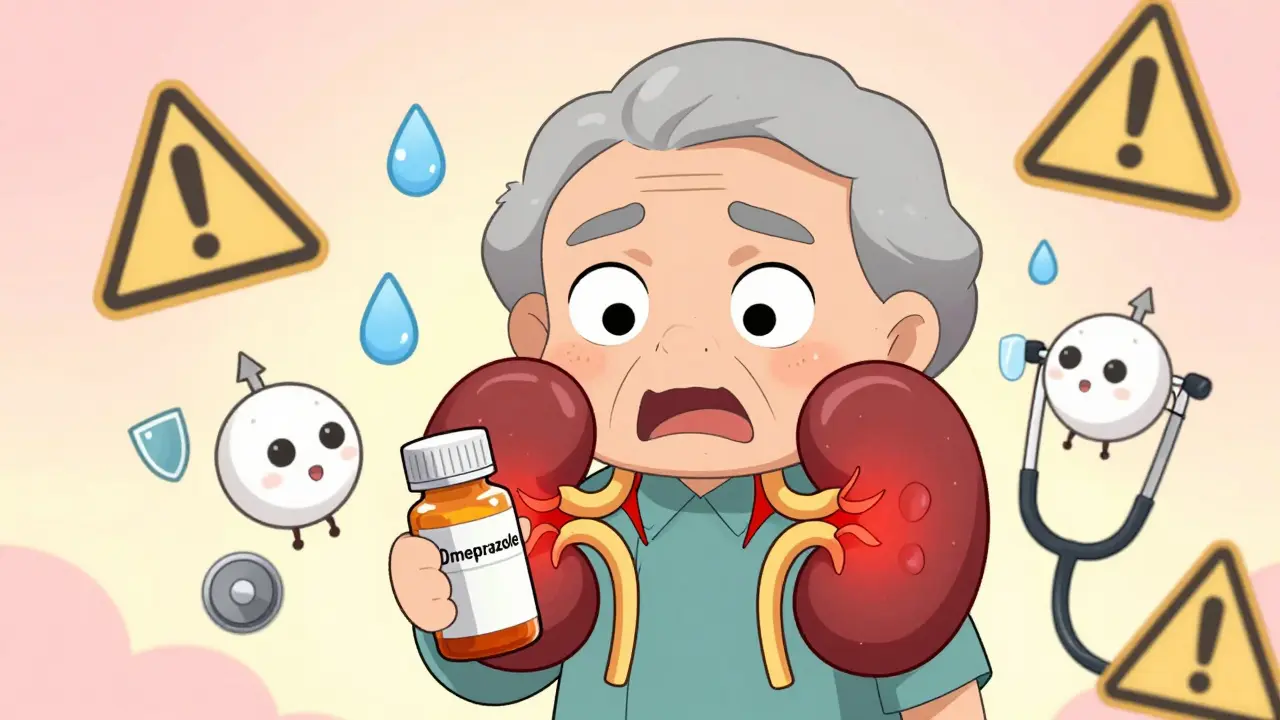
When your kidneys suddenly stop working like they should, it’s easy to blame dehydration, infection, or bad luck. But for many people, the real culprit is something they took every day without a second thought: a common medication. Acute interstitial nephritis (AIN) isn’t rare. It’s one of the leading causes of sudden kidney failure in adults, and most of the time, it’s caused by drugs we think are harmless. If you’re on proton pump inhibitors, antibiotics, or NSAIDs - especially if you’re over 50 - this could matter more than you realize.
What Exactly Is Acute Interstitial Nephritis?
Acute interstitial nephritis is a type of kidney injury where the tissue between the tubules becomes inflamed. Unlike infections or blockages, AIN isn’t about clogged pipes or germs. It’s an immune reaction. Your body mistakes part of the kidney for a threat and sends white blood cells to attack it. The result? Swelling, scarring, and a sharp drop in kidney function.
Most cases show up as acute kidney injury - meaning creatinine levels spike, urine output drops, and you feel tired, nauseous, or just "off." Some people develop fever, rash, or joint pain. But here’s the problem: in over 90% of cases, none of these classic signs appear. That’s why AIN is often missed. Doctors think it’s a urinary tract infection, dehydration, or even the flu. By the time a kidney biopsy confirms it, weeks may have passed.
Which Drugs Cause It?
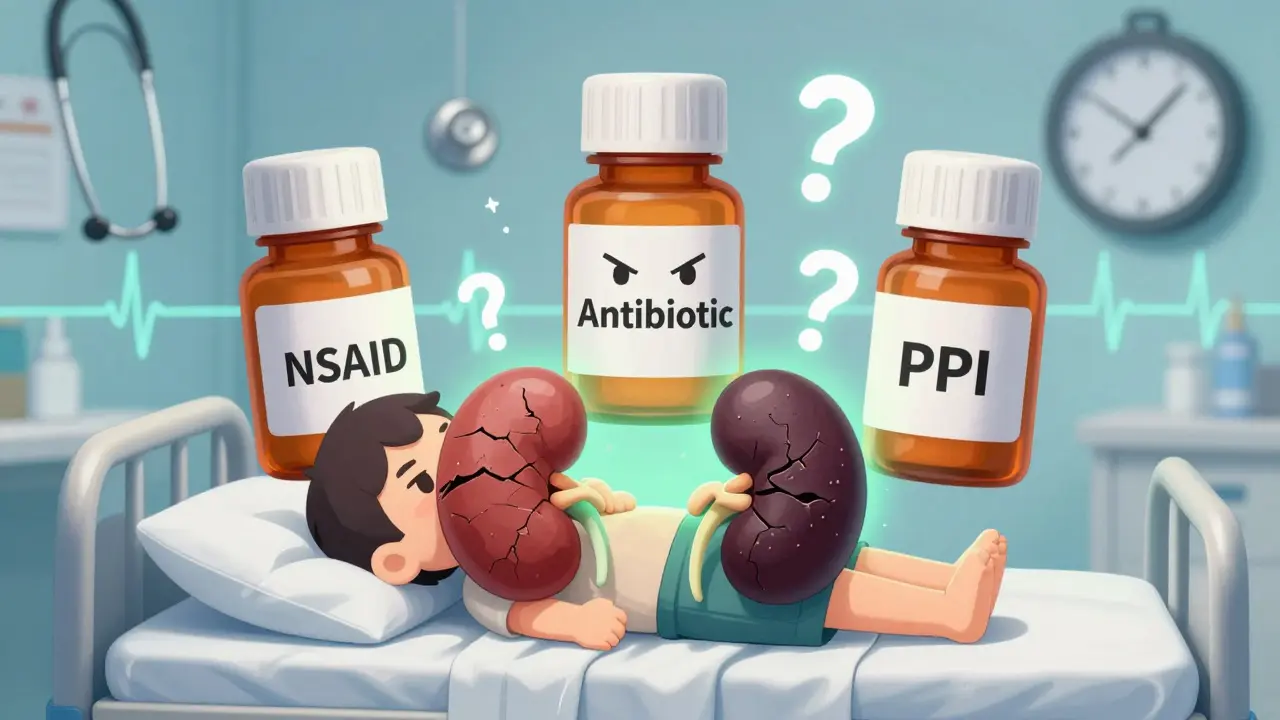
Over 250 medications have been linked to AIN. But three classes account for nearly 80% of cases:
- Proton pump inhibitors (PPIs) - like omeprazole, pantoprazole, esomeprazole
- Antibiotics - especially penicillins, cephalosporins, sulfonamides, and ciprofloxacin
- NSAIDs - ibuprofen, naproxen, diclofenac, and even aspirin in high doses
Twenty years ago, antibiotics were the #1 trigger. Today, PPIs have taken the lead. In the UK and US, PPI-induced AIN now affects 12 out of every 100,000 people annually. That’s a 40% increase since 2010. Why? Because PPIs are everywhere - prescribed for heartburn, taken long-term for no clear reason, and even bought over the counter without supervision.
NSAIDs are sneaky. People think they’re safe because they’re available without a prescription. But if you’re over 65, have high blood pressure, or take diuretics, even a few weeks of daily ibuprofen can trigger kidney inflammation. The damage builds slowly. By the time you feel it, your kidneys are already injured.
How Do You Know It’s AIN - Not Something Else?
There’s no blood test that says "AIN." No urine dipstick. No scan. The only way to be sure is a kidney biopsy. It sounds scary, but it’s a simple procedure. A tiny needle takes a sample from the kidney, and under a microscope, pathologists look for telltale signs: immune cells flooding the space between tubules, eosinophils (a type of white blood cell), and swelling.
Other tests - like gallium scans or checking for eosinophils in urine - used to be popular. But they’re unreliable. One study found eosinophiluria was present in less than 40% of confirmed AIN cases. That means most patients get false negatives. Relying on them delays diagnosis.
Doctors now use a checklist:
- Did kidney function drop suddenly (within days or weeks)?
- Did you start or increase a new medication in the last 1-8 weeks?
- Are you on a high-risk drug (PPI, antibiotic, NSAID)?
- Is there no other obvious cause (like dehydration or infection)?
If the answer is yes to most of these, a biopsy is the next step - even if you don’t have a rash or fever.
Recovery: It Depends on the Drug
The good news? AIN is often reversible - if caught early. The bad news? Recovery isn’t guaranteed, and it varies wildly depending on what caused it.
Antibiotic-induced AIN - usually the most dramatic. People often feel awful within days of starting the drug. But they also recover fastest. Over 75% regain full kidney function within 2-4 weeks after stopping the medication. Many notice improvement in just 72 hours.
NSAID-induced AIN - the most dangerous long-term. Patients are often older, with other health problems. The inflammation is deeper, and fibrosis (scarring) is common. Only about 50% recover fully. Nearly half end up with permanent kidney damage (eGFR below 60), and 42% progress to chronic kidney disease within a year.
PPI-induced AIN - the newest puzzle. These cases are often milder at first. People take omeprazole for years. Then, suddenly, their creatinine climbs. The inflammation isn’t as severe, but recovery is worse than with antibiotics. Only 50-60% regain normal kidney function. One patient case from Manchester showed a 63-year-old woman on omeprazole for 18 months needed dialysis for three weeks. A year later, her eGFR was still at 45 - a 30% loss.
What Should You Do If You Suspect AIN?
Stop the drug - immediately. That’s step one. No waiting. No "let’s see if it gets better." If you’re on a PPI, NSAID, or antibiotic and your kidney function has dropped, the medication is almost certainly the cause. Continuing it will only make things worse.
Next, see a nephrologist. Don’t wait for your GP to refer you. If your creatinine is rising and you’ve been on one of these drugs, ask for a referral now. Time matters. Studies show that if you get diagnosed within 7 days of symptoms starting, your chance of full recovery jumps by 35%.
Corticosteroids? They’re controversial. There’s no large trial proving they work. But in real-world practice, they help - especially if your eGFR is below 30. A typical course is methylprednisolone for 2-4 weeks, then a slow taper over two months. Many nephrologists in the UK and US use them routinely for severe cases.
For the 15-20% of patients who need dialysis, recovery usually happens within 4-6 weeks. But those who wait too long to stop the drug often never fully recover.
Who’s at Highest Risk?
You’re at higher risk if you:
- Are over 65
- Take 5 or more medications daily
- Have diabetes, heart failure, or high blood pressure
- Use NSAIDs or PPIs long-term without medical supervision
- Have had AIN before
People over 65 have a risk 4 times higher than those under 45. Polypharmacy - taking 5+ drugs - triples your risk. That’s why AIN is more common in nursing homes and long-term care facilities.
What Can You Do to Prevent It?
Don’t take PPIs longer than 4-8 weeks unless you have a confirmed diagnosis like Barrett’s esophagus or severe ulcers. Ask your doctor: "Is this still necessary?" Many people stay on them for years because no one ever told them to stop.
Use NSAIDs sparingly. If you need pain relief, try acetaminophen first. If you’re on daily NSAIDs for arthritis, ask about alternatives like physical therapy or low-dose colchicine.
Monitor your kidney function. If you’re on long-term medications, get a basic blood test (creatinine, eGFR) once a year. If you’re over 65 or on multiple drugs, do it every 6 months.
Keep a list of all your medications - including over-the-counter ones - and bring it to every doctor visit. Many cases of AIN happen because one doctor prescribes a PPI, and another prescribes an NSAID, and no one connects the dots.
What Happens If You Don’t Act?
Left untreated, AIN doesn’t just go away. It turns into chronic kidney disease. About 30% of patients develop stage 3 or worse CKD within 12 months. That means permanent loss of kidney function. Some end up on dialysis. Others face higher risks of heart attack, stroke, and early death.
One patient in a UK nephrology forum wrote: "I thought my fatigue was just aging. Turns out I had AIN from omeprazole. I’m 71 now. My eGFR is 40. I’m on a waiting list for a transplant. I wish I’d known sooner."
That’s not rare. It’s becoming more common.
Can AIN happen from a single dose of a drug?
Yes. While most cases develop after weeks or months of use, some people react after just one or two doses - especially with antibiotics like penicillin or sulfa drugs. The immune system can overreact quickly. That’s why doctors warn against restarting a drug that caused AIN in the past.
Is a kidney biopsy always necessary?
In most cases, yes. Blood and urine tests can suggest AIN, but they can’t confirm it. Other conditions like glomerulonephritis or urinary obstruction look similar. A biopsy is the only way to rule those out. Delaying it can lead to permanent damage. Most nephrologists agree: if clinical suspicion is high, don’t wait.
Can you get AIN from herbal supplements or vitamins?
Rarely, but yes. Some herbal products - especially those containing aristolochic acid (found in certain traditional remedies) - are known to cause kidney damage. Even high doses of vitamin C or E have been linked to rare cases. Always tell your doctor about supplements. They’re not harmless.
If I recover, can I take the same drug again?
Never. Once you’ve had AIN from a drug, re-exposure almost always causes a faster, more severe reaction. Even if you felt fine after taking it before, your immune system now remembers it as a threat. Avoid it completely. Tell every doctor you see.
How long does it take to get results from a kidney biopsy?
Usually 3-5 days. The sample is processed, stained, and examined under a microscope. In urgent cases, some hospitals provide preliminary results in 24 hours. If you’re already on dialysis or your kidney function is crashing, your nephrologist will act before the full report comes back.
If you’re on long-term medications - especially PPIs or NSAIDs - don’t wait for symptoms. Talk to your doctor. Ask about your kidney function. Ask if the drugs you’re taking are still necessary. AIN is preventable. But only if you know the signs - and act before it’s too late.



Carrie Schluckbier
February 18, 2026 AT 22:22Let me guess-Big Pharma is hiding this. They know PPIs cause kidney failure but keep pushing them because they make billions. I’ve seen 3 people go on dialysis after years of omeprazole. No one talks about it because the FDA won’t force black box warnings. It’s not a coincidence. It’s corporate murder with a side of heartburn pills. 🚨
Tony Shuman
February 19, 2026 AT 07:20Yeah right. Next you’ll say ibuprofen is a communist plot. My grandpa took naproxen for 20 years and still hikes mountains. This is just another fearmongering article from someone who thinks a glass of water is a health crisis.
Linda Franchock
February 20, 2026 AT 03:35Okay but like… have you ever actually *met* someone who got AIN from a PPI? Or are we just circling the drain on another ‘meds are evil’ hot take? I’m not saying it doesn’t happen-I’m saying it’s not the epidemic they’re selling. Also, NSAIDs? Try walking up stairs at 70 without them. 😅
Dennis Santarinala
February 21, 2026 AT 03:14This is actually really well-written. I’ve been on PPIs for reflux since 2018, and I had no idea this was a thing. I’m gonna call my doctor tomorrow and ask for a creatinine check. I’ve been feeling off lately-tired, a little nauseous. Could be stress… or could be my stomach meds attacking my kidneys. Scary stuff. Thanks for the wake-up call. 🙏
PRITAM BIJAPUR
February 21, 2026 AT 09:25Human physiology is a symphony of delicate balances, and we, as a species, have become reckless conductors. We ingest substances not to heal, but to suppress discomfort without addressing root causes. The kidney, silent and steadfast, bears the burden of our convenience. AIN is not merely a medical condition-it is a metaphysical indictment of our pharmacological arrogance. 🌿🩺
guy greenfeld
February 22, 2026 AT 05:34They’re lying. The real cause of AIN is glyphosate in the water supply. The FDA, WHO, and Big Pharma all know it. They just don’t want you to know that your morning coffee and oatmeal are slowly killing your kidneys. The biopsy? That’s just a distraction. Get a hair test. Or better yet-move to a cabin in Alaska. No meds. No toxins. Just pure nature. 🌲💧
Adam Short
February 22, 2026 AT 23:37Of course it’s drugs. We’ve let our healthcare system become a pharmaceutical vending machine. In Britain, we used to treat heartburn with diet and posture. Now? We hand out PPIs like candy. And the NHS pays for it. This isn’t medicine-it’s laziness dressed up in a white coat. We need to stop treating symptoms and start treating British resilience.
Prateek Nalwaya
February 24, 2026 AT 17:24Interesting how the body reacts to synthetic molecules like they’re invaders. I wonder if this is evolution’s way of saying: ‘Hey, you didn’t evolve with omeprazole in your diet.’ Maybe we should be asking: why do we even need these drugs? Is it the food? The stress? Or just the fact that we’ve forgotten how to chew properly? 🤔
Agnes Miller
February 25, 2026 AT 23:57Just had my creatinine checked last week-eGFR 58. I’ve been on naproxen for knee pain since last year. I’m canceling my next prescription. This post scared me. Also, I typed ‘eGFR’ wrong three times. Sorry. 😅
Kancharla Pavan
February 26, 2026 AT 09:47People who take PPIs for years without medical supervision are not just irresponsible-they are a danger to the healthcare system. You think you’re being proactive? You’re just delaying the inevitable. Your kidneys don’t care about your ‘I feel better’ illusion. They’re dying quietly, and you’re too busy scrolling to notice. Stop being a coward. Get off the drugs. Or pay the price. No one else will.
Haley DeWitt
February 26, 2026 AT 12:26I’m so glad someone finally said this!! 😭 I’ve been on omeprazole since 2020 for ‘mild reflux’ and I had no clue. I just started getting weird swelling in my ankles. I’m going to my doctor this week. Thank you for being so clear. Also-can someone send me a list of safe painkillers?? I’m scared now. 🙏💖
John Haberstroh
February 27, 2026 AT 18:11There’s something poetic about how the body turns our attempts to feel better into weapons against itself. We take a pill to quiet the fire, and it starts burning the house down. Maybe the real lesson isn’t about drugs-it’s about listening. Not to ads. Not to doctors who rush. But to the quiet, persistent whispers of our own bodies before they scream.