
When you pick up a generic inhaler, patch, or injection, you expect it to work just like the brand-name version. But here’s the thing: bioequivalence for these delivery systems isn’t like comparing two pills. It’s not enough to check if they contain the same amount of drug. The real question is: does the drug get to the right place in your body, at the right speed, in the right amount? For inhalers, patches, and injections, that’s where things get complicated.
Why Bioequivalence Isn’t Just About Blood Levels
For oral pills, bioequivalence is straightforward. You give someone the generic and the brand-name drug, measure how much of the drug shows up in their blood over time, and compare the peak level (Cmax) and total exposure (AUC). If both are within 80-125%, they’re considered equivalent. Simple. But for inhalers, patches, and injections? That rule doesn’t cut it. Why? Because the drug doesn’t always need to enter the bloodstream to work. Take asthma inhalers. The drug isn’t meant to circulate in your blood-it’s meant to land in your lungs. If the particles are too big, they hit your throat and get swallowed. Too small, and they get exhaled before they do anything. The FDA requires that 90% of particles in a generic inhaler fall between 1 and 5 micrometers. If the particle size distribution is off by even 5%, the drug might not reach the same part of the lung. That’s why a generic inhaler can pass standard bioequivalence tests but still fail in real use. Transdermal patches work differently too. They release drug slowly through your skin over hours or days. The peak blood level (Cmax) isn’t as important as the total amount delivered over time (AUC). But even AUC isn’t enough. The patch has to stick to your skin the same way, release the drug at the same rate, and leave behind the same amount of unused drug. If the adhesive changes, the drug might leak or not absorb properly. Injectables are the trickiest. If you’re using a simple saline solution, bioequivalence is easy. But if the drug is wrapped in a lipid bubble (liposome), or suspended in nanoparticles, the size, shape, and surface charge of those particles matter. The FDA requires that particle size stay within 10% of the original, polydispersity under 0.2, and zeta potential within 5 millivolts. Change any of those, and the drug might get cleared from your body faster-or worse, trigger an immune reaction.How Regulators Test These Systems
Regulators don’t rely on blood tests alone. They use a layered approach called the totality-of-the-evidence strategy. For inhalers, the FDA requires:- In vitro testing: Particle size distribution using cascade impactors, plume geometry (how the spray spreads), and delivered dose uniformity (must be within 75-125% of label claim).
- In vivo testing: Blood tests for systemic drugs like albuterol. For corticosteroids, they measure lung function-like FEV1 (forced expiratory volume)-to see if breathing improves the same way.
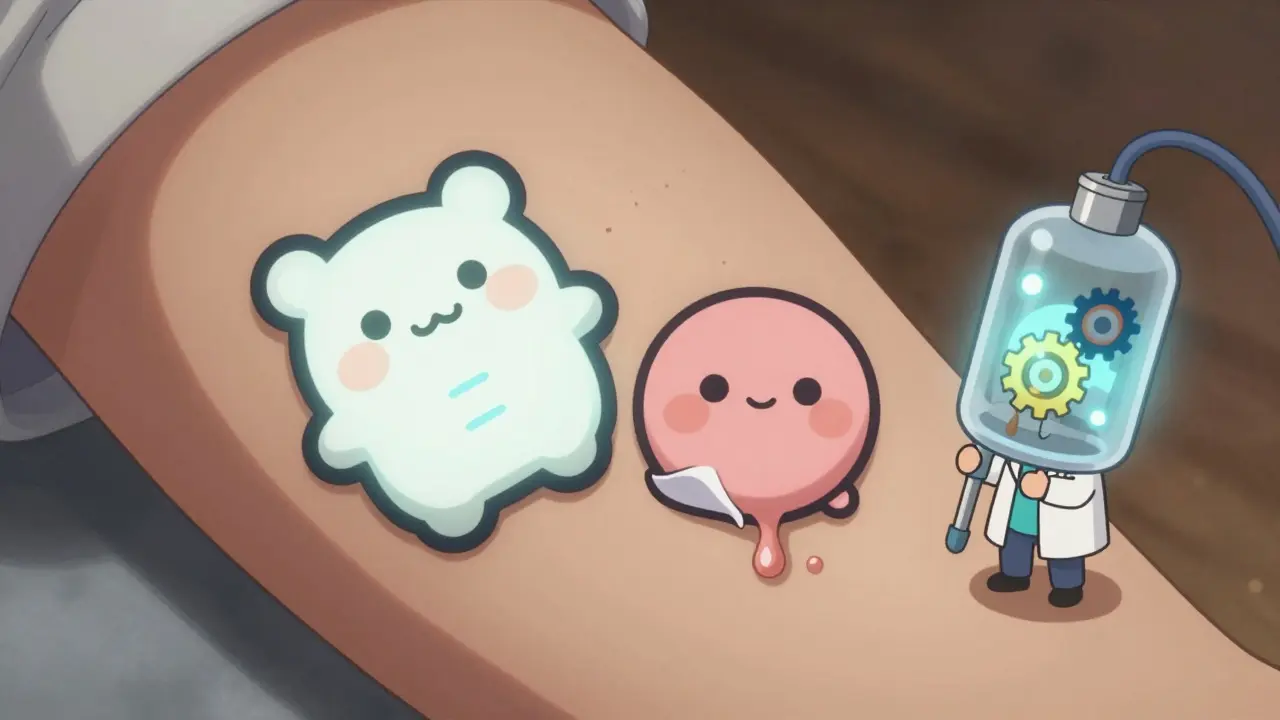
- In vitro release testing: Drug release over 24-48 hours in a Franz diffusion cell. The release rate must match within 10% at every time point.
- Adhesion and residual drug: The patch must stick the same way. If it peels off early, the drug doesn’t get delivered. Residual drug left on the skin after removal must be within 5% of the reference.
- Pharmacokinetics: AUC must fall within 80-125%, but Cmax is often ignored because it’s naturally low and slow with patches.
- Physicochemical matching: Particle size, charge, viscosity, and chemical structure must be nearly identical.
- In vitro release: How fast the drug leaks out of its carrier must match exactly.
- Pharmacokinetics: For narrow therapeutic index drugs, the acceptable range tightens to 90-111% for both AUC and Cmax.
Why Approval Rates Are So Low
Only 38% of generic inhalers get approved. Transdermal patches: 52%. Complex injectables: 58%. Compare that to 78% for regular oral generics. Why so low? Because the margin for error is tiny. One company spent $32 million and 42 months trying to copy insulin glargine. They changed the formulation 17 times just to get the particle size right. Another tried to copy a generic albuterol inhaler. Their drug delivery was perfect-but the plume temperature was 2°C higher than the original. The FDA rejected it. Temperature affects how the propellant expands, which changes how the spray hits the lungs. The Bydureon BCise auto-injector was rejected in 2021 because the generic version’s needle mechanism released the drug 0.1 seconds slower. That tiny delay changed the injection profile enough to affect absorption. These aren’t minor issues. They’re clinical risks. A small difference in lung deposition can mean more asthma attacks. A patch that doesn’t stick well can lead to withdrawal symptoms. A slower injection can cause clotting or bleeding.Costs, Time, and Who Can Afford It
Developing a generic pill costs $5-10 million and takes 18-24 months. A generic inhaler? $25-40 million. Three to four years. That’s why only a handful of companies do this. Teva, Mylan, and Sandoz hold most of the approved complex generics. Small companies can’t afford the $150,000 cascade impactor or the $200,000 particle analyzer. Even the labs that run these tests need specialized staff trained for 18-24 months just to operate the equipment correctly. And yet, the market is growing. The global complex generics market hit $78.3 billion in 2022 and is expected to reach $112.6 billion by 2027. Why? Because big drugs like Humira and Stelara are losing patent protection. Patients and insurers want cheaper options. But here’s the catch: even when generics are approved, they only make up 15% of the value of the generic drug market-despite being used in 30% of prescriptions. Why? Because these products still cost more than pills. Insurance often pays more for them, and patients don’t always switch.
What’s Changing-and What’s Next
The field is evolving. In 2022, 65% of complex generic submissions included PBPK (physiologically-based pharmacokinetic) modeling. That’s computer simulations that predict how a drug behaves in the body based on its physical properties. It’s not perfect, but it’s reducing the need for expensive human trials. The FDA is also pushing for more in vitro-in vivo correlations (IVIVC). If you can prove that a lab test (like particle size) reliably predicts how the drug works in the body, you might not need as many human studies. Only 35% of companies have succeeded so far, but progress is being made. The EMA now requires patient training materials to be part of the approval process. If your inhaler needs a different breathing technique than the original, that’s a problem. Patients can’t be expected to learn two different methods. And there’s a new worry: biocreep. Imagine a brand-name drug. Then a first generic. Then a second. Each one meets bioequivalence standards-but each has tiny differences. Over time, those differences add up. The fifth generic might not work the same as the original. No one’s proven this yet, but regulators are watching.What This Means for Patients
You might not see the difference between your generic inhaler and the brand. But that doesn’t mean it’s the same. The science behind it is more complex than ever. The system is designed to catch differences that could hurt you-before you even use the drug. If you’re switching to a generic, ask your pharmacist: Is this one approved under the complex product pathway? If it’s an inhaler, patch, or injectable, it should be. If they don’t know, it’s worth checking. The goal isn’t just to save money. It’s to save lives-by making sure every version of a drug, no matter how it’s delivered, works exactly as it should.What does bioequivalence mean for inhalers?
For inhalers, bioequivalence means the generic must deliver the same amount of drug to the lungs as the brand-name version. This isn’t just about how much drug is in the canister-it’s about particle size (1-5 micrometers), how the spray spreads (plume geometry), and how much reaches deep in the lungs. Regulators require both lab tests and human studies measuring lung function or drug levels in blood.
Why are generic patches harder to approve than pills?
Patches release drug slowly through the skin, so blood levels rise gradually. Standard bioequivalence (Cmax and AUC) doesn’t capture how well the patch sticks, how evenly it releases the drug, or whether it leaves behind too much unused medication. Regulators require exact matches in drug release rate, adhesion, and residual drug-something you don’t need to test for pills.
Can a generic injection be approved without human trials?
Sometimes, but only for simpler injectables. For complex ones like liposomes or nanoparticles, human trials are almost always required. Even if the chemical formula matches, differences in particle size or surface charge can change how the body handles the drug. The FDA requires matching physicochemical properties, in vitro release profiles, and often pharmacokinetic studies in humans.
Why do some generic inhalers get rejected even if they deliver the same dose?
Because delivery isn’t just about dose-it’s about where the drug lands. If the spray’s temperature, speed, or particle size is slightly off, the drug might hit the throat instead of the lungs. One generic was rejected because its plume was 2°C warmer than the original, changing how the propellant expanded and how the spray dispersed. That small difference could mean less medicine reaches the airways.
Are generic complex drugs safe?
Yes-if they’re approved. The approval process for inhalers, patches, and complex injectables is stricter than for pills. Regulators require multiple layers of testing: lab, animal, and human. The rejection rate is high because the system is designed to catch even small differences that could affect safety or effectiveness. Approved generics meet the same standards as the brand-name versions.





jeremy carroll
December 15, 2025 AT 05:41Natalie Koeber
December 16, 2025 AT 02:10Rulich Pretorius
December 17, 2025 AT 10:45Thomas Anderson
December 17, 2025 AT 16:19Dwayne hiers
December 19, 2025 AT 11:56Jonny Moran
December 21, 2025 AT 08:59Sarthak Jain
December 21, 2025 AT 12:09Daniel Thompson
December 22, 2025 AT 21:58Alexis Wright
December 24, 2025 AT 00:39Daniel Wevik
December 24, 2025 AT 18:41Rich Robertson
December 24, 2025 AT 21:01Wade Mercer
December 26, 2025 AT 09:25Tim Bartik
December 27, 2025 AT 17:40Sinéad Griffin
December 28, 2025 AT 21:56