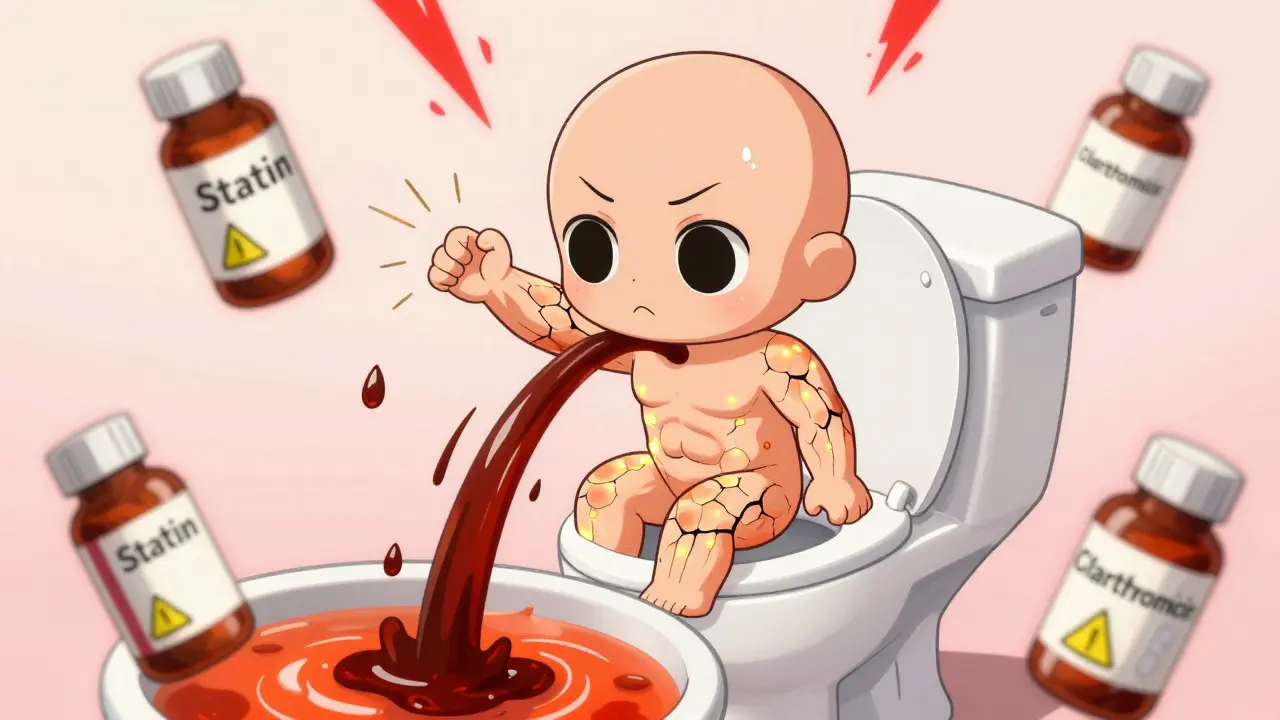
Imagine taking your daily statin for cholesterol, then adding an antibiotic for a sinus infection - and waking up two days later with dark urine, intense muscle pain, and weakness so bad you can’t climb stairs. This isn’t rare. It’s rhabdomyolysis, and it’s one of the most dangerous drug interactions you’ve probably never heard of.
Every year in the U.S., over 27,000 people are hospitalized because their muscles started breaking down from medications. In most cases, it’s not one drug alone - it’s how two or more drugs interact inside your body. And when that happens, muscle cells explode, spilling toxic proteins into your bloodstream that can shut down your kidneys. You might not feel sick at first. But by the time you notice dark urine or extreme fatigue, it could already be too late.
What Exactly Is Rhabdomyolysis?
Rhabdomyolysis is when skeletal muscle tissue breaks down rapidly, releasing harmful substances like myoglobin, potassium, and creatine kinase (CK) into the blood. Myoglobin is the protein that gives muscle its red color. When it floods the kidneys, it clogs the tiny filters, leading to acute kidney injury. In severe cases, you’ll need dialysis. About half of all rhabdomyolysis patients develop kidney problems. Up to 15% die if it’s not caught early.
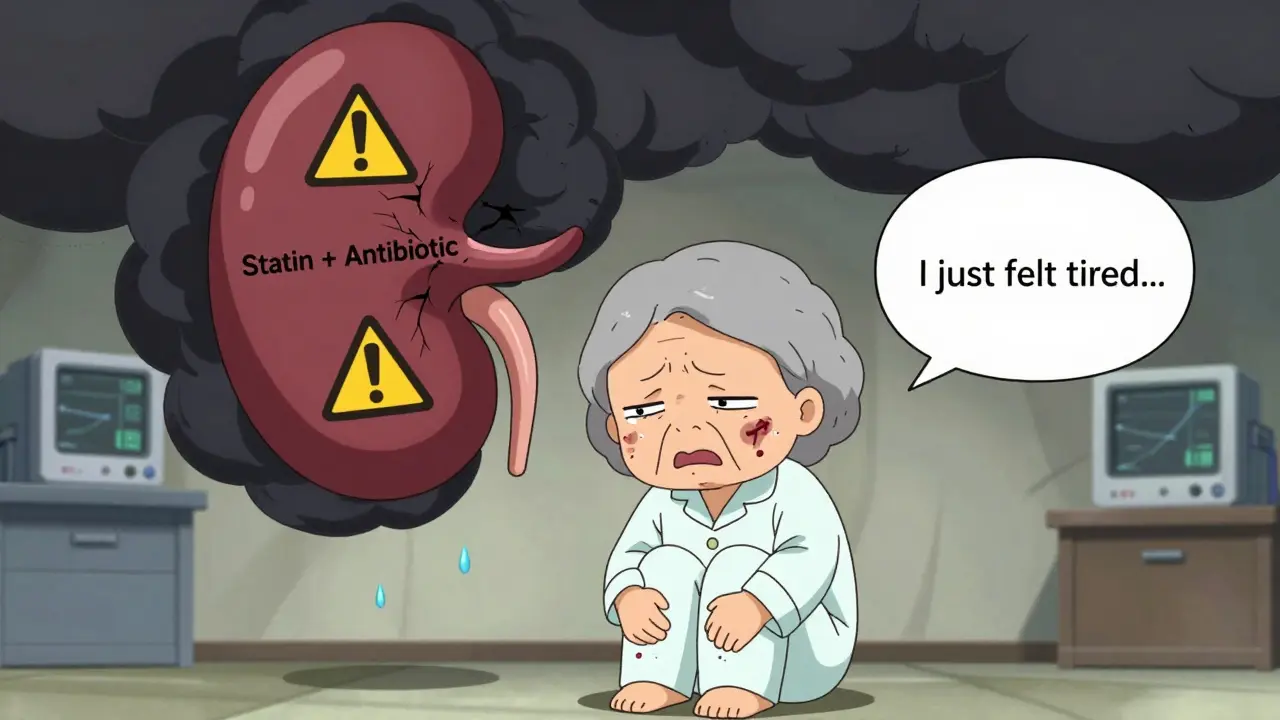
The classic signs - muscle pain, weakness, and dark urine - only show up in about half of cases. Many people feel nausea, fever, or just extreme tiredness. Others have abdominal pain or swelling in their arms or legs. By the time someone says, “I just feel off,” the damage may already be underway.
Which Medications Cause This?
Statins are the biggest culprit. They’re prescribed to over 100 million people worldwide. But they’re not the problem alone. The danger spikes when they’re mixed with other drugs that interfere with how the body breaks them down.
Here’s how it works: Most statins are processed by an enzyme called CYP3A4. If another drug blocks this enzyme - like the antibiotic clarithromycin, the antifungal itraconazole, or even grapefruit juice - the statin builds up in your blood. Too much statin = muscle damage. Simvastatin and atorvastatin are the most common offenders. Together, they account for nearly 80% of statin-related rhabdomyolysis cases.
But statins aren’t the only problem. Other high-risk combinations include:
- Colchicine + clarithromycin or erythromycin: This combo increases risk by 14 times. Colchicine is used for gout. Clarithromycin is common for chest infections. Many doctors don’t realize how deadly this mix can be.
- Statin + fibrate (like gemfibrozil): This combination raises risk 15 to 20 times higher than statins alone.
- Erlotinib (cancer drug) + simvastatin: One case showed CK levels over 42,000 U/L - more than 40 times the normal limit - after just 72 hours of both drugs being taken together.
- Zidovudine (HIV drug) + statins: In HIV patients, up to 12% develop CK levels over 10 times normal.
- Leflunomide (arthritis drug): Rare, but when it happens, CK levels often exceed 50,000 U/L. Plasma exchange is needed because the drug stays in the body for weeks.
Even propofol - the IV anesthetic used in surgery - can cause rhabdomyolysis in ICU patients. It’s rare, but when it happens, it’s often fatal. The drug interferes with energy production in muscle cells at the mitochondrial level, literally starving them of power.
Who’s Most at Risk?
It’s not just about what you take - it’s who you are.
- People over 65: Their risk is more than triple that of younger adults. Aging muscles are more fragile, and kidney function declines naturally.
- Women: They’re 1.7 times more likely than men to develop drug-induced rhabdomyolysis. Why? We don’t fully know, but body composition and hormone differences may play a role.
- Those with kidney problems: If your eGFR (a measure of kidney function) is below 60, your risk jumps 4.5 times. Your kidneys are already struggling - adding muscle toxins pushes them over the edge.
- People on five or more medications: This group faces a 17-times higher risk. Polypharmacy isn’t just common - it’s a ticking time bomb.
- Those with the SLCO1B1*5 gene variant: This genetic trait, found in about 15% of Europeans, makes simvastatin 4.5 times more likely to cause muscle damage. Testing for it isn’t routine - but it should be for high-risk patients.
How Do You Know If It’s Happening?
There’s no single test. But doctors look for three things:
- CK levels: Normal is under 200 U/L. Anything over 1,000 U/L raises suspicion. Severe cases hit 5,000 to 100,000 U/L. A single spike doesn’t confirm rhabdomyolysis - but two or three rising measurements do.
- Urine color: Tea-colored, cola-colored, or dark brown urine means myoglobin is being filtered out. This is a red flag.
- Symptoms: Muscle pain (especially in thighs, shoulders, or lower back), weakness, swelling, nausea, fever, or confusion. If you’ve started a new drug or changed a dose in the last 30 days, treat these as warning signs.
Many patients report that their doctors dismissed early symptoms. One Reddit user said, “I told my GP my legs felt heavy after starting clarithromycin. He said it was just tiredness.” Two days later, her CK hit 28,500 U/L. She needed dialysis.
What Happens in the Hospital?
Time is muscle - and kidney tissue. The moment rhabdomyolysis is suspected, treatment begins.
- Stop the offending drugs: No exceptions. Even if it’s your blood pressure pill or cholesterol med - stop it.
- Aggressive IV fluids: The goal is to flush out myoglobin before it clogs the kidneys. The Cleveland Clinic protocol recommends 3 liters of saline in the first 6 hours, then 1.5 liters per hour. That’s a lot - but it saves lives.
- Urine alkalinization: Adding sodium bicarbonate to IV fluids keeps urine pH above 6.5. This prevents myoglobin from clumping and blocking kidney tubules.
- Monitor electrolytes: High potassium (hyperkalemia) can cause cardiac arrest. Low calcium (hypocalcemia) can lead to muscle spasms and seizures. Both must be corrected quickly.
- Watch for compartment syndrome: Swelling in muscles can cut off blood flow. If pressure builds, surgery may be needed to relieve it.
Recovery takes weeks. If you didn’t need dialysis, full muscle recovery usually takes 12 weeks. If you did? It can take over 6 months. And 44% of survivors still feel weak six months later.

Why Do Doctors Miss This?
Because it’s not taught well. In a 2022 survey of pharmacists, 92% said providers failed to recognize early muscle symptoms as dangerous. Many think “muscle soreness” is just exercise or aging. But drug-induced rhabdomyolysis isn’t gradual - it’s sudden. And it’s preventable.
The FDA issued black box warnings on statins in 2012. The EMA now requires all statin labels to list specific drug interactions. Yet, in 2023, the number of rhabdomyolysis reports rose 22% after remdesivir was widely used for COVID-19. Why? Because new drugs are added to complex regimens without checking for hidden risks.
How to Protect Yourself
If you take any of these medications, ask your doctor or pharmacist:
- “Could any of my meds interact to cause muscle damage?”
- “Am I on a high-risk combo like statin + clarithromycin or statin + fibrate?”
- “Should I get tested for the SLCO1B1 gene variant if I’m on simvastatin?”
- “What should I do if I notice dark urine, weakness, or unexplained pain?”
Keep a list of all your medications - including supplements and over-the-counter drugs. Even herbal products like St. John’s Wort can interfere with statins. Bring this list to every appointment.
Don’t ignore muscle pain after starting a new drug. Call your provider immediately if you have:
- Dark or cola-colored urine
- Severe muscle pain or weakness
- Swelling in limbs
- Fever or nausea without explanation
It’s not paranoia - it’s prevention.
What’s Next?
Researchers are working on solutions. The NIH just funded a $2.4 million project to build real-time drug interaction alerts for pharmacists and doctors. The European Renal Association is testing drugs that protect mitochondria in muscle cells during statin therapy. Genetic screening for SLCO1B1*5 may become routine within five years.
But until then, the best defense is awareness. Medication interactions aren’t rare. They’re predictable. And they’re deadly - if no one’s watching for them.
Can rhabdomyolysis happen without taking drugs?
Yes. Trauma, extreme exercise, heatstroke, seizures, or severe infections can trigger rhabdomyolysis. But drug interactions are the most common cause in hospitalized patients. In fact, about 7-10% of all cases are linked to medications, with statins alone accounting for over 60% of those.
Is it safe to take statins if I’m on antibiotics?
It depends on the antibiotic. Macrolides like clarithromycin and erythromycin, azole antifungals like itraconazole, and even some HIV drugs can dangerously increase statin levels. If you need an antibiotic, ask your doctor if your statin dose should be lowered or paused. For example, switching from simvastatin to pravastatin (which doesn’t rely on CYP3A4) can reduce risk.
How long does it take for rhabdomyolysis to develop after a drug interaction?
Most cases occur within 30 days of starting a new drug or changing a dose. Statin-related cases typically appear around 28 days after starting. But with strong interactions - like statin + clarithromycin - symptoms can show up in as little as 48 hours. Don’t wait for pain to get worse.
Can I take statins again after having rhabdomyolysis?
It’s possible, but risky. Most doctors avoid restarting the same statin. If cholesterol control is still needed, they may switch to a different class - like ezetimibe or PCSK9 inhibitors - which don’t carry the same muscle risk. Restarting statins after rhabdomyolysis increases recurrence risk by over 50%, according to a 2021 study in the Journal of Clinical Lipidology.
Are natural supplements safer than prescription drugs?
No. Red yeast rice contains a natural form of lovastatin and can cause rhabdomyolysis just like prescription statins. Other supplements like niacin, creatine, and high-dose vitamin D can also stress muscles or kidneys. Supplements aren’t regulated like drugs - so interactions are often unknown. Always tell your doctor what you’re taking.

Levi Viloria
March 5, 2026 AT 06:09Matt Alexander
March 6, 2026 AT 22:07Tildi Fletes
March 8, 2026 AT 05:36Sharon Lammas
March 9, 2026 AT 15:49Diane Croft
March 10, 2026 AT 02:13Mike Dubes
March 11, 2026 AT 19:18Helen Brown
March 13, 2026 AT 14:35Dean Jones
March 13, 2026 AT 15:21John Smith
March 15, 2026 AT 04:07John Cyrus
March 16, 2026 AT 00:17Stephen Vassilev
March 17, 2026 AT 21:58Deborah Dennis
March 18, 2026 AT 16:04marjorie arsenault
March 20, 2026 AT 01:49Gretchen Rivas
March 20, 2026 AT 21:03Shivam Pawa
March 21, 2026 AT 14:20