
For decades, generic drug makers followed a simple rule: copy the brand-name pill, test the final product, and hope it passes. But that approach is outdated. Today, Quality by Design (QbD) isn’t just a buzzword-it’s the new standard for developing generic medicines that are safe, consistent, and reliably equivalent to the original. If you’re working in generic pharmaceuticals, you’re either using QbD or falling behind.
What Exactly Is Quality by Design?
Quality by Design isn’t about testing more samples or running more lab tests. It’s about building quality into the product from day one. The International Council for Harmonisation (ICH) defines QbD as a systematic approach that starts with clear goals, uses science to understand how the product works, and controls the process to make sure it always delivers the right result. This shift came from the ICH Q8(R2) guideline in 2009, and by 2017, the U.S. FDA made it mandatory for all new generic drug applications.
Before QbD, companies used fixed recipes: mix for 15 minutes at 25°C, compress at 12 kN, dry at 45°C. If the tablet failed a test, they blamed the batch. With QbD, you ask: Why did it fail? What variables affect the outcome? How wide can those variables go before quality drops? That’s the difference between guessing and knowing.
The Five Pillars of QbD in Generic Drugs
QbD isn’t a single tool-it’s a system built on five interconnected parts. Each one has specific regulatory expectations, especially when you’re trying to prove bioequivalence to the reference drug.
1. Quality Target Product Profile (QTPP)
This is your blueprint. It lists everything the final product must do: dissolve at the right rate, contain the correct amount of active ingredient, stay stable for 24 months, and keep impurities below ICH Q3B limits. For generics, the FDA requires at least 95% similarity to the brand-name drug’s performance-especially in dissolution testing. If your tablet doesn’t release the drug the same way, it won’t be approved.
2. Critical Quality Attributes (CQAs)
These are the measurable traits that directly impact safety or effectiveness. For most generic tablets, you’ll identify 5 to 12 CQAs. The big ones? Dissolution profile (must hit f2 >50 vs. the reference), content uniformity (RSD under 6.0%), and impurity levels. If your impurity profile doesn’t match the original, regulators will reject you-even if the active ingredient is identical.
3. Critical Process Parameters (CPPs)
These are the levers you control during manufacturing: granulation moisture, compression force, drying temperature. You don’t guess these. You test them using Design of Experiments (DoE). For example, a study might show that compression force between 10-15 kN keeps tablet hardness and dissolution within target. Outside that range? Risk of failure jumps. DoE turns guesswork into data-driven ranges.
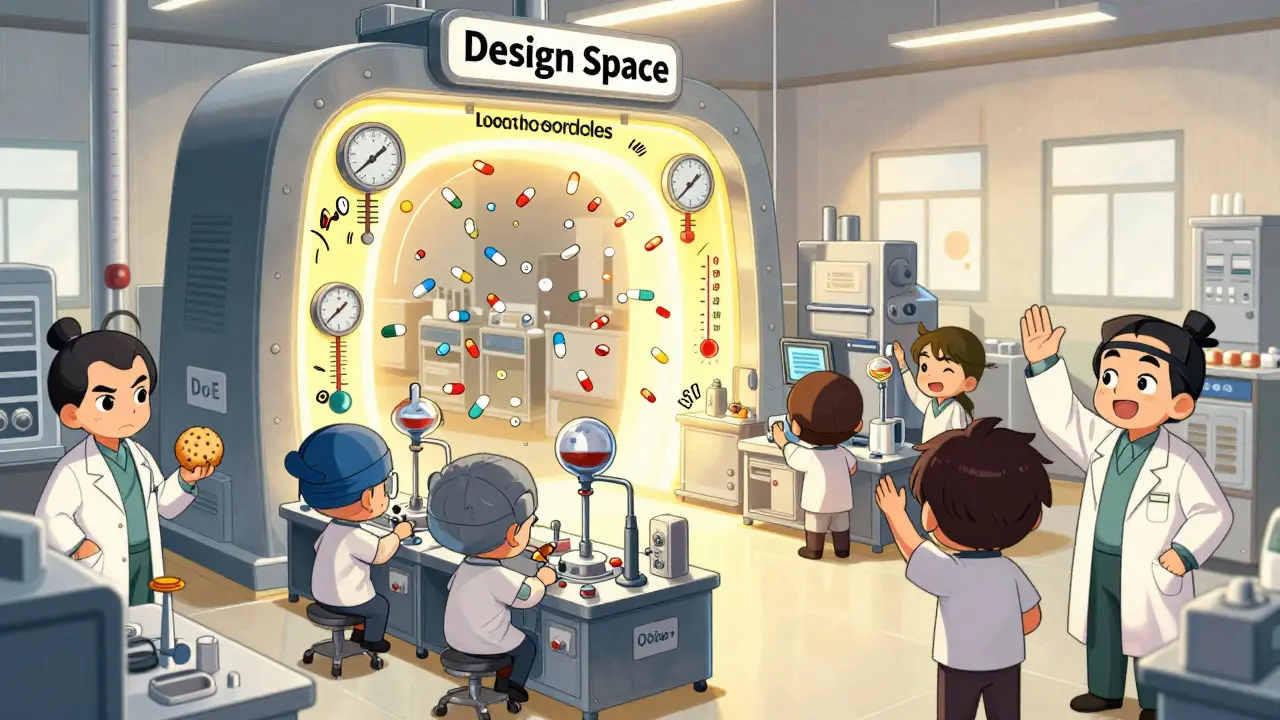
4. Design Space
This is where QbD gets powerful. The design space is the multidimensional zone where all your CPPs can vary and still produce a quality product. The FDA accepts design spaces built on data from 100+ simulated batches. Once approved, you can adjust parameters within that space without submitting a new application. That’s huge. One manufacturer saved $2.1 million a year by moving a drying temperature from 45°C to 48°C without regulatory delays.
5. Control Strategy
This is how you monitor quality during production. Instead of waiting until the end to test every batch, QbD uses real-time tools like near-infrared (NIR) spectroscopy to check moisture, blend uniformity, or API concentration as the tablet is made. Eighty-seven percent of QbD users now use Process Analytical Technology (PAT). That cuts end-product testing by 35-60% and catches problems before they become recalls.
QbD vs. Old-School Generic Development
Traditional development was like baking cookies with a fixed recipe: 2 cups flour, 1 cup sugar, bake at 350°F for 12 minutes. If the cookies burned, you blamed the oven. If they were too soft, you blamed the sugar. You didn’t know why.
QbD is like understanding the chemistry of baking. You know that sugar caramelizes at 160°C, flour proteins need hydration time, and oven airflow affects browning. Now you can adjust temperature, time, and humidity within safe ranges and still get perfect cookies every time.
The numbers don’t lie. According to the FDA’s Office of Generic Drugs, QbD-based applications get approved in 9.2 months on average-nearly five months faster than traditional submissions. They also face 31% fewer Complete Response Letters (CRLs), the official “we need more data” notices that delay approvals and cost millions.
But QbD isn’t magic. It costs more upfront. Developing a QbD strategy adds 4-8 months to the timeline and increases initial costs by 25-40%. For a simple immediate-release tablet, that might be $450,000 extra. For a complex inhaler or transdermal patch? It’s worth it. For a $2 pill sold in bulk? You need to be smart about it.

Where QbD Shines-and Where It’s Overkill
QbD isn’t one-size-fits-all. It’s most valuable for complex generics: extended-release tablets, inhalers, injectables, and topical products where bioequivalence is hard to prove with just dissolution tests. In these cases, traditional methods often fail because the body absorbs the drug differently even if the pill looks identical.
For simple immediate-release tablets with well-known excipients and a straightforward dissolution profile, over-engineering QbD can be wasteful. Dr. James Polli from the University of Maryland warns that some companies spend half a million dollars on DoE studies for a drug that’s been copied a hundred times. That’s like building a rocket to deliver a letter.
The key is proportionality. Use QbD where it adds real value. For a 505(b)(2) product (a modified version of an existing drug), you need deep understanding of how changes affect absorption. For a generic metformin tablet? Stick to the essentials: dissolution, uniformity, impurities, and a solid control strategy.
Real-World Wins and Challenges
Companies that have embraced QbD aren’t just surviving-they’re thriving.
Hikma Pharmaceuticals reduced post-approval quality deviations from 14 per year to just 2 after implementing QbD for their esomeprazole product. That saved $850,000 annually in investigations and recalls.
At Mylan (now Viatris), a QbD-based control strategy for simvastatin allowed 11 manufacturing changes during the pandemic without prior FDA approval. That meant uninterrupted supply when global logistics were collapsing.
But it’s not all smooth sailing. Training is a big hurdle. Scientists need 80-120 hours of specialized training in risk management (ICH Q9) and DoE. Software like MODDE Pro costs $15,000 per user per year. PAT tools? Minimum $500,000 investment. Smaller manufacturers, especially in India and other emerging markets, struggle with these costs. Still, even there, the top 10 generic companies invested $227 million in QbD capabilities in 2022.
Another challenge? Proving in vitro-in vivo correlation (IVIVC). For complex formulations, you need to show that how the drug dissolves in a lab dish predicts how it behaves in the human body. The EMA reports that 22% of applicants fail here. Without IVIVC, regulators demand clinical bioequivalence studies-expensive, slow, and ethically tricky.
What’s Next for QbD?
QbD is evolving fast. The FDA’s new ICH Q14 guideline (effective December 2023) requires more robust analytical method validation but rewards it with faster approval. QbD-aligned methods now validate 40% quicker.
Continuous manufacturing is the next frontier. The FDA’s Emerging Technology Program has approved 27 QbD-based continuous manufacturing applications-with a 100% success rate. Teva’s 2022 levothyroxine case showed 28% better batch consistency using continuous production with QbD controls.
By 2027, McKinsey predicts 95% of new generic approvals will use QbD. The WHO now includes QbD in its prequalification program, meaning global supply chains will demand it. Even regulators in Japan (PMDA) and Europe (EMA) now treat QbD as essential for complex generics.
But the industry is also pushing back. The Generic Pharmaceutical Association warns that applying full QbD to ultra-low-cost generics-products selling for pennies-isn’t sustainable. They recommend “proportionate implementation”: use enough science to ensure safety, but don’t over-invest where the return is zero.
How to Get Started with QbD
If you’re new to QbD, don’t try to boil the ocean. Start small:
- Define your QTPP using the reference listed drug (RLD) as your baseline.
- Identify 3-5 key CQAs. Focus on dissolution and impurities first.
- Run a simple DoE on 2-3 CPPs (e.g., compression force, drying time).
- Build a design space based on data-not assumptions.
- Use PAT tools for at least one critical in-process control.
The FDA offers free QbD training modules. The Parenteral Drug Association (PDA) has certified practitioner courses with 85% pass rates. Use them. Don’t hire a consultant to write your QbD plan-learn to write it yourself.
QbD isn’t about perfection. It’s about control. It’s about knowing why your product works-and being able to prove it to regulators, patients, and your own team. In generic drug development, that’s no longer optional. It’s the only way forward.
Is QbD mandatory for all generic drugs?
Yes, for all Abbreviated New Drug Applications (ANDAs) submitted to the FDA after October 1, 2017. While not every regulator globally enforces it the same way, the FDA, EMA, and PMDA require QbD elements for complex generics, and adoption is rapidly becoming the global standard. Even if not legally required, skipping QbD makes approval harder and slower.
Does QbD eliminate the need for bioequivalence studies?
No. QbD doesn’t replace clinical bioequivalence studies-it reduces the need for them. For simple immediate-release generics, in vitro dissolution data (with f2 >50) is usually enough. For complex products like extended-release tablets or inhalers, regulators may still require clinical studies unless you can demonstrate a validated in vitro-in vivo correlation (IVIVC). QbD gives you the data to argue why clinical studies aren’t needed.
How long does it take to implement QbD?
For a simple immediate-release tablet, expect 6-9 months of development work. For complex products like transdermal patches or inhalers, it’s 12-18 months. The timeline includes defining QTPP, identifying CQAs, running DoE studies, building the design space, and validating controls. The upfront time pays off in faster approvals and fewer post-market changes.
Can small generic manufacturers afford QbD?
It’s challenging, but possible. Start with proportionate implementation: focus on the most critical CQAs, use open-source or shared DoE software, and partner with contract labs for PAT testing. The FDA’s QbD Pilot Program has a 92% approval rate for submissions, and free training resources are available. Many small firms use consultants for the first application, then build internal expertise. The goal isn’t to match big pharma’s budget-it’s to use science wisely.
What happens if my design space is rejected?
If the FDA rejects your design space, they’ll issue a Complete Response Letter (CRL) explaining why. Common reasons include insufficient data, lack of mechanistic understanding, or failure to demonstrate robustness across the proposed range. You’ll need to run additional experiments, refine your statistical models, or narrow the design space. Many companies resubmit successfully after addressing the gaps-QbD is iterative by design.
Is QbD only for tablets and capsules?
No. QbD applies to all dosage forms: injectables, inhalers, transdermal patches, ophthalmic solutions, and even 3D-printed drugs. In fact, it’s most valuable for complex products where traditional methods fail. For example, inhalers require precise particle size and spray pattern control-QbD’s multivariate analysis is essential here. The principles are the same; the tools change.


Alisa Silvia Bila
December 18, 2025 AT 18:07QbD isn't just fancy jargon-it's the difference between guessing and knowing. I've seen teams waste months retesting batches because they didn't understand why a tablet cracked. With QbD, you fix the root cause, not the symptom.
Marsha Jentzsch
December 20, 2025 AT 07:35Wait-so you’re telling me the FDA just made us spend $500K more on a pill that’s supposed to be CHEAP?? This is corporate greed disguised as science!! They’re making us pay for their lazy R&D!!
Janelle Moore
December 21, 2025 AT 13:41They’re hiding something. QbD? More like Quality by Dictate. Big Pharma paid the FDA to push this so small generics can’t compete. You think they care about safety? Nah. They just want you to buy their expensive software and hire their consultants. Watch for the hidden RFID chips in the tablets next.
Henry Marcus
December 23, 2025 AT 12:12QbD? More like ‘Quit Being Dumb’-and hand over your wallet to the FDA’s corporate overlords. They’re not protecting patients-they’re protecting their $200K-per-hour consultants. And don’t even get me started on NIR spectroscopy… that’s just a fancy $500K flashlight that tells you what your grandma could’ve guessed with a magnifying glass.
Andrew Kelly
December 24, 2025 AT 05:26This whole QbD push is a regulatory power grab. The FDA doesn’t want to approve drugs faster-they want to control every variable. You’re not developing a medicine anymore; you’re running a compliance audit with a tablet in hand. And the cost? It’s not ‘investment’-it’s extortion disguised as science.
Dev Sawner
December 26, 2025 AT 03:51While the conceptual framework of Quality by Design is commendable from a regulatory and scientific standpoint, the practical implementation in resource-constrained environments remains fraught with systemic inefficiencies. The capital expenditure required for PAT infrastructure is disproportionate to the marginal gains in batch consistency, particularly for low-margin generics. Furthermore, the regulatory burden imposed by ICH Q14 lacks equitable scalability across global manufacturing ecosystems.
Moses Odumbe
December 27, 2025 AT 03:42QbD is 🔥 but the cost? 😩 I get it, but for a $0.10 pill? Bro, just test the dissolution and move on. Why spend $500K to prove what we’ve known since 2010? 🤷♂️ #GenericLife #TooMuchScience
Meenakshi Jaiswal
December 28, 2025 AT 08:02Start small. Define your QTPP. Pick 3 CQAs-dissolution, uniformity, impurities. Run a 2x2 DoE on compression force and drying time. Use free tools like R or Python. You don’t need MODDE Pro on day one. I’ve helped three small Indian labs implement this with under $20K in training and open-source software. It’s doable.
bhushan telavane
December 28, 2025 AT 20:09In India, we copy pills for $0.02. Now they want us to do DoE and NIR? My factory runs on electricity that cuts out twice a day. How am I supposed to run a 100-batch DoE when my lab fridge can’t keep ice? This isn’t science-it’s a luxury for rich countries.
Mahammad Muradov
December 29, 2025 AT 10:51The entire QbD framework is a Western imposition. We have been manufacturing safe generics for decades without Design Space or PAT. The FDA’s insistence on this is cultural arrogance disguised as regulatory rigor. Our products are bioequivalent. Our patients are healthy. Why are we being punished for efficiency?
Kitt Eliz
December 30, 2025 AT 00:46QbD IS THE FUTURE. 🚀 You’re not just making pills-you’re engineering predictability. PAT + DoE + Design Space = ZERO recalls. I’ve seen it. My team cut CRLs by 70%. Stop thinking ‘cost’-think ROI. Every dollar spent on QbD saves 5 in recalls, delays, and reputational damage. Let’s go full throttle. 💪 #PharmaInnovation
Alana Koerts
December 31, 2025 AT 23:15QbD is overkill. The FDA just wants more paperwork. If the dissolution profile matches, it works. Everything else is consulting theater. Spend the money on more tablets, not more spreadsheets.
Dikshita Mehta
January 2, 2026 AT 08:21For simple immediate-release tablets, QbD is unnecessary. But for extended-release or inhalers? Absolutely critical. The key is proportionality. Don’t use a sledgehammer to crack a nut. Focus on what matters: dissolution, impurities, and a solid control strategy. The rest is noise.
pascal pantel
January 2, 2026 AT 18:09QbD is just a way for the FDA to extend their control. They don’t care if your drug works-they care if your DoE matrix has enough factorial points. The entire system is designed to exclude small players. And don’t even get me started on IVIVC-that’s a black box that only big pharma can crack.
Sajith Shams
January 4, 2026 AT 03:00They say QbD reduces approval time. But in reality, it just delays it by 8 months while you submit 300 pages of DoE data. And when they reject your design space? You start over. It’s not innovation-it’s bureaucratic inertia dressed up in statistical jargon.