When your doctor or pharmacist gives you advice about your medications, it’s not just a quick chat. It’s a critical piece of your health story. And if you don’t write it down-or if your provider doesn’t document it properly-it could lead to mistakes, missed doses, dangerous interactions, or even hospital visits. You’re not just remembering what was said; you’re building a safety net for your future care.
Why Documentation Matters More Than You Think
Every year, about 7,000 people in the U.S. die from medication errors. Many of those errors happen because someone didn’t know what was prescribed, how to take it, or what side effects to watch for. It’s not always the pharmacist’s fault. It’s not always the patient’s fault. Often, it’s because the information wasn’t clearly recorded or passed along. The American Medical Association, the Joint Commission, and the Centers for Medicare & Medicaid Services all agree: medication documentation is non-negotiable. It’s not optional. It’s part of the standard of care. If your provider doesn’t write it down, it didn’t happen-not legally, not clinically, and not safely. Think of it this way: if you’re seeing a new doctor next month, or you get rushed to the ER after a fall, they’ll open your chart. What will they see? A list of pills? Or a full picture of what you were told, what you understood, and what you agreed to?What Exactly Needs to Be Documented
You don’t need to write a novel. But you do need to capture the essentials. Here’s what every piece of medication advice should include:- Medication name-both brand and generic, if applicable
- Dosage-how much (e.g., 10 mg, 5 mL)
- Frequency-how often (e.g., once daily, every 6 hours)
- Route-how to take it (swallowed, injected, applied to skin)
- Duration-how long to take it (e.g., 7 days, until finished, long-term)
- Number of refills-how many times you can get it renewed
- Purpose-why you’re taking it (e.g., “for high blood pressure,” “to reduce inflammation”)
- Side effects to watch for-what’s normal, what’s dangerous
- Food or activity restrictions-e.g., “take on empty stomach,” “avoid alcohol,” “don’t drive”
- What to do if you miss a dose
- Allergies or past reactions-even if you think it’s obvious
- Patient’s response-did they say they understood? Did they ask questions? Did they refuse?
That’s it. No fluff. Just facts. And if your provider says something like, “Just take it as needed,” that’s not enough. “As needed” for what? Pain? Anxiety? How many times a day? What’s the max? If it’s not written, it’s not clear.
How Providers Should Document It
In a clinical setting, documentation isn’t just about typing into a computer. It’s about precision. The Joint Commission requires that all medication information be recorded accurately and passed along during every transition of care-whether you’re moving from the hospital to home, or from your primary care doctor to a specialist. Here’s what good documentation looks like in practice:- Each entry is dated and timed
- It includes the provider’s initials or electronic signature
- It uses clear, objective language-not opinions like “patient seemed confused” but facts like “patient stated, ‘I don’t know when to take the pill’”
- It captures verbal instructions given during the visit
- It includes any follow-up advice given over the phone or via patient portal
Many providers use templates or macros in their electronic health records (EHRs). But here’s the catch: if the template says “Patient educated on medication use” without adding what was actually said, it’s useless. The record must reflect your case-not a generic checklist.
For example, a good note might read: “Patient advised to take lisinopril 10 mg once daily in the morning with water. Warned of possible dry cough and dizziness. Patient repeated instructions back: ‘Take in AM, watch for cough, call if dizzy.’ No allergies reported. Refills: 3.”
That’s specific. That’s actionable. That’s what saves lives.
What Patients Can Do to Protect Themselves
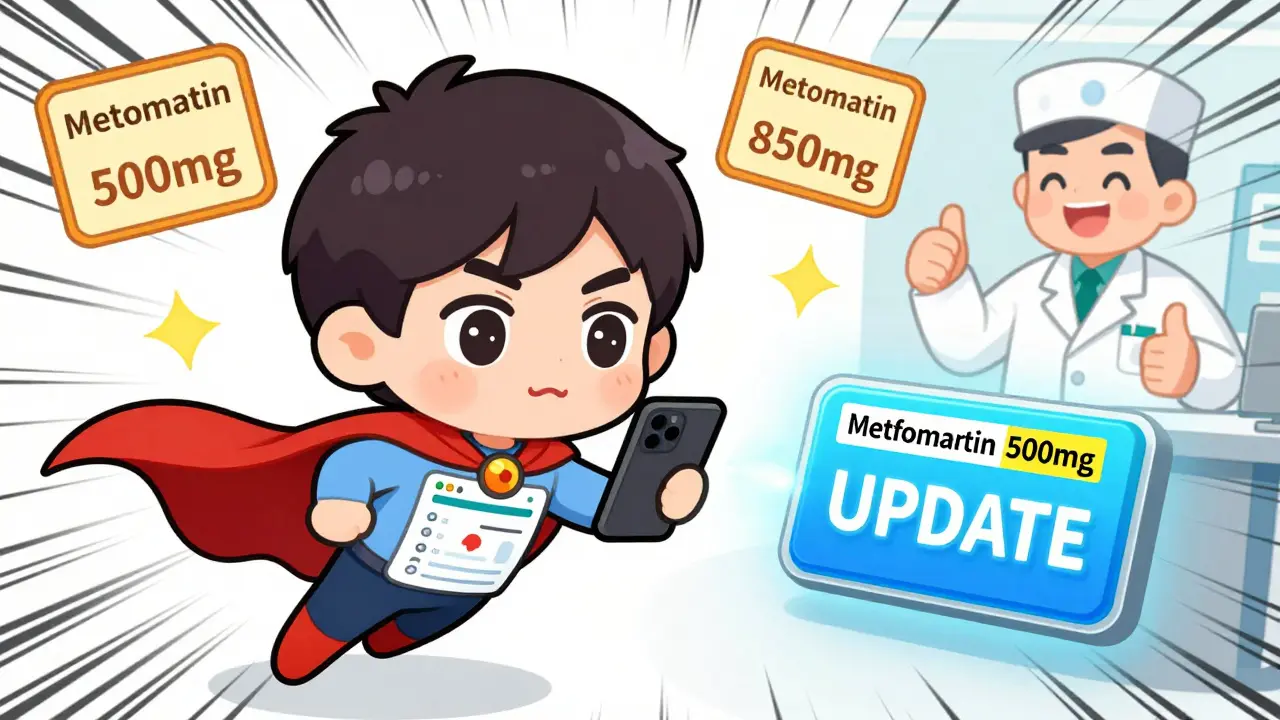
You don’t have to wait for your provider to document everything perfectly. You can-and should-take charge.- Bring a notebook or use your phone to write down advice during the visit
- Ask: “Can you repeat that back to me?” Then say it out loud. If you get it right, they’ll confirm. If you’re wrong, they’ll correct you.
- Request a printed summary or email with the medication details
- Check your patient portal after the visit. Is the medication listed correctly? Are the instructions accurate?
- If something’s missing or wrong, call the office and ask them to update the record
- Keep your own list of all medications-prescription, over-the-counter, supplements-and update it after every appointment
One patient I know kept a handwritten log in her wallet. Every time she saw a new provider, she handed it to them. She said it saved her from being prescribed a drug that interacted with her blood thinner. That log wasn’t part of the hospital system. But it kept her alive.
What Happens When Documentation Fails
Poor documentation isn’t just inconvenient. It’s dangerous-and costly. - 38% of medical malpractice claims involve medication errors, according to the Physician Insurers Association of America. Many of those cases hinge on missing or unclear records. - The National Committee for Quality Assurance found that 22% of preventable adverse drug events in outpatient settings stem from incomplete or inaccurate medication documentation. - Medicare and Medicaid now require providers to document current medications at every visit. If they don’t, they can lose reimbursement under the Merit-based Incentive Payment System (MIPS). - In dental offices, failure to document a conversation about pain medication-even if it happened over the phone-can lead to legal liability if a patient has a bad reaction.What you write today might be read in court tomorrow. That’s why the American Dental Association says: “Keep in mind that what you write in the record could be read aloud in a court of law.” The same applies to every provider, everywhere.
The Future: Digital Tools and Patient Access
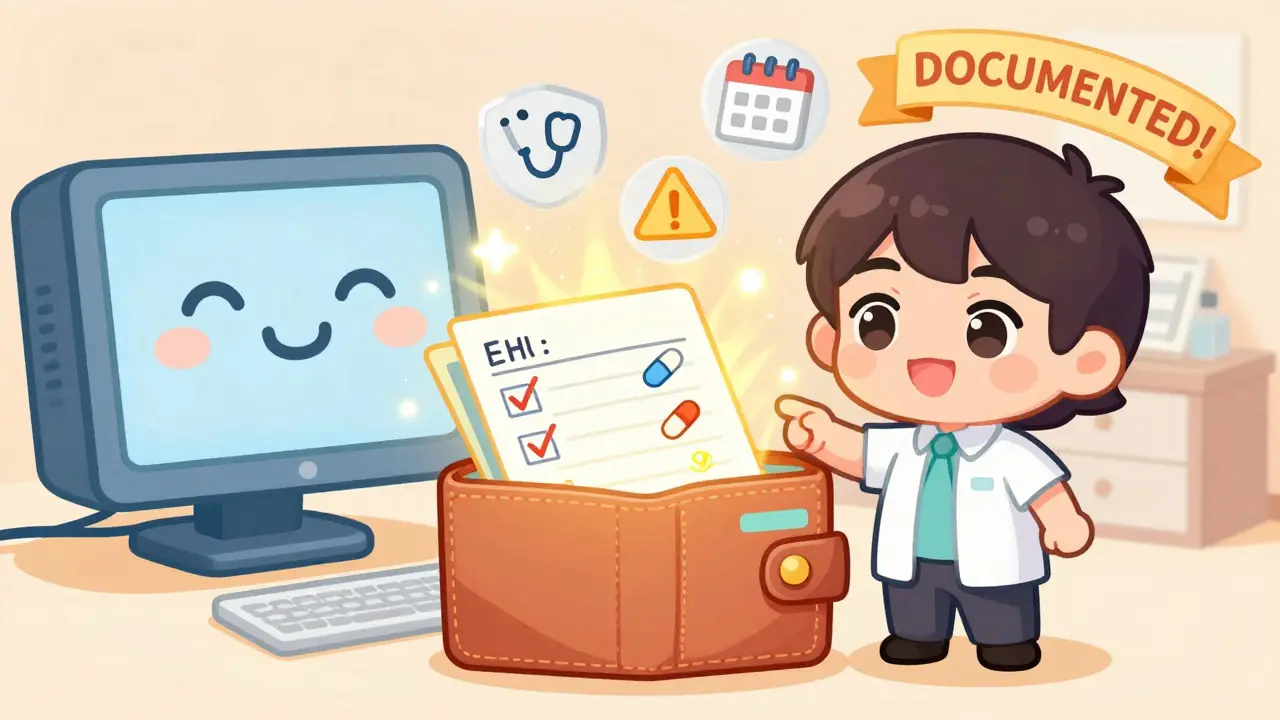
By 2025, nearly all medication documentation will happen in electronic health records linked to patient portals. Patients will be able to see their medication list, refill requests, and provider notes in real time. The FDA is also pushing for standardized Patient Medication Information (PMI) sheets-single-page, easy-to-read summaries that come with every prescription. These will include clear instructions, warnings, and what to do in case of side effects. This shift means patients have more power than ever. But it also means you need to check your portal regularly. Don’t assume the information is right. If your medication list shows “Metformin 500 mg twice daily” but you’ve been taking 850 mg, speak up. Update it. Demand accuracy.Final Checklist: Your Medication Documentation Rules
Use this before you leave any appointment:- Did the provider write down the exact name, dose, and schedule of each medication?
- Did they note any side effects or warnings you discussed?
- Did they record whether you understood the instructions?
- Is your allergy list current and clearly marked?
- Did they document any refusals or noncompliance?
- Can you access this information in your patient portal within 24 hours?
- Do you have a personal copy (digital or paper) that matches what’s in the record?
If you can’t answer yes to all of these, ask for clarification. And if the answer still doesn’t come, call back. Your health depends on it.
What to Do If Documentation Is Missing
If you notice something missing from your medical record:- Call your provider’s office and ask for a correction
- Request a written addendum to your chart
- Ask for a copy of the updated record
- Keep your own version as backup
Under federal law, you have the right to access and request corrections to your medical records. Don’t wait until something goes wrong. Fix it now.




Rhiannon Bosse
January 28, 2026 AT 11:49So let me get this straight - if my doctor says ‘take it as needed’ and doesn’t write down what ‘needed’ means, I’m basically playing Russian roulette with my liver? 😅
And don’t even get me started on how EHRs use templates like ‘Patient educated’ - that’s not documentation, that’s a napkin doodle with a DEA number.
I once had a pharmacist call me because my chart said ‘as needed for pain’ but didn’t specify *which* pain. I had three conditions. THREE. I had to send them a spreadsheet.
They apologized. Then they did it again next month.
Meanwhile, my mom died because her discharge papers said ‘continue metoprolol’ but didn’t say she was allergic to beta-blockers. The note just said ‘tolerated well.’
Yeah. Tolerated well. Until she didn’t.
This isn’t bureaucracy. This is a death sentence with a progress bar.
I keep a laminated card in my wallet with every med, dose, and side effect. My dog knows more about my meds than my last three doctors.
And yet - they still don’t update the portal. Why? Because it’s easier to blame the patient than fix the system.
They’ll charge you $200 for a ‘medication reconciliation visit’ but won’t type ‘do not give if allergic’ into a dropdown menu.
It’s not negligence. It’s negligence with benefits.
And the FDA’s ‘PMI’ sheets? Cute. But they’re not mandatory yet. And when they are, they’ll be 12-point font on a 10-inch scroll.
Until then? I’m the human firewall. And I’m tired.
Lance Long
January 28, 2026 AT 17:46Listen - I’ve been on 17 different meds in the last five years. I’ve had ER visits. I’ve had doctors ignore my notes. I’ve had nurses say ‘we don’t do that here’ after I showed them my own handwritten log.
But here’s what changed everything: I started recording every conversation. On my phone. With permission. I say, ‘Can I record this so I don’t miss anything?’
Ninety percent say yes. Ten percent act like I’m asking to film their soul.
Then I transcribe it. I send it to myself. I upload it to my portal. I tag it: ‘Med Consult - Dr. Chen - 4/12/24’.
One time, I caught a typo in my chart: they wrote ‘hydrocodone’ when I was prescribed ‘hydromorphone’. That’s a 10x difference in potency.
They fixed it. Apologized. Gave me a free refill.
Don’t wait for them to do it right. Do it for them - and for yourself.
You’re not being difficult. You’re being alive.
Irebami Soyinka
January 29, 2026 AT 04:13Ohhh so this is why Nigerian hospitals are still using pencil and paper? 😂
Here we write everything in red ink - because if it ain’t red, it ain’t real!
And if your doctor don’t write your meds in your ‘medical diary’ (which we all carry like holy scripture), you better bring your mama with you - she’ll scream louder than the EHR!
One cousin got given insulin for diabetes… but the note said ‘for hypertension’ - so he took it at breakfast. He woke up dead.
Now every Nigerian patient carries a ‘Medication Passport’ - like a driver’s license for your body.
USA? You got apps, portals, AI bots… but still dying from ‘as needed’?
My people use WhatsApp to send med lists to relatives. You use ‘patient portals’ and still get poisoned.
Y’all need to stop being polite and start being dangerous with your health.
Write it. Say it. Screaming it. If they ignore you - take your body and go to another hospital. No drama. No mercy. Just survival.
God bless the ones who write it down. 👊❤️
doug b
January 30, 2026 AT 13:01I used to think this was overkill. Then my dad almost died because his new doctor didn’t know he was on warfarin. The chart said ‘anticoagulant’ - no name, no dose, no INR history.
They gave him a new blood thinner. He bled internally.
Turns out, the old doctor had documented it perfectly - but the new one didn’t check the portal.
Now I print out my med list after every visit. I give one copy to my primary, one to my pharmacy, one to my wife, and one to my phone’s Notes app.
It takes 5 minutes. It could save your life.
Don’t wait for the system to fix itself. Fix it yourself. Right now.
Mel MJPS
February 1, 2026 AT 09:35This hit me hard. My grandma used to say, ‘If they don’t write it down, it didn’t happen.’ She was right.
I used to feel guilty asking for notes - like I was being annoying.
But after my mom’s near-miss with a bad interaction, I stopped apologizing.
Now I say: ‘Can you write this down for me? I want to make sure I get it right.’
Most providers are happy to help. The ones who aren’t? I find new ones.
You’re not being difficult. You’re being responsible.
And honestly? That’s the bravest thing you can do.
SRI GUNTORO
February 1, 2026 AT 23:22It’s pathetic. People die because doctors are too lazy to type. You’re not a patient - you’re a data entry task.
And now you’re supposed to fix their sloth with your notebook? That’s not healthcare. That’s survival theater.
If your life depends on your ability to transcribe, then the system has already failed.
Stop being the human clipboard. Demand better.
Or stop being a patient altogether.
Because this isn’t medicine. It’s a glitch in the matrix.
Kevin Kennett
February 2, 2026 AT 22:23Here’s the thing - this isn’t just about documentation. It’s about dignity.
When a doctor looks you in the eye and says, ‘You’re doing great,’ and then writes ‘patient noncompliant’ - that’s not a note. That’s a betrayal.
I’ve seen people get written off because they didn’t ‘understand’ - when the provider never explained it clearly.
So here’s what I tell my patients: ‘You are not a problem to be solved. You are the expert on your own body.’
Write it down. Record it. Share it. Fight for it.
And if they roll their eyes? Find someone who won’t.
Your life isn’t a footnote. It’s the whole damn chapter.
Jess Bevis
February 3, 2026 AT 01:09Write it down.
Always.
Even if it’s just a sticky note.
It saves lives.
Rose Palmer
February 3, 2026 AT 18:15As a healthcare administrator with over two decades of experience in clinical documentation compliance, I must emphasize that the structural deficiencies outlined in this post are not anomalies - they are systemic failures rooted in inadequate EHR design, insufficient provider training, and misaligned financial incentives under fee-for-service models.
While patient-initiated documentation is commendable and necessary as a stopgap, true progress requires policy reform: mandatory structured data entry fields for medication orders, real-time audit trails for EHR documentation, and reimbursement parity for time spent on patient education and documentation verification.
The Joint Commission’s standards are clear - but enforcement remains inconsistent. Until documentation is treated as a core clinical competency - not an administrative afterthought - preventable errors will persist.
Patients are not responsible for fixing broken systems. However, their advocacy remains the most powerful catalyst for change.
Bryan Fracchia
February 4, 2026 AT 18:42I used to think documentation was just paperwork.
Then I met a guy in the ER who had been on the same meds for 12 years - but his chart said ‘allergic to all NSAIDs’ because a nurse misheard him say ‘I’m not allergic’ as ‘I’m allergic.’
He couldn’t get pain relief for a broken leg because of a typo.
He cried.
And I realized - words matter. Not just the ones we say - the ones we write.
Every time you write down a dose, a warning, a question - you’re not just filling a form.
You’re building a bridge between fear and safety.
You’re saying: ‘I see you. I hear you. I won’t let you be forgotten.’
So write it down.
Even if no one else does.
Someone - maybe even you - will need it someday.