
For years, many people with tinnitus were told, "You’ll just have to live with it." But what if the problem isn’t the sound itself - but how your brain reacts to it? That’s the core idea behind tinnitus retraining therapy (TRT), a treatment that doesn’t try to silence the ringing, but teaches your brain to ignore it. Developed in the early 1990s by Dr. Pawel Jastreboff, TRT is one of the few tinnitus treatments backed by solid neuroscience and decades of clinical results.
Why Tinnitus Feels So Loud (Even When It’s Not)
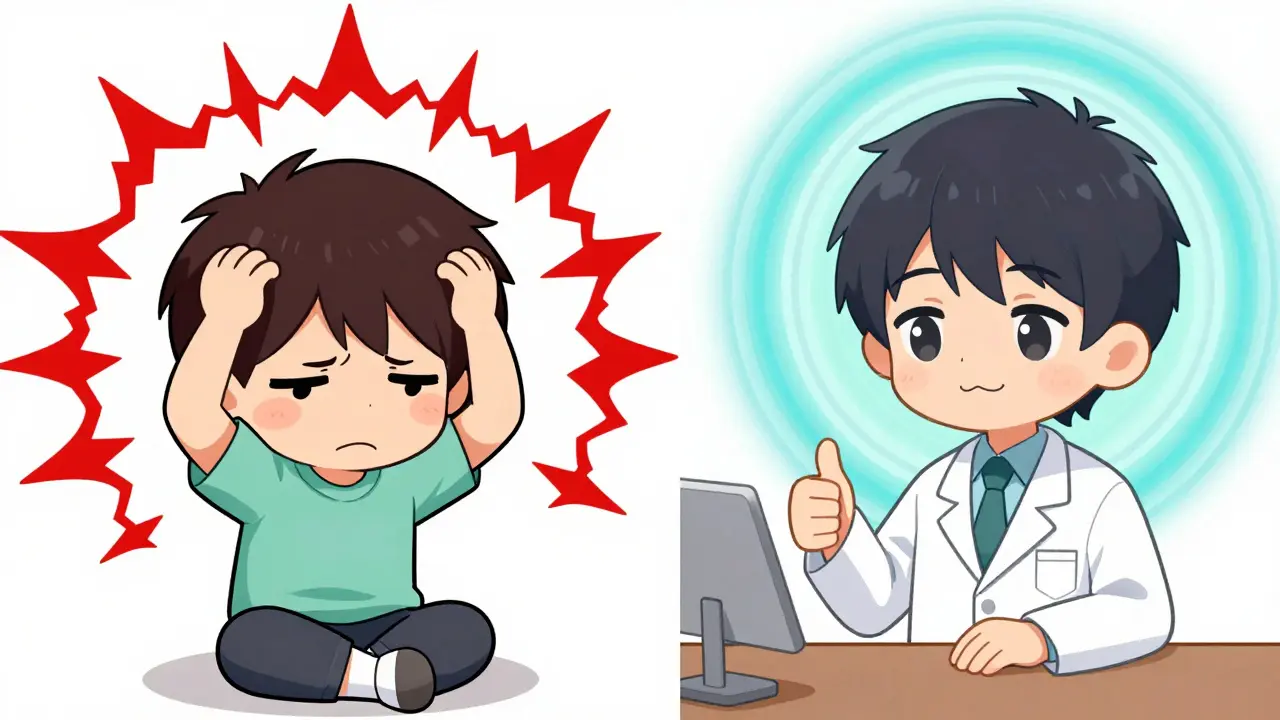
Tinnitus isn’t a disease. It’s a symptom - usually caused by damage to the inner ear, exposure to loud noise, or even stress. But here’s the twist: the sound you hear isn’t getting louder over time. What’s changing is your brain’s response to it. When your brain first notices the ringing, it flags it as a threat. Your limbic system (the emotional center) and autonomic nervous system (which controls stress responses) kick in. Suddenly, you’re anxious, irritable, and hyper-aware of the noise - even in quiet rooms. This creates a feedback loop: the more you notice it, the more your brain thinks it’s dangerous, and the louder it seems. TRT breaks this cycle. Instead of fighting the sound, it rewires your brain’s reaction to it. Think of it like living next to a busy road. At first, the traffic noise is unbearable. But after a few weeks, you barely notice it. Your brain learned to filter it out. TRT does the same thing - but for tinnitus.The Two Pillars of TRT: Counseling and Sound Therapy
TRT isn’t one thing. It’s two tightly linked parts: specialized counseling and sound therapy. Both are essential. Skip one, and you’re unlikely to see lasting results. Counseling is where the real change happens. In weekly or monthly sessions, an audiologist walks you through how your hearing system works - not in textbook terms, but in a way that makes sense. You’ll learn that tinnitus isn’t a sign of brain damage or impending deafness. It’s just a misfiring signal, like static on an old radio. The goal? To remove the fear. Once your brain stops seeing tinnitus as a threat, it stops paying attention. This isn’t just talk. Studies show counseling accounts for 60-70% of TRT’s success. Patients who understand the neurophysiological model - how the ear, brain, and emotions connect - are far more likely to stick with the therapy and see results. Sound therapy works alongside counseling. You wear small, discreet devices (like hearing aids or sound generators) that play low-level, steady noise - white noise, pink noise, or broadband sound. The key? It’s not meant to cover up your tinnitus. It’s meant to soften the contrast between the ringing and silence. Think of it like turning on a faint fan in the background. You still hear the fan, but it’s not distracting. Over time, your brain starts treating tinnitus the same way - as just background noise. The sound level is carefully calibrated: just below your tinnitus volume. Too loud, and it’s annoying. Too quiet, and it does nothing. Most people use the sound for 6-8 hours a day - while working, reading, or relaxing. It’s not meant to be worn while sleeping.Who Is TRT For? Four Patient Groups
TRT isn’t one-size-fits-all. It’s tailored based on your hearing and tinnitus profile. There are four main groups:- Group 1: Normal hearing, tinnitus only. Uses sound generators alone.
- Group 2: Hearing loss, but tinnitus isn’t noticeable in quiet. Uses hearing aids only.
- Group 3: Hearing loss AND tinnitus. Uses both hearing aids and sound generators.
- Group 4: Tinnitus with extreme sensitivity to everyday sounds (hyperacusis). Needs a modified, slower approach.
How Long Does TRT Take? Realistic Expectations
TRT isn’t a quick fix. It’s a long-term brain training program. Most people start noticing changes after 3-6 months. Full habituation - where tinnitus fades into the background and no longer causes distress - usually takes 12 to 24 months. You won’t wake up one day and not hear the ringing. Instead, you’ll notice subtle shifts: less anxiety when you hear it, fewer nighttime awakenings, less urge to check if it’s louder. Eventually, you might only notice it for 5-15% of your waking hours - down from 80-100% before treatment. Success isn’t measured by silence. It’s measured by peace.What Does the Science Say?
TRT has been studied for over 30 years. A 2002 study in the Journal of the American Academy of Audiology found 80% of patients improved significantly after 12-24 months. A 2019 review in JAMA Otolaryngology showed TRT led to a 13-point greater improvement on the Tinnitus Functional Index than standard care. Brain scans from 2018 and 2020 confirmed what Jastreboff proposed: people with distressing tinnitus have stronger connections between their auditory cortex and emotional centers like the amygdala. TRT weakens those connections over time. It literally rewires the brain. But it’s not perfect. Some experts, like Dr. Richard Tyler, argue that the counseling component doesn’t offer much more than general education. Others point out that only about 15-20% of audiologists in the U.S. are certified in TRT. That’s a big barrier. Still, the American Academy of Otolaryngology lists TRT as a Level A - the highest - recommendation for tinnitus treatment. So does the American Tinnitus Association. It’s one of only two treatments with that status, alongside Cognitive Behavioral Therapy (CBT).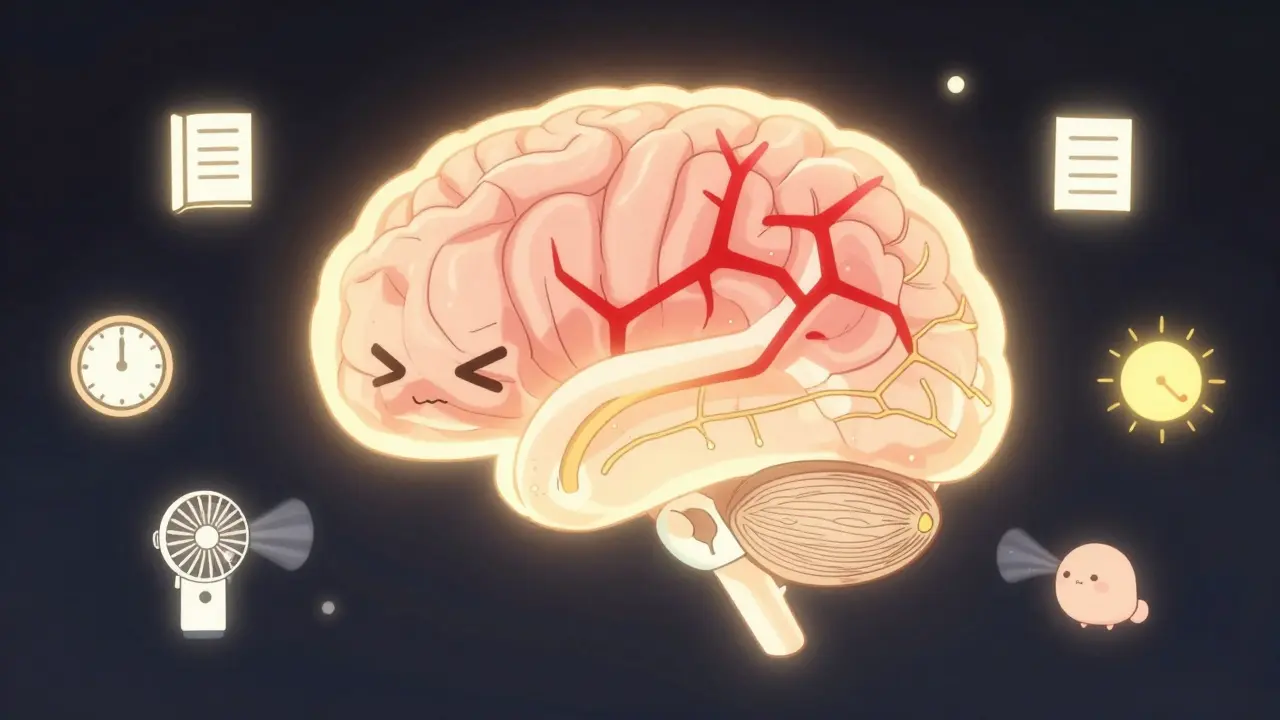





Bennett Ryynanen
January 1, 2026 AT 00:37TRT worked for me after 18 months. I thought I was gonna go insane. Now I forget I have it unless I’m in a silent room. No magic pills, no apps - just dumb patience and a little white noise. Best decision I ever made.
Deepika D
January 1, 2026 AT 10:55As someone who’s been living with tinnitus since college and tried everything from acupuncture to CBD gummies, TRT is the only thing that actually rewired my brain’s panic response. The counseling part? Game changer. I used to think the ringing meant I was dying or losing my mind. Turns out it’s just a glitch - like a Wi-Fi router that won’t shut up. Once I stopped fighting it, my anxiety dropped like a rock. The sound generators felt weird at first - like wearing tiny space heaters in my ears - but now I leave them on while working, cooking, even watching Netflix. It’s not silence. It’s peace. And honestly? That’s more than enough. If you’re reading this and still skeptical, just give it 6 months. Don’t quit because it feels slow. Your brain’s not a smartphone. It doesn’t update overnight. But it *does* learn. And it learns well if you let it.
Chandreson Chandreas
January 2, 2026 AT 22:13Been on TRT for 14 months now 🌿
Still hear the buzz... but it’s like a distant fan now. Not a siren. Not a alarm. Just... background. Like the hum of the fridge. I used to check my phone every 5 mins to see if it got louder. Now I forget it’s there until I’m alone in a library. Crazy how the brain adapts, huh? 🤯
Also - stop buying those $80 ‘tinnitus silence’ apps. They’re just fancy white noise with a fancy UI. Real TRT? It’s slow. It’s boring. But it works. 💪
Darren Pearson
January 3, 2026 AT 06:52While the anecdotal success rates cited are compelling, one must question the methodological rigor of the studies referenced. The 2002 JAAA paper, for instance, lacked a control group utilizing cognitive behavioral therapy as a comparator. Moreover, the Jastreboff protocol, though theoretically elegant, has not been consistently replicated in large-scale, multi-center trials. The assertion that TRT ‘rewires’ neural pathways is an oversimplification of neuroplasticity - a term frequently misappropriated in clinical marketing. One cannot reasonably claim causality without controlling for placebo effects, expectancy bias, and the natural fluctuation of tinnitus perception over time. Until we have double-blind, sham-device-controlled RCTs with longitudinal fMRI validation, TRT remains an intriguing hypothesis rather than an evidence-based standard.
Stewart Smith
January 4, 2026 AT 09:00Wow. So you’re telling me the solution to my ringing ears is… to pay $4k and sit through therapy for two years? And the reward is I’ll still hear it - just not care? Sounds like the universe’s most expensive zen retreat. 🙃
Meanwhile, I’m just gonna keep turning up the TV.
Retha Dungga
January 5, 2026 AT 01:19life is noise anyway
why fight the sound when you can just be the sound
the ringing is your soul whispering
you just gotta learn to listen without screaming back
peace is not the absence of noise
its the presence of calm
and i found mine in a little white noise machine
and a lot of deep breaths
and a little more acceptance
and less trying to fix what aint broken
namaste 🌿🌀
Jenny Salmingo
January 6, 2026 AT 10:07I’m from a small town in Kansas. We don’t have TRT specialists here. But my audiologist gave me a cheap sound generator and explained the brain thing in simple words. I didn’t understand all the science. But I understood this: it’s not in my ears. It’s in my head. And I can train it. Now I use it while I garden. It’s not perfect. But I sleep better. And that’s enough for me.
Aaron Bales
January 6, 2026 AT 10:35TRT works if you do it right. Counseling + calibrated sound. Not one or the other. And don’t expect miracles. Expect progress. 1% better every week. That’s how brains change. Stick with it.
Lawver Stanton
January 7, 2026 AT 21:31Okay, so let me get this straight. After 30 years of research, the best solution we have is… to pay thousands of dollars to wear earplugs that play static for 8 hours a day while someone tells you it’s ‘just a glitch’? And we’re supposed to believe this isn’t just a fancy placebo wrapped in neuroscience jargon? I’ve seen this movie before. Remember when everyone swore acupuncture cured chronic pain? Then we did the real studies and it was just… nerves and hope. Same thing here. The ‘85% success rate’? That’s from clinics that hand-pick patients who are already motivated. What about the people who are depressed, broke, and just want to sleep? They get told to ‘retrain their brain’ while the audiologist gets paid $300 an hour. And don’t even get me started on the ‘telehealth certification’ - you can’t teach neuroplasticity over Zoom with a $200 sound generator from Amazon. This isn’t medicine. It’s a wellness cult with a white coat. The only thing being rewired here is my wallet.