Anticholinergic Risk Calculator
Medication Risk Assessment
Enter medications you're taking. The calculator uses the Anticholinergic Cognitive Burden (ACB) scale (0-3) to assess dementia risk. Each drug's ACB score contributes to your total cumulative exposure.
Current Medications
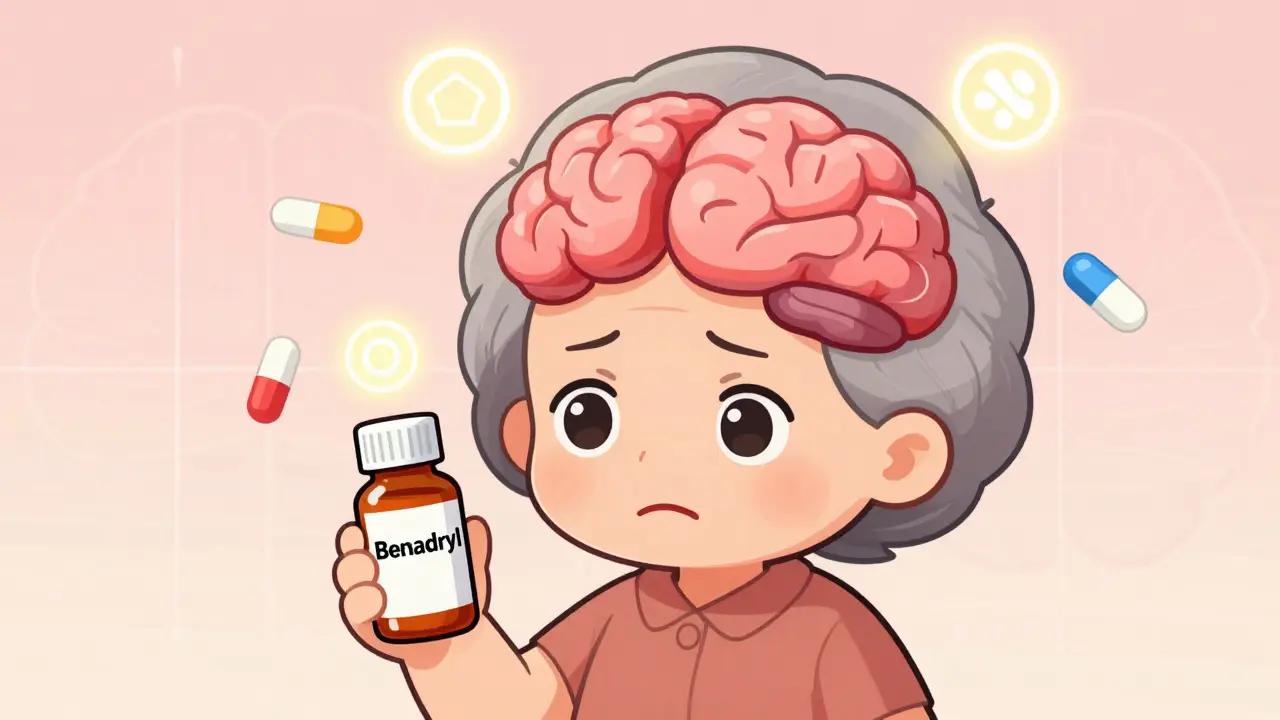
Many people over 65 take medications like Benadryl for allergies, oxybutynin for overactive bladder, or amitriptyline for nerve pain or depression. These drugs work well for their intended purposes-but what they don’t tell you on the label could be quietly affecting your brain. Growing evidence shows that long-term use of anticholinergic medications may increase the risk of dementia, even in people who show no signs of memory problems yet.
What Are Anticholinergic Medications?
Anticholinergic drugs block acetylcholine, a chemical in your brain and body that helps with memory, muscle control, digestion, and sleep. These medications were developed decades ago and are still widely used today. Common ones include:
- Diphenhydramine (Benadryl, Tylenol PM) - for allergies and sleep
- Oxybutynin (Ditropan) and Solifenacin (Vesicare) - for overactive bladder
- Amitriptyline (Elavil) - for depression and chronic pain
- Chlorpheniramine - in many cold and flu remedies
- Hyoscine - for motion sickness
There are about 100 of these drugs available, both by prescription and over the counter. What makes them dangerous over time isn’t the short-term use-it’s the cumulative exposure. Studies show that taking these medications for months or years can lead to measurable changes in the brain.
The Link Between Anticholinergics and Dementia
A 2019 study using data from over 3,400 older adults found that people who took medications with high anticholinergic activity for three years or more had a 49% higher risk of developing dementia compared to those who didn’t take them. The risk didn’t jump overnight-it climbed steadily with each extra dose.
Brain scans from the Alzheimer’s Disease Neuroimaging Initiative revealed something alarming: long-term users showed 0.5% to 1.2% more brain volume loss each year in areas like the hippocampus and amygdala-regions critical for memory. Their brains also used 4% to 8% less glucose, a sign of reduced activity. These aren’t subtle changes. They’re the kind of damage seen in early Alzheimer’s.
Not all anticholinergics are created equal. Tricyclic antidepressants like amitriptyline carried the highest risk (29% increased dementia odds), followed by bladder drugs like oxybutynin (23% increase) and antipsychotics. But some drugs in the same class, like trospium for bladder issues, showed no increased risk. Why? Because they don’t cross the blood-brain barrier as easily. That’s why the type of drug matters as much as the dose.
How Much Is Too Much?
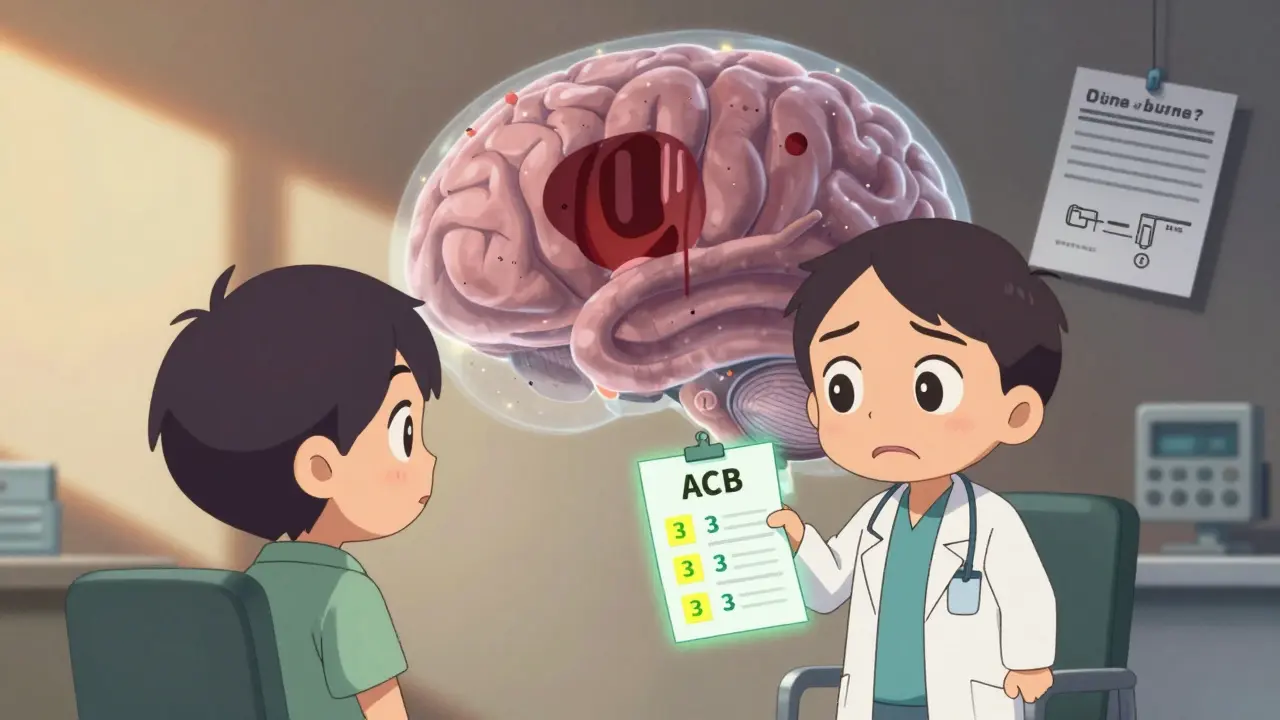
Researchers use a tool called the Anticholinergic Cognitive Burden (ACB) scale to rate drugs from 0 (no effect) to 3 (strong effect). A score of 3 means the drug has a major impact on the brain. If you’re taking multiple drugs with scores of 1 or 2, those add up.
One study found that people who took a total of 1,095 daily doses over time-roughly three years of one daily pill-had nearly double the dementia risk. That’s not a huge number. It’s less than one pill a day for three years. Many people don’t realize they’re hitting that threshold because they’re taking over-the-counter meds on top of prescriptions.
For example: someone on amitriptyline (ACB=3) for depression, diphenhydramine (ACB=3) for sleep, and oxybutynin (ACB=3) for bladder control is already at a cumulative score of 9. That’s not rare. It’s common. And it’s dangerous.
Who’s Most at Risk?
It’s not just older adults. People in their 50s and 60s who’ve been on these drugs for a decade are now showing up with memory complaints. The risk is highest for those who:
- Take more than one anticholinergic at a time
- Use them for three years or longer
- Have the APOE-ε4 gene (a genetic risk factor for Alzheimer’s)
- Already have mild memory problems
But here’s the thing: you don’t need to be diagnosed with anything to be at risk. These drugs can quietly erode cognitive function before you notice it. One woman in her late 60s, on amitriptyline for eight years, saw her MMSE score drop from 28 (normal) to 22 (mild impairment). After stopping the drug, her score stabilized-but never returned to what it was.
What Doctors Aren’t Telling You
Despite the evidence, only 37% of primary care doctors routinely check for anticholinergic burden in patients over 65. Many still believe these drugs are harmless short-term fixes. But the American Geriatrics Society’s Beers Criteria® has warned since 2019: avoid strong anticholinergics in older adults. The European Medicines Agency restricted seven bladder drugs for elderly use in 2021. The FDA added stronger warnings to 14 anticholinergic medications in 2020.
Yet patient leaflets? Only 42% mention cognitive risks-even though EU law requires it. Most people don’t know their sleep aid or bladder pill could be harming their brain. And when they do, they’re often told, “It’s just a side effect-it’ll go away.” But research shows: it doesn’t always.

Alternatives That Work
You don’t have to live with symptoms just to avoid dementia. Safer options exist for nearly every condition:
- For overactive bladder: Switch from oxybutynin to mirabegron (Myrbetriq). It works just as well, has an ACB score of 0, and doesn’t cross into the brain.
- For depression or anxiety: Try an SSRI like sertraline or escitalopram instead of amitriptyline. You lose the brain fog and gain better long-term outcomes.
- For insomnia: Skip diphenhydramine. Try cognitive behavioral therapy for insomnia (CBT-I)-it’s more effective long-term and has no side effects.
- For allergies: Use non-sedating antihistamines like loratadine (Claritin) or cetirizine (Zyrtec). They’re just as effective and have no anticholinergic activity.
These aren’t experimental. They’re standard, approved, and widely available. The only barrier? Awareness.
What You Can Do Now
If you or a loved one is taking one or more of these drugs, here’s what to do:
- Make a list of every medication you take-including supplements and OTC pills.
- Check the ACB score using free online tools from the University of Eastern Finland or ask your pharmacist.
- Don’t stop cold turkey. Some drugs, like antidepressants, need to be tapered slowly to avoid withdrawal.
- Ask your doctor: “Is this drug necessary? Is there a non-anticholinergic alternative?”
- Track changes. Note any memory lapses, confusion, or trouble focusing before and after switching meds.
One woman in Manchester replaced her nightly Benadryl with melatonin and a strict bedtime routine. Within six weeks, she stopped forgetting where she put her keys. “I didn’t realize I’d been foggy for years,” she said.
The Bigger Picture
Experts estimate that reducing anticholinergic use could prevent up to 15% of dementia cases each year-that’s over half a million people globally. This isn’t just about individual pills. It’s about a system that prioritizes symptom relief over long-term brain health.
Research is moving fast. The PREPARE trial, currently enrolling 3,000 people at risk for Alzheimer’s, is testing whether stopping these drugs can delay or prevent dementia. Meanwhile, seven new bladder drugs and three antidepressants in Phase III trials are being designed to avoid brain penetration entirely.
The message is clear: if you’re taking an anticholinergic drug long-term, it’s time to ask questions. Your brain is worth it.
Can anticholinergic medications cause dementia, or just make memory worse temporarily?
Long-term use can cause lasting cognitive decline, not just temporary confusion. Studies using brain scans show real structural changes-like shrinkage in the hippocampus-and reduced glucose use in key brain areas. These changes resemble early Alzheimer’s and often don’t reverse after stopping the drug.
Are all anticholinergic drugs equally risky?
No. Drugs like amitriptyline, oxybutynin, and diphenhydramine carry the highest risk because they easily cross into the brain. Others, like trospium or glycopyrrolate, have minimal brain effects and show little to no increased dementia risk. The key is the drug’s ability to penetrate the blood-brain barrier, not just its anticholinergic label.
How do I know if I’m taking an anticholinergic medication?
Check the drug’s name against the Anticholinergic Cognitive Burden (ACB) scale. Common ones include Benadryl (diphenhydramine), Ditropan (oxybutynin), Elavil (amitriptyline), and many sleep aids or allergy pills. You can also ask your pharmacist or use free online calculators from the University of Eastern Finland. If it’s used for sleep, bladder control, or depression, it’s likely anticholinergic.
Can stopping these drugs improve cognition?
Yes-for some people. Studies and patient reports show cognitive stabilization or modest improvement after discontinuation, especially if the drug was taken for less than five years. But if brain changes have already occurred, full recovery isn’t guaranteed. The earlier you stop, the better the chance of preserving function.
Is it safe to stop anticholinergic drugs on my own?
No. Stopping suddenly can cause withdrawal symptoms like nausea, dizziness, anxiety, or rebound bladder issues. Always work with your doctor to taper off safely. For antidepressants or bladder drugs, this usually takes 4-8 weeks. Your doctor can help you switch to a safer alternative without triggering side effects.
Why don’t doctors always warn patients about this risk?
Many doctors aren’t trained to screen for anticholinergic burden, and patient leaflets often omit cognitive risks. Also, these drugs are effective for symptoms like incontinence or insomnia, so the immediate benefit outweighs the distant risk in many clinicians’ minds. But guidelines from the American Geriatrics Society now clearly recommend avoiding them in older adults-and awareness is slowly improving.




tali murah
January 8, 2026 AT 09:48Let me get this straight-we’re giving elderly people drugs that literally shrink their brains, and the only warning is a tiny footnote in a 40-page pamphlet? This isn’t negligence, it’s industrialized elder abuse. The pharmaceutical industry doesn’t care if you forget your grandkids’ names-as long as you keep buying the next refill. And don’t even get me started on how doctors still prescribe Benadryl like it’s candy. We’ve turned aging into a pharmacological punchline.
Phil Kemling
January 9, 2026 AT 02:42It’s ironic, isn’t it? We build machines to remember everything for us-phones, calendars, AI assistants-while simultaneously poisoning the very organ that remembers. These drugs don’t just block acetylcholine; they block the quiet, slow, human part of us that lingers in memory, in smell, in the way your mother’s voice sounds when she says your name. Maybe the real dementia isn’t in the brain-it’s in the system that lets this happen.
Kiruthiga Udayakumar
January 10, 2026 AT 12:06People in India have been using neem, turmeric, and ashwagandha for brain health for centuries-and now we’re poisoning ourselves with OTC pills we buy at the pharmacy like they’re snacks. If you’re taking diphenhydramine for sleep, you’re not sleeping-you’re slowly turning your brain into Swiss cheese. And no, ‘it’s just a little drowsiness’ doesn’t cut it. This is criminal. Stop it. Now.
Patty Walters
January 11, 2026 AT 11:46hi! i just wanted to say i read this and went through my meds and found i was on oxybutynin and benadryl. i had no idea. my doc never mentioned it. i switched to mirabegron and stopped the sleep aid-my brain feels clearer already. like, i remembered where i put my glasses yesterday. small win, but huge for me. if you’re on anything for bladder or sleep, check your acb score. it’s free. you can thank me later. 🙏
Diana Stoyanova
January 11, 2026 AT 22:21Okay, real talk: if your grandma is on five different anticholinergics and you’re telling yourself ‘she’s fine, she’s just forgetful’-you’re not helping her, you’re enabling a slow-motion tragedy. I watched my aunt go from baking pies to forgetting how to turn on the stove. It wasn’t ‘just aging.’ It was amitriptyline + diphenhydramine + chlorpheniramine + oxybutynin + a mystery pill from her ‘natural health’ friend. We didn’t catch it until her MMSE was 18. She’s 72. She’s not supposed to be in a memory unit. We can do better. We have to. Your loved one’s brain is not a sacrifice zone.
Catherine Scutt
January 12, 2026 AT 04:04Wow. Just wow. So now we’re supposed to believe that every old person who forgets their keys is being poisoned by their own meds? What’s next? Are we blaming the microwave for bad memory? People are getting older. Their brains change. This is just fearmongering dressed up as science. Next thing you know, we’ll be told aspirin causes existential dread.
Jacob Paterson
January 12, 2026 AT 17:07Oh please. You people act like doctors are evil geniuses conspiring to turn seniors into zombies. These drugs are prescribed because they WORK. Your aunt’s memory problems? Probably genetics. Your mom’s bladder? She’s 80. She’s not going to do pelvic floor exercises. And no, I’m not going to ‘ask my doctor’ if my sleep aid is slowly erasing my soul. I need to sleep. I’m not a lab rat. This is just another way for wellness influencers to sell you $90 herbal teas.
Johanna Baxter
January 13, 2026 AT 09:22I took Benadryl for 12 years. I forgot my wedding anniversary. I cried for three days because I couldn’t remember my dog’s name. I thought I was going crazy. Then I stopped. And I didn’t cry anymore. I just… remembered. I still miss my dog. But at least I remember him now. I’m not okay. But I’m not gone. And if you’re on these drugs? Stop. Please. Before it’s too late. 🥺
Jerian Lewis
January 13, 2026 AT 17:30There’s a reason these drugs are still on the market: because they’re cheap, effective, and profitable. The system doesn’t want you to know this. It wants you to believe aging means inevitable decline. But it doesn’t. It’s preventable. And if you’re reading this and you’re over 50? You’re not too late. Check your meds. Talk to your pharmacist. You have more power than you think.
Jenci Spradlin
January 15, 2026 AT 11:48hey just wanted to add-i work in a pharmacy and i see this every day. people come in with 7 prescriptions and 3 otc sleep aids and 2 allergy pills. no one ever asks about interactions. we try to flag it, but most people just say ‘my doctor said it’s fine.’ the acb scale is free, easy to use, and no one uses it. shame. also, mirabegron is way better than oxybutynin. trust me, i’ve seen the difference.
Elisha Muwanga
January 15, 2026 AT 13:50Why are we letting scientists and activists dictate how older Americans live? In my day, you took your pills and didn’t complain. If your brain gets foggy, that’s what retirement is for. You don’t need to ‘optimize’ your cognition like some Silicon Valley bro. Just enjoy your tea, your lawn, and your quiet forgetfulness. This over-medicalization of aging is ridiculous.
Maggie Noe
January 16, 2026 AT 15:32Just read this and cried. I’m 58. I’ve been on amitriptyline for 15 years for migraines. I thought my brain fog was just ‘stress.’ Turns out, it’s chemical. I’m switching to sertraline next week. I’m scared, but I’m also hopeful. My mom had Alzheimer’s. I don’t want to follow that path. 🫂 I’m not alone, right? 💙
Gregory Clayton
January 16, 2026 AT 16:34Let’s be real: this is all part of the woke medical agenda. They don’t want seniors to sleep or be comfortable. They want us to suffer so we’ll vote for their ‘universal healthcare’ nonsense. I’m 70 and I take my Benadryl like a man. My brain’s fine. My bladder’s fine. My politics? Also fine. Don’t mess with my meds, woke doctors.
Pooja Kumari
January 18, 2026 AT 09:00I’ve been working in geriatric care for 22 years. I’ve seen patients on 4-5 anticholinergics for decades. I’ve watched their eyes go dull. Their speech slow. Their laughter disappear. I’ve watched families ignore the signs because they’re too tired to fight the system. This isn’t science fiction. It’s Tuesday. And the worst part? We could fix it. But we’d have to change how we treat aging. And nobody wants to do that. So we keep giving them pills. And they keep forgetting who they are.
Angela Stanton
January 19, 2026 AT 23:34ACB score = 9? That’s not a cocktail-that’s a chemical assault. The hippocampal volume loss data is terrifying. Glucose hypometabolism? That’s not ‘normal aging’-that’s neurodegeneration on a timeline. And the fact that 63% of patients are unaware of their exposure? That’s a systemic failure of informed consent. We need mandatory ACB disclosure on all OTC packaging. Like nicotine warnings. This is public health emergency-grade negligence.
Patty Walters
January 20, 2026 AT 16:25to the person who said ‘it’s just aging’-my mom took amitriptyline for 10 years. she started forgetting how to make coffee. then she forgot how to turn on the stove. then she forgot my name. we switched her to sertraline. she didn’t get her memory back. but she stopped crying every night. that’s not aging. that’s poisoning. please check your meds.