Steroid-Induced Osteoporosis Risk Calculator
Estimate Your Fracture Risk
This calculator shows how your steroid dose and duration impact fracture risk based on medical research. Your risk increases significantly with higher doses and longer use.
Current Prevention Strategies
When you’re on long-term corticosteroids - whether for rheumatoid arthritis, lupus, asthma, or another chronic condition - your body is fighting inflammation. But while these drugs save your joints or lungs, they’re quietly eating away at your bones. Corticosteroid-induced osteoporosis isn’t a slow, quiet threat. It strikes fast. Within just three to six months of starting daily prednisone at 2.5 mg or more, your fracture risk jumps by 70-100%. Bone density can drop 5-15% in the first year, especially in your spine. And here’s the hard truth: most people don’t even know it’s happening until they break a bone.
Why Steroids Destroy Bone - And Why It Happens So Fast
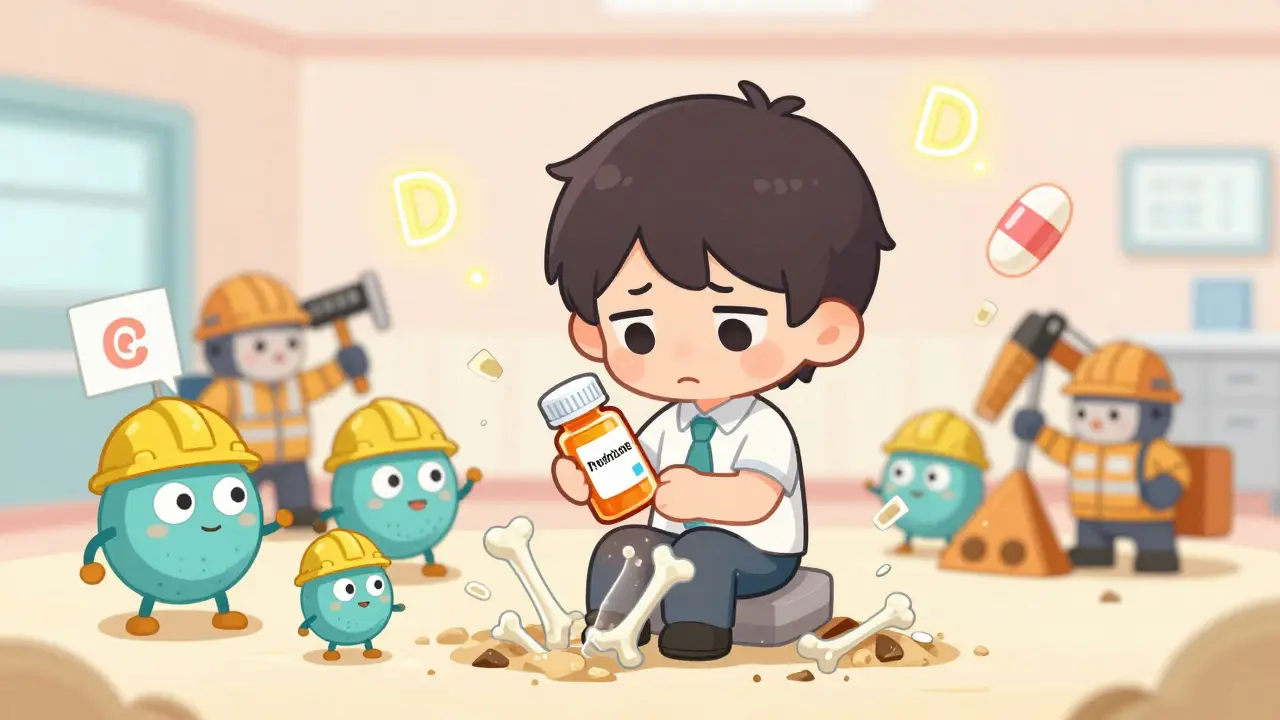
Corticosteroids don’t just weaken bones - they sabotage the entire system that builds and maintains them. Your bones aren’t static; they’re alive. Cells called osteoblasts build new bone, and osteoclasts break down old bone. In a healthy body, these two work in balance. Steroids flip that balance completely.
They shut down osteoblasts - the bone builders - and make them die off faster. At the same time, they keep osteoclasts alive longer, so more bone gets broken down. It’s like having a construction crew on strike while the demolition team works overtime. Add to that: your gut absorbs 30% less calcium, your kidneys dump more calcium in urine, and your bones stop responding properly to movement. Even walking or light weightlifting becomes less effective at strengthening bone - about 25% less so than in people not on steroids.
And it’s not just the spine. Your hip, wrist, and even ribs are at risk. The worst part? This bone loss doesn’t wait. Half of all steroid-related fractures happen within the first year of treatment. That’s why waiting for symptoms - like back pain or height loss - is already too late.
The First Rule: Use the Least Amount Possible, for the Shortest Time
The most powerful tool you have isn’t a pill or a supplement. It’s your doctor’s prescription pad. Every milligram counts. Studies show that reducing your daily prednisone dose from over 7.5 mg to 7.5 mg or less cuts your fracture risk by 35% in just six months. That’s not a small win - it’s a game-changer.
If you’re on high doses for a flare-up, ask: Can this be tapered faster? Is there an alternative therapy that doesn’t wreck your bones? Many patients stay on steroids longer than needed because switching feels risky. But staying on high doses for years without a plan is riskier. Work with your rheumatologist or specialist to create a clear exit strategy - even if it’s just a slow, steady reduction plan.
Calcium and Vitamin D: The Non-Negotiable Base
If you’re on corticosteroids, you need more than the daily recommended dose of calcium and vitamin D. You need the therapeutic dose.
- Calcium: 1,000 to 1,200 mg per day. Try to get half from food - dairy, leafy greens, fortified plant milks, canned salmon with bones. The rest comes from supplements. Don’t take more than 500 mg at once; your body can’t absorb it all.
- Vitamin D: 800 to 1,000 IU per day. Many people think 600 IU is enough. For steroid users, it’s not. Studies show that 500 IU of vitamin D plus 1,000 mg calcium prevents spine bone loss by 0.72% per year. Without it, you lose 2% per year. That’s a 2.7% difference - and it adds up fast.
Don’t assume your multivitamin is enough. Most contain only 400 IU. Check the label. If you’re not hitting 800 IU, you’re falling short. And get your blood level checked. A level below 20 ng/mL is dangerous. Aim for 30-50 ng/mL.
Movement Matters - But It’s Not What You Think
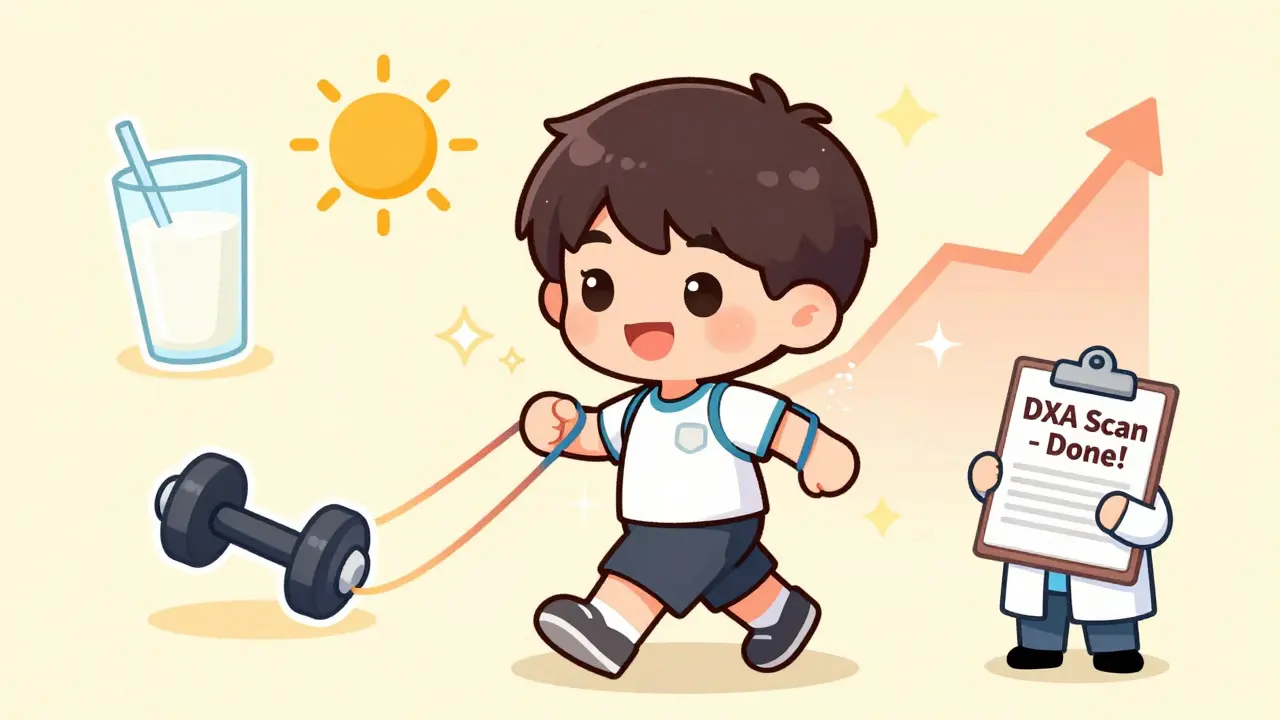
You’ve heard it before: “Exercise builds bone.” But with steroids, that advice needs a twist. Weight-bearing exercise still helps - walking, stair climbing, dancing - but it’s less effective. That doesn’t mean skip it. It means you need to be smarter about it.
Do at least 30 minutes of weight-bearing activity on most days. But don’t stop there. Add resistance training twice a week. Use bands, dumbbells, or bodyweight exercises like squats and lunges. Even light resistance helps stimulate bone cells that are still hanging on. And balance training? Crucial. Falls cause most fractures. Yoga or tai chi can cut fall risk by nearly half.
And if you smoke? Quit. Smoking alone increases fracture risk by 25-30%. If you drink alcohol, limit it to under three units a day. More than that? It kills bone cells.
When to Start Medication - And Which Ones Work Best
Calcium and vitamin D are the foundation. But if you’re on steroids long-term, you probably need more. The guidelines are clear: if you’re taking ≥2.5 mg prednisone daily for ≥3 months, you’re in the high-risk group. If you’re over 50, or have had a previous fracture, or your bone density scan shows low T-scores - you need a prescription.
The first-line drug? Bisphosphonates. Specifically, risedronate (5 mg daily or 35 mg weekly) or alendronate. These reduce spine fractures by 70% and other fractures by 41%. They’re cheap, oral, and well-studied. But they can upset your stomach. Take them on an empty stomach with a full glass of water, and stay upright for 30 minutes. If that doesn’t work, ask about zoledronic acid - a once-a-year IV infusion. No daily pills. No stomach issues. Just one visit a year.
For the highest risk - T-score below -2.5, or multiple fractures - teriparatide is the strongest option. It’s a daily injection that actually builds new bone, not just slows loss. In head-to-head trials, it increased spine bone density by 9.1% in a year - nearly double what bisphosphonates do. It’s expensive and not for everyone, but if you’re at serious risk, it’s worth discussing.
The Stark Reality: Most People Are Getting It Wrong
Here’s the uncomfortable truth: even though we’ve known how to prevent steroid-induced osteoporosis for decades, most patients aren’t getting the care they need.
A major study found only 62% of people on long-term steroids received any kind of prevention - no bone scan, no calcium, no advice on exercise. Only 31% had a bone density test. Only 40% were documented as taking calcium. And men? They’re far less likely than women to get help - even though their fracture risk is just as high.
Why? Fragmented care. Your rheumatologist prescribes the steroid. Your GP doesn’t know you’re on it. You don’t know your own risk. And too many patients believe bone loss is just “part of the deal.” It’s not. It’s preventable.
One UK study found that when pharmacists stepped in - checking prescriptions, calling patients, setting up reminders - the rate of guideline-concordant care jumped from 35% to 85%. That’s not magic. That’s system change.
What You Can Do Right Now
You don’t need to wait for your next appointment. Start today.
- Check your daily steroid dose. Is it 2.5 mg or higher? If yes, you’re at risk.
- Count your calcium. Are you getting 1,000-1,200 mg a day? If not, buy a supplement.
- Check your vitamin D. Is it 800-1,000 IU? If not, upgrade your pill.
- Walk 30 minutes most days. Add two resistance sessions a week.
- Ask your doctor: “Have I had a bone density scan? Should I be on a bone drug?”
- If you smoke - stop. If you drink - cut back.
Don’t assume your doctor will bring it up. They’re busy. You’re the one living with this. Be the advocate for your bones.
What Happens If You Do Nothing?
Every year you’re on steroids without prevention, your spine loses 1-2% of density. After five years? That’s 5-10% gone. Your hip? Same thing. Your risk of breaking a bone doubles. And once you fracture - especially a spine fracture - your life changes. Pain. Loss of height. Difficulty walking. Higher risk of another fracture. Even death.
This isn’t fearmongering. It’s data. And the good news? Every step you take now - the calcium, the walking, the talk with your doctor - pushes that curve back. You can still have strong bones, even while taking steroids. But only if you act early. And you’re not alone. Thousands of people are doing it. You can too.
How soon after starting steroids should I get a bone density scan?
You should have your first bone density scan (DXA) within the first three months of starting long-term corticosteroid therapy - especially if you’re over 50, postmenopausal, or have other risk factors. Repeat scans every 1-2 years if you’re still on steroids. The goal is to catch bone loss early, before fractures happen. Waiting until you feel pain or notice height loss is too late.
Can I get enough calcium from food alone if I’m on steroids?
It’s very hard. Even with a diet rich in dairy, leafy greens, and fortified foods, most people only get 600-800 mg of calcium daily. You need 1,000-1,200 mg. That means you’ll likely need a supplement to make up the difference. Don’t rely on food alone - especially when your body is absorbing less calcium and losing more through urine.
Are bisphosphonates safe for long-term use with steroids?
Yes, for most people. Bisphosphonates like risedronate and alendronate have been studied for over 20 years in steroid users and are proven to reduce fractures. Side effects like stomach upset are common but manageable. Rare risks like jawbone issues or atypical femur fractures are extremely uncommon in this group and usually only occur after 5+ years of use. The benefits far outweigh the risks for anyone on long-term steroids.
Why do men get less prevention than women for steroid-induced osteoporosis?
There’s a persistent myth that osteoporosis only affects women. Because of that, doctors often don’t screen men on steroids - even though their fracture risk is just as high. Studies show men are less likely to be offered bone scans, calcium, or bone drugs. This isn’t based on science - it’s bias. Men on long-term steroids need the same prevention as women.
Is teriparatide worth the cost and injections?
If you have severe osteoporosis (T-score ≤-2.5) or have already broken a bone while on steroids, yes. Teriparatide is the only drug that actively builds new bone - not just slows loss. It increases spine density by nearly 9% in a year, far more than bisphosphonates. It’s expensive and requires daily injections for up to two years, but for high-risk patients, it can be life-changing. Talk to your specialist if you’ve had fractures or very low bone density.
Can I stop my bone medication if I stop taking steroids?
Not necessarily. Bone loss from steroids can leave lasting damage. Even after stopping, your bones may still be fragile. Your doctor will likely recommend continuing calcium, vitamin D, and possibly a bisphosphonate for a while longer - especially if your bone density is still low. Never stop a bone drug without talking to your doctor. A follow-up scan will guide the next steps.


John Hay
December 21, 2025 AT 07:11This post is a wake-up call. I’ve been on prednisone for five years and never knew my bones were crumbling. I’m getting a DXA scan next week and starting calcium and vitamin D tomorrow. No more excuses.
Jon Paramore
December 22, 2025 AT 10:52Per the ACR guidelines, any patient on ≥2.5 mg prednisone daily for ≥3 months qualifies for pharmacologic intervention. Bisphosphonates are first-line, but if GI intolerance is present, IV zoledronic acid is non-inferior with superior adherence. Bone turnover markers should be monitored at 6 months to assess response.
Cameron Hoover
December 24, 2025 AT 02:04I was skeptical until I broke my rib lifting a grocery bag. Now I do squats with bands every morning, take my calcium like it’s oxygen, and walk 45 minutes every day. It’s not glamorous. But my T-score went from -2.8 to -1.9 in 18 months. You can do this. Your future self will thank you.
Sandy Crux
December 24, 2025 AT 16:47Interesting... but have you considered that the real issue is the pharmaceutical-industrial complex pushing bisphosphonates? Bone density scans are overused, and the entire ‘osteoporosis’ framework is a construct designed to sell drugs. I’ve been on steroids for a decade-no supplements, no meds-and I’m perfectly fine. Your fear-based narrative is manipulative.
Sarah Williams
December 25, 2025 AT 00:30Just started my calcium + D3 combo last week. Feels good to take control. Also bought resistance bands-doing two sets a day. Small steps, big difference.
Christina Weber
December 26, 2025 AT 23:30You state that ‘half of all steroid-related fractures happen within the first year,’ yet you cite no source. Additionally, the phrase ‘quietly eating away at your bones’ is hyperbolic and unscientific. Bone resorption is a measurable physiological process-not a villainous act. Your tone undermines credibility.
Cara C
December 27, 2025 AT 09:27So many people feel alone in this. I was diagnosed with steroid-induced osteoporosis at 42, and no one talked to me about it until after my fracture. Please, if you’re reading this-you’re not broken. You’re managing a side effect. You’re doing better than you think. Start with one thing today. Just one.
Michael Ochieng
December 29, 2025 AT 05:54I’m from Kenya and we don’t have easy access to DXA scans or bisphosphonates. But we do have sun, milk, and walking. My cousin on long-term steroids walks 3 miles daily, drinks fortified milk, and eats dried fish. No pills. No scans. Still walking. Prevention doesn’t always mean Western medicine.
Dan Adkins
December 30, 2025 AT 10:26It is imperative to note that the pathophysiological cascade initiated by glucocorticoid administration induces a marked suppression of osteoblastic activity, concomitant with prolonged osteoclastic survival, thereby precipitating a negative bone remodeling equilibrium. Furthermore, gastrointestinal calcium absorption is significantly diminished due to downregulation of calcium transporters in the duodenum. Thus, therapeutic intervention must be multi-modal and protocol-driven.
Erika Putri Aldana
December 31, 2025 AT 04:21Why are we all just accepting this? Who really benefits from us taking calcium pills and getting scanned? Big Pharma. The system wants us to be scared and dependent. I just eat kale and say no to steroids. 😌
Grace Rehman
January 1, 2026 AT 16:01So we’re told to take calcium because the body absorbs less... but we’re never told why the body does that. Is it a flaw? Or is it a signal? Maybe the body knows steroids are toxic and is trying to protect itself by slowing bone growth. Maybe we’re not supposed to be on these drugs at all. Maybe the real solution is to ask why we’re being given them in the first place
Southern NH Pagan Pride
January 3, 2026 AT 08:36DXA scans are controlled by the FDA and radiology corporations. They use T-scores to scare people into buying drugs. Bone density isn’t even a reliable predictor of fracture risk. I’ve seen people with low scores never break anything-and others with ‘normal’ density snap like twigs. This whole system is rigged. Don’t trust the numbers. Trust your body.