
When you vomit something that looks like coffee grounds, or pass black, tarry stools, it’s not just a bad stomach bug. It’s a medical emergency called upper GI bleeding. This isn’t rare-it happens to about 100 out of every 100,000 adults every year in the U.S. And while some cases are mild, others can kill you within hours if not treated fast. The two biggest culprits? Peptic ulcers and esophageal varices. Both bleed differently, need different treatments, and both demand immediate action.
What Exactly Is Upper GI Bleeding?
Upper GI bleeding means blood is coming from somewhere in your upper digestive tract-your esophagus, stomach, or the first part of your small intestine (duodenum). It’s not just a little blood in your spit. It’s enough to drop your hemoglobin fast, make your heart race, and send your blood pressure crashing. You might feel dizzy, faint, or just overwhelmingly weak. Some people think they’re having a heart attack. Others assume it’s food poisoning. But if you’re vomiting blood or passing black, sticky stools, you’re not just "feeling off." You need an ER right now.The most common cause? Peptic ulcers. These are open sores in the stomach or duodenum lining, often caused by H. pylori bacteria or long-term use of NSAIDs like ibuprofen or aspirin. About half of all upper GI bleeds come from ulcers. Duodenal ulcers bleed more often than gastric ones-70-80% of ulcer bleeds start there. The second big cause? Esophageal varices. These are swollen, fragile veins in the esophagus, usually from liver disease like cirrhosis. They don’t bleed often, but when they do, they bleed hard. About 1 in 5 upper GI bleeds are from varices, and 1 in 5 of those patients die within six weeks if not treated properly.
How Do You Know It’s Bleeding? The Real Symptoms
It’s not always obvious. Some people think they need to see blood in their vomit to worry. But here’s the truth: if you’re vomiting dark, grainy material that looks like coffee grounds, that’s partially digested blood. It’s not "just acid." That’s a red flag. Same with black, tar-like stools-melena. That means blood has been sitting in your gut for hours, breaking down. It’s not from eating beets or iron pills. If you’re on iron, you’d know. This is different.Other signs? A heart rate over 100 beats per minute. Blood pressure below 90 systolic. Cold, clammy skin. Confusion or passing out. These aren’t "maybe" signs. These are signs your body is going into shock. A 2021 study found that if your blood urea nitrogen (BUN) to creatinine ratio is above 30:1, there’s a 69% chance you’re bleeding somewhere in your upper GI tract. That’s a lab test your ER doctor will check within minutes.
And don’t wait for symptoms to get worse. A Reddit user, u/StomachSOS, wrote in July 2023: "Doctor dismissed my black stools as iron supplements for two weeks. I collapsed. Hemoglobin was 5.8." That’s dangerously low. Normal is 12-16 for women, 13-17 for men. At 5.8, you’re one step from cardiac arrest.
Diagnosis: What Happens in the ER
First thing? Stabilize. Oxygen, IV fluids, blood tests. They’ll check your hemoglobin, your INR (to see how well your blood clots), and your BUN/creatinine ratio. Then comes the Glasgow-Blatchford score. This isn’t a guess. It’s a proven tool that uses six numbers: your hemoglobin level, blood pressure, heart rate, whether you have melena, if you’ve fainted, and if you have liver or heart disease. A score of 2 or higher? You’re going to the hospital. A score of 0? You might be safe to go home.But the real key? Endoscopy. Not tomorrow. Not in the morning. Within 12 hours. A 2022 study showed that getting an endoscopy within 12 hours cuts death risk by 25% compared to waiting longer. During the procedure, doctors use the Forrest classification to judge how bad the bleeding is. Class Ia? Blood spurting out. 90% chance it’ll rebleed without treatment. Class Ib? Oozing. 50% rebleed risk. Class IIa? You see a blood vessel. Still 50% risk. That’s why they don’t just look-they act.
Treatment: Ulcers vs. Varices
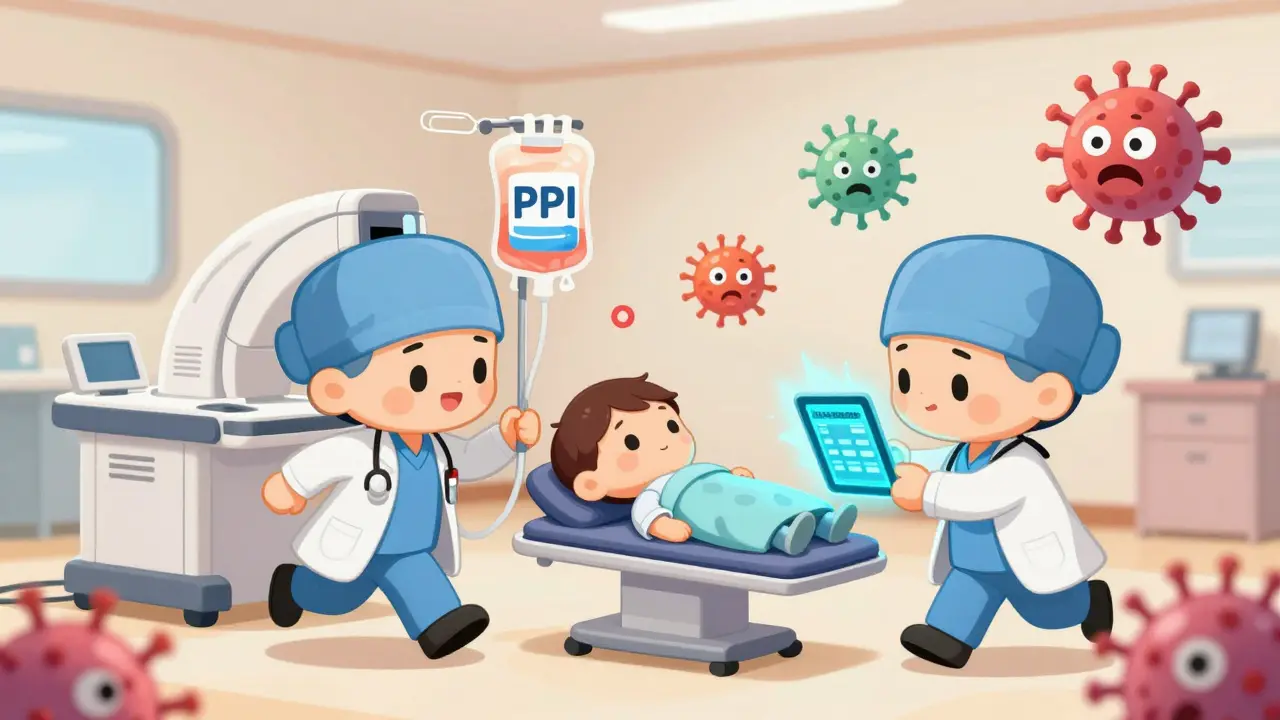
- For ulcers: First, they give you an 80mg IV bolus of a proton pump inhibitor (PPI), then a continuous drip of 8mg/hour. This shuts down stomach acid, letting the ulcer heal. The COBALT trial in 2022 showed this cuts rebleeding from 22.6% down to 11.6%. Then comes endoscopic treatment-epinephrine injections to shrink blood vessels, followed by clips or heat to seal the spot. This works in 90-95% of cases.
- For varices: No PPIs here. They need vasoactive drugs. Terlipressin or octreotide. These drugs squeeze the veins in your liver to stop the bleeding. Along with that, they give you antibiotics-usually ceftriaxone-to prevent deadly infections. Then, endoscopic band ligation. They put tiny rubber bands around the swollen veins. It’s quick. It’s effective. It cuts rebleeding from 60% to 25%. Sclerotherapy (injections) is outdated. Banding is standard now.
Transfusions? Only if you’re truly low. Don’t just give blood because you "look pale." The goal isn’t to get hemoglobin back to normal. It’s to get it to 7-9 g/dL. Too much blood can overload your heart, especially if you have liver disease. Each unit of packed red cells raises your hemoglobin by about 1 g/dL. So if you’re at 6, two units gets you to 8. That’s enough.
The New Tools: AI and Hemospray
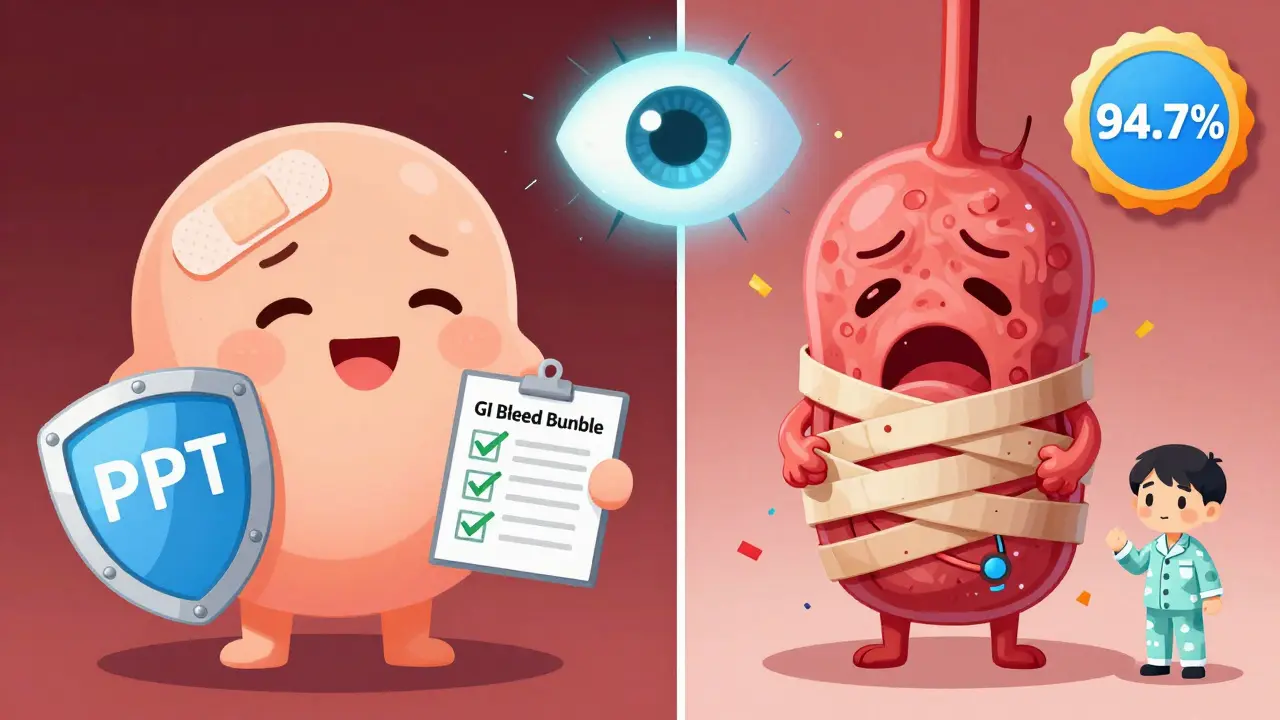
The field is changing fast. In 2023, the FDA approved Hemospray-a fine powder that’s sprayed onto bleeding sites during endoscopy. It forms a physical barrier, like a bandage. In trials, it stopped bleeding in 92% of cases where other methods failed. That’s huge for patients with tricky, flat ulcers or diffuse oozing.Even bigger? AI-assisted endoscopy. A 2023 study called ENDOSCAPE showed AI systems spotted bleeding signs with 94.7% accuracy. Human endoscopists? Only 78.3%. That’s a massive jump. But there’s a catch. These AI tools were trained mostly on data from white patients. In Black and Hispanic patients, accuracy drops by 15%. That’s not just a technical glitch-it’s a health equity issue. The NIH’s UGIB-360 study, launched in January 2024, is tracking 10,000 people to fix that. They’re using genomic data, gut microbiome info, and real-time clinical signs to build personalized risk models. Results come in late 2025.
What Happens After the ER?
You’re not done when you leave the hospital. A 2022 University of Michigan study found that 68% of patients were terrified of bleeding again within 30 days. Many stopped taking NSAIDs on their own. 42% cut out coffee, alcohol, spicy food. But 31% stopped their medications without talking to a doctor. That’s dangerous. If you were on blood thinners or SSRIs, you need a plan. SSRIs double your risk of GI bleeding. That’s not a myth. It’s from a 2022 JAMA study of 500,000 people.Hospitals that use a "GI Bleed Bundle"-a checklist of five steps-see better results. Rapid assessment within 30 minutes. Risk scoring. PPI within an hour. Endoscopy within 12 hours. Follow-up within 72 hours. One hospital cut mortality from 8.7% to 5.3% just by sticking to this. It’s not magic. It’s discipline.
Who’s at Highest Risk?
Age is the biggest factor. If you’re under 50, your risk is about 50 per 100,000. If you’re over 80? It jumps to 300 per 100,000. That’s six times higher. Why? More ulcers, more liver disease, more meds. Also, people with cirrhosis, chronic kidney disease, or heart failure are at higher risk. And if you’re in East Asia? Your risk is higher than in Europe or North America because H. pylori is more common there.And don’t forget the cost. Each hospital stay for upper GI bleeding averages $15,200. If you rebleed? That jumps to $25,100. That’s why preventing rebleeding isn’t just medical-it’s economic.
What does coffee-ground vomit mean?
Coffee-ground vomit is partially digested blood from an upper GI bleed. It looks dark brown or black and grainy because stomach acid breaks down the blood. It’s not food residue. It’s a sign you need urgent medical care.
Can I treat upper GI bleeding at home?
No. Upper GI bleeding is a life-threatening emergency. Even if symptoms seem mild, internal bleeding can worsen rapidly. Delaying care increases death risk by up to 40%. Always go to the ER if you vomit blood or pass black, tarry stools.
Do PPIs stop bleeding?
PPIs don’t stop active bleeding. They reduce stomach acid, which helps ulcers heal and lowers the chance of rebleeding. But they’re not a substitute for endoscopy. Giving PPIs without confirming the cause with endoscopy leads to unnecessary treatment in 30% of low-risk patients.
Why are varices so dangerous?
Varices are swollen veins in the esophagus caused by liver cirrhosis. They’re thin-walled and under high pressure. When they rupture, they bleed fast and heavily. Mortality is 20% within six weeks without treatment. They require immediate drugs (terlipressin/octreotide), antibiotics, and endoscopic banding-not just PPIs.
Is upper GI bleeding more common in older adults?
Yes. Rates jump from 50 per 100,000 in people under 50 to 300 per 100,000 in those over 80. Older adults take more medications (NSAIDs, blood thinners), have more ulcers, and are more likely to have liver or kidney disease-all increasing risk.
Can AI really improve diagnosis?
Yes. AI systems now detect subtle bleeding signs during endoscopy with 94.7% accuracy-far better than human eyes (78.3%). But current AI tools are less accurate in Black and Hispanic patients due to biased training data. Ongoing research aims to fix this by 2025.



vishnu priyanka
January 14, 2026 AT 01:32Man, I saw this one time in Mumbai - guy passed out on the bus, vomit looked like wet coffee grounds. Everyone thought he was drunk. Turned out he’d been popping ibuprofen for back pain for years. Got to the hospital just in time. India’s got a huge NSAID problem. No one checks. Just pop, pop, pop. Scary stuff.
Lethabo Phalafala
January 14, 2026 AT 23:17I lost my uncle to this. They told him it was "just acid" for three weeks. He was 72, on aspirin for his heart. When he finally went to the ER, his Hb was 4.9. They gave him six units of blood. He didn’t make it past midnight. This isn’t just medical info - it’s a death sentence if ignored. Why do we wait until we’re dying to listen?
Priyanka Kumari
January 15, 2026 AT 06:01Thank you for writing this with such clarity. As a nurse in Pune, I see this too often - patients delaying care because they think it’s "just indigestion." The GI Bleed Bundle you mentioned? We implemented it last year. Mortality dropped from 11% to 6% in just six months. Small changes save lives. Let’s keep pushing for standardization everywhere.
Alan Lin
January 15, 2026 AT 21:02You’re absolutely right about the AI bias. But let’s be honest - the entire medical system is biased. The NIH’s UGIB-360 study? Long overdue. We’ve spent decades training algorithms on white, middle-class data while Black and Hispanic patients die because their symptoms are "atypical." This isn’t a tech problem. It’s a moral failure. Fix the data, fix the outcomes. No more excuses.
John Pope
January 16, 2026 AT 03:05Look, I get it - PPIs aren’t a cure. But let’s not pretend endoscopy is some magic wand. I had one last year. They stuck a tube down my throat while I was half-asleep, and the doctor was scrolling through TikTok on his phone. Then he said, "Oh, you’ve got a small ulcer." No epinephrine. No clips. Just a pat on the back and a prescription. Meanwhile, my BUN/Cr was 38. That’s not a 0 on the Glasgow-Blatchford scale - that’s a red flag waving in a hurricane. The system’s broken. We need better doctors, not just better tech.
And Hemospray? Sounds like snake oil with a fancy name. I’ve seen it used on a patient who bled again three hours later. It’s a band-aid on a severed artery. Don’t get me wrong - I’m glad it exists. But don’t sell it as the future. The future is accountability. The future is doctors who actually care.
And don’t even get me started on SSRIs. I’m on sertraline. My doctor never mentioned the bleeding risk. Not once. So I googled it. Turns out I’ve been walking around with a ticking time bomb in my stomach. Thanks for the heads-up, I guess.
Also - coffee ground vomit? I thought it was a metaphor. Like, "my soul is vomiting coffee grounds." Turns out it’s literal. That’s… disturbing. And real. And I’m never ignoring a stomach ache again.
Also - why does everyone think cirrhosis only happens to alcoholics? My cousin had it from hepatitis C. Never drank. Never smoked. Just got unlucky. Varices don’t care about your lifestyle. They just want you dead.
And AI? It’s great until it misdiagnoses a Black patient because it’s never seen their melanin before. We’re not building tools to save lives. We’re building tools to automate bias. And we’re proud of it.
Someone needs to sue the FDA for approving Hemospray without requiring diverse training data. That’s not innovation. That’s negligence.
And yes - I’m mad. You should be too.
Angel Tiestos lopez
January 16, 2026 AT 21:43Bro. I just Googled "black poop" and ended up here. 😳 I thought I ate too many blueberries. Turns out I’ve been taking naproxen for my knees for 6 months. My grandma died from this. I’m quitting NSAIDs today. 🙏
Trevor Whipple
January 18, 2026 AT 20:00Y’all are overcomplicating this. If you’re puking coffee grounds or shittin’ tar, you’re dying. Go to the ER. Stop reading Reddit. Stop Googling. Just go. I’ve seen 3 people die from waiting. One was my cousin. He waited for his insurance to approve an appointment. He died on the phone. Literally. So don’t be a hero. Just. Go.
Nelly Oruko
January 19, 2026 AT 06:48Thank you for the thorough breakdown. I’m a medical student, and this is exactly the kind of clinical reasoning we need to internalize. The distinction between ulcer and variceal bleeding is fundamental - yet so many residents confuse them. PPIs for ulcers, vasoactive agents for varices. Endoscopy within 12 hours. Not "soon." Not "tomorrow." 12 hours. That’s the line between life and death. And the AI bias issue? That’s not just a footnote. It’s a crisis. We must demand equitable datasets. The NIH’s UGIB-360 study could be the turning point. Let’s hope they’re listening.