
Finding lung cancer early can be the difference between a challenging battle and a successful cure. For a long time, chest X-rays were the go-to tool, but they often missed small tumors until it was too late. Today, Low-Dose CT is a specialized imaging test that uses a small amount of radiation to create detailed 3D images of the lungs, allowing doctors to spot tiny nodules long before symptoms appear. Also known as LDCT, this technology has fundamentally changed how we approach early detection for high-risk individuals.
If you've smoked or have a history of smoking, you might be wondering if this scan is right for you. It's not a test for everyone-only those whose risk outweighs the potential downsides, like false alarms. In this guide, we'll break down who qualifies, what the results actually mean, and how the process works in the real world.
Who is Eligible for Lung Screening?
Not everyone needs a lung scan. Because the test can sometimes find "spots" that aren't cancer, medical organizations set strict rules to ensure the right people get screened. The U.S. Preventive Services Task Force is the primary body that sets evidence-based screening recommendations for the US healthcare system (USPSTF) currently defines the gold standard for eligibility.
Generally, you are eligible for annual Low-Dose CT screening if you meet these three criteria:
- Age: You are between 50 and 80 years old.
- Smoking History: You have a "20 pack-year" history. (A pack-year is calculated by multiplying the number of packs smoked per day by the number of years smoked. For example, one pack a day for 20 years equals 20 pack-years).
- Current Status: You currently smoke or quit within the last 15 years.
However, different organizations have slightly different takes. The National Comprehensive Cancer Network a non-profit alliance of leading cancer organizations that develops clinical practice guidelines (NCCN) is often more flexible, suggesting that people who quit more than 15 years ago-or those with family histories of cancer and workplace exposure to toxins-might still benefit from screening.
| Organization | Age Range | Smoking Requirement | Quit Time Limit |
|---|---|---|---|
| USPSTF | 50-80 | ≥20 pack-years | Within 15 years |
| ACS | 50-80 | ≥20 pack-years | Case-by-case after 15y |
| NCCN | 50-85 | ≥20 pack-years | No strict limit |
| CMS (Medicare) | 50-77 | ≥20 pack-years | Within 15 years |
How LDCT Works and What to Expect
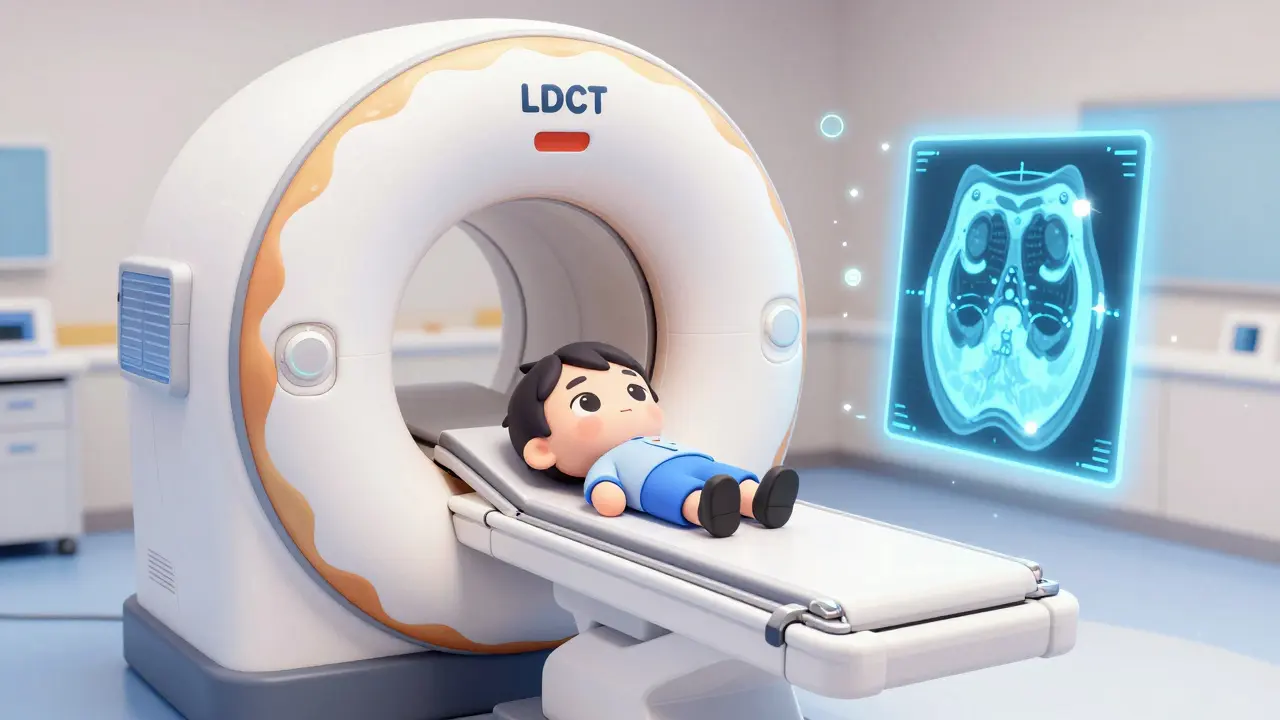
If you've had a standard CT scan before, you know it involves lying on a table while a doughnut-shaped machine slides over you. An LDCT is very similar, but it's modified to be faster and use significantly less radiation. In fact, the American College of Radiology the largest professional association of radiologists in the US that accredits imaging facilities (ACR) ensures these scans use about 1/10th of the radiation of a traditional diagnostic CT.
The process usually starts with a "shared decision-making" visit. This is a 20-to-30-minute conversation with your doctor to discuss the pros and cons. Once you're cleared, the actual scan takes only a few minutes. You don't need to drink contrast dye or undergo any sedation. You simply breathe normally, and the machine captures thin "slices" of your lung tissue (usually 1.5 mm or thinner) to find tiny nodules.
In recent years, AI has entered the chat. Many clinics now use software like LungPoint an FDA-approved AI-assisted software designed to help radiologists detect and track lung nodules to help radiologists spot nodules more accurately and reduce the time it takes to read the images. This doesn't replace the doctor, but it acts as a second set of highly precise eyes.
Understanding Your Results
Getting your results can be the most nerve-wracking part of the process. It's important to know that a "positive" result doesn't automatically mean you have cancer. In fact, the vast majority of positive screens are benign.
Results generally fall into three categories:
- Negative: No suspicious nodules were found. You'll likely be told to come back in one year for your next annual scan.
- Indeterminate (Positive): The scan found a nodule (usually 4mm or larger) that isn't clearly calcified (which would suggest it's harmless). This is common. Data shows that about 96% of these positive findings eventually turn out to be benign.
- Highly Suspicious: The nodule has characteristics (like irregular borders) that strongly suggest malignancy.
If you have an indeterminate result, your doctor won't just guess. They'll likely follow a protocol-such as the Fleischner Society an international organization that sets standards for the reporting and interpretation of thoracic imaging guidelines-which might involve a follow-up scan in 3 to 6 months to see if the nodule grows. If it stays the same size, it's likely harmless. If it grows, they may order a PET-CT an imaging test that combines a PET scan and a CT scan to identify metabolic activity in nodules to see if the spot is "active" or cancerous.
Does it Actually Save Lives?
The short answer is yes. The evidence is backed by massive studies, most notably the National Lung Screening Trial a major US study that proved LDCT reduces lung cancer mortality compared to chest X-rays (NLST). This study found a 20% reduction in lung cancer deaths among high-risk people who were screened annually with LDCT compared to those who had standard X-rays.
The real magic of LDCT is that it catches cancer at Stage I. When cancer is found at this early stage, it is often treatable through surgery-specifically VATS Video-Assisted Thoracoscopic Surgery, a minimally invasive surgical technique for removing lung tissue . Because VATS is less invasive than open surgery, hospital stays have dropped from over five days to around three days on average.
But there are trade-offs. Some people experience significant anxiety while waiting for follow-up results. There's also a small risk of "overdiagnosis," where a doctor finds a slow-growing tumor that might never have caused a problem in the patient's lifetime, leading to unnecessary surgery.

Common Challenges and Barriers
Despite the benefits, not everyone who should be screened actually gets it. Many people cite fear of a cancer diagnosis or worry about false positives as the main reasons for avoiding the scan. There are also systemic issues; people in rural areas often have to drive dozens of miles to find an ACR-accredited facility, which significantly lowers screening rates compared to urban centers.
Cost is another factor. While Medicare the US government program that provides health coverage for people 65 or older and certain younger people typically covers LDCT for those who meet the CMS guidelines, out-of-pocket costs for subsequent diagnostic tests (like a biopsy or specialized CT) can still add up, sometimes reaching several hundred dollars per visit.
Is a low-dose CT the same as a regular CT scan?
No. A regular CT scan is used to diagnose a known problem and uses a higher dose of radiation. A low-dose CT (LDCT) is a screening tool for people without symptoms, specifically designed to use much less radiation (about 1/10th of a standard scan) while still providing enough detail to spot early-stage nodules.
What happens if my scan finds a nodule?
First, don't panic. Most nodules are benign. Your doctor will either recommend a follow-up scan in a few months to see if the nodule changes size or, if the nodule looks suspicious, may order a PET-CT or a biopsy to get a definitive answer.
How often should I get screened?
If you meet the eligibility criteria, the current gold standard is to undergo screening once every year. Consistency is key because lung cancer can grow quickly, and annual scans provide the best chance of catching it while it's still treatable.
I quit smoking 20 years ago. Am I still eligible?
According to the USPSTF guidelines, the cutoff is 15 years. However, the NCCN and some doctors believe risk remains elevated for 25 years or more. You should discuss your specific risk factors-like family history or job exposures-with your doctor to see if a scan is still recommended for you.
Does insurance always cover the scan?
Medicare and most private insurers cover the initial annual screening if you meet the age and smoking history requirements. However, if the screening finds something that requires further "diagnostic" testing (like a biopsy), those costs may be processed differently and could involve co-pays.
Next Steps: What to do Now
If you believe you fit the age and smoking criteria, the next step is to schedule a consultation with your primary care physician. Don't just ask for a scan; ask for a "shared decision-making visit." This ensures you understand the radiation risk, the possibility of false positives, and the plan for follow-up care.
If you live in a rural area and don't have a local accredited center, ask your doctor about transportation assistance programs or telehealth options for the initial consultation. If you are feeling anxious about the possibility of a positive result, remember that catching a nodule at 6mm is a victory-it's the difference between a localized surgery and a systemic struggle.






Sarah Mifsud
May 3, 2026 AT 05:17I lapped through this and its really helpful!! Just a litle tip for anyone nervous about the scan, the table moves real fast and you dont feel a thing. I helped a few family members get thier first ones and the anxiaty is always the worst part, not the actual procedure.
Lando Neal
May 5, 2026 AT 03:36This is such great info!!! I didn't even know about the pack-year calculation... it makes so much sense when you actually do the math!!! Glad to see AI is helping the docs out too!!!
Rebekah Korak
May 5, 2026 AT 03:58It is truly fascinating how we've become obsessed with these biological blueprints and the desperate quest to quantify our inevitable decay through thin slices of radiation, as if a 1.5mm image can actually capture the essence of a life lived or the metaphysical weight of a smoking habit. We treat the body like a machine to be serviced, ignoring the cosmic irony that the very technology meant to save us often fuels a new kind of existential dread where we spend our twilight years staring at grey blobs on a screen, wondering if a tiny nodule is the herald of the end or just a phantom of the imaging process, which honestly just reflects our collective inability to accept the organic chaos of existence in favor of a sterile, digital certainty that doesn't actually exist in the grand scheme of the universe anyway.
Srinivas Komakula
May 6, 2026 AT 23:04The integration of AI-assisted software like LungPoint is precisely where the systemic surveillance state begins... the algorithmic quantification of pulmonary tissue provides the perfect dataset for bio-metric profiling!!! One must wonder why the radiation dosages are truly "low" or if this is merely a calibration to maintain long-term viability for data harvesting purposes!!! The Fleischner Society guidelines are merely a heuristic mask for deeper, more opaque industrial protocols!!!
J. Walter Jenkem
May 8, 2026 AT 18:17It is a good idea to emphasize the shared decision-making part. It helps people feel more in control of the process.
Christina Lancey
May 9, 2026 AT 11:23Every small step toward health is a win. It's okay to be scared, but catching things early is a wonderful gift to yourself and your family.
Seema Karanje
May 9, 2026 AT 13:51Stop whining about the fear and just get the scan!! If you smoked for twenty years, you don't have the luxury of being "nervous"!! Get it done or deal with the consequences!!
Preety Singh
May 10, 2026 AT 05:11The lack of standardized global implementation is quite lamentable. One finds the American reliance on Medicare guidelines rather quaint when compared to the sophisticated private healthcare tiers available to the true elite in international hubs
Halle Dagley
May 10, 2026 AT 20:07The United States of America posseses the most advanced medical infra-structure in the world!! It is a disgrace that rural citizens cannot access these facilities, yet we must ensure our national standards remain superior to all foreign entities!!