If you’ve ever opened a pill bottle and noticed something off-the packaging looks wrong, the pills are a different color, or they don’t dissolve like they should-you’re not imagining things. Counterfeit or tampered medications are real, dangerous, and more common than most people think. In 2022, the global market for fake drugs was worth over $205 billion. These aren’t just ineffective-they can kill. The good news? Reporting them can save lives. And you don’t need to be a doctor or pharmacist to do it.
What Counts as a Counterfeit or Tampered Medication?
A counterfeit medicine is designed to look real but isn’t. It might have the wrong active ingredient, no active ingredient at all, or toxic substances mixed in. Tampered medication has been altered after leaving the manufacturer-maybe the bottle was opened and refilled, the expiration date changed, or the seal broken and resealed. Common signs include:- Packaging with misspelled words, blurry logos, or poor print quality
- Pills that are a different color, shape, or size than usual
- Unusual odor, taste, or texture
- Missing or altered batch numbers, expiration dates, or barcodes
- Seals that don’t match the manufacturer’s design or are broken
- Prescriptions filled from online pharmacies that aren’t verified
Don’t wait for symptoms to appear. If something feels wrong, it probably is. The FDA estimates that over 2,300 counterfeit drug products were removed from U.S. markets between 2015 and 2022-mostly because someone spoke up.
What to Do Right After You Suspect a Fake
The first thing you should do is stop using the medication. Don’t swallow another pill. Don’t flush it or throw it in the trash. Keep it, along with the packaging, receipt, and any prescription labels. These are your evidence. If you’re a patient:- Don’t return it to the pharmacy unless they ask you to. Some may try to cover it up.
- Take clear photos of the packaging, pills, and any labels. Zoom in on batch numbers and barcodes.
- Write down where you bought it, when, and how much you paid.
If you’re a pharmacist or healthcare provider:
- Do not dispense the product.
- Secure the item and isolate it from other inventory.
- Notify your pharmacy’s compliance officer immediately.
- Call local law enforcement if you suspect forgery or theft.
According to experts at Oxford University, reports with high-resolution images and batch numbers are 68% more likely to lead to a successful investigation. Don’t skip the details.
How to Report in the United States
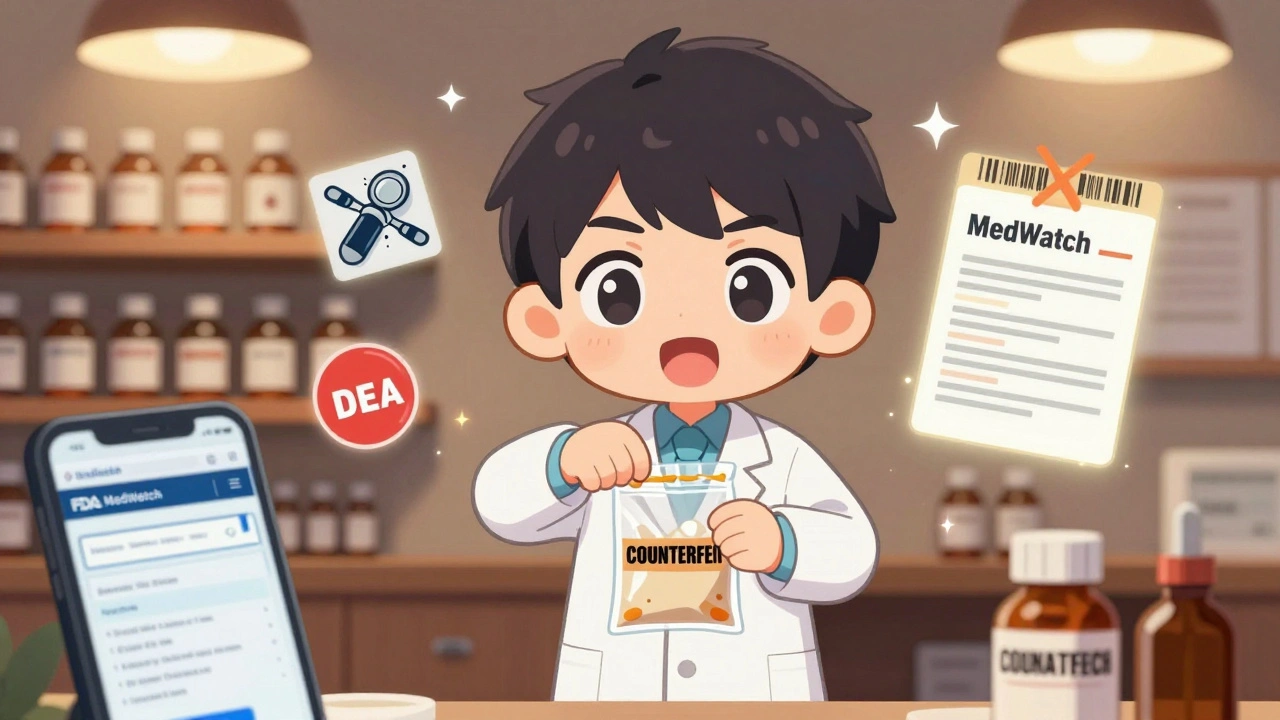
The U.S. has two main systems for reporting fake or tampered drugs: MedWatch and the DEA’s RxAbuse Tip Line.Use MedWatch for Most Cases
MedWatch is the FDA’s official system for reporting drug safety issues, including counterfeits. It’s free, confidential, and accepts reports from anyone-patients, caregivers, pharmacists, doctors. You can report online at fda.gov/medwatch using Form 3500, or call 1-800-FDA-1088. The form takes about 12-15 minutes to complete. What to include:- Product name (brand and generic)
- Batch or lot number
- Expiration date
- Manufacturer name and address
- Where and when you bought it
- Photos of packaging and pills
- Your contact info (optional, but helps if they need to follow up)
The FDA says reports submitted within 24 hours lead to product removal 4.2 times faster than those delayed beyond 72 hours. Speed matters.
Report Suspicious Prescriptions or Diversion to the DEA
If you suspect a prescription was forged, stolen, or sold illegally-especially for controlled substances like opioids, Adderall, or Xanax-call the DEA’s RxAbuse Tip Line at (571) 324-6499 or file online at dea.gov/diversion.They accept anonymous tips. The DEA says 73% of successful investigations in San Diego between 2018 and 2020 started with a tip from the public. If you see someone buying large quantities of pills with cash, or a pharmacy with no license posted, report it.
Reporting for Healthcare Professionals
If you’re a pharmacist, nurse, or doctor, you have legal responsibilities under the Drug Supply Chain Security Act (DSCSA), which became fully active in November 2023.- You must report suspected illegitimate products to the FDA within 24 hours.
- Use the 3911 platform in CDER NextGen (preferred) or email Form FDA 3911 to [email protected].
- Include the product’s serial number, lot number, and how you determined it was counterfeit.
Wholesale distributors and pharmacies had a compliance rate of only 82.3% in 2022. That means many are still missing deadlines. Don’t be one of them. Late reports delay recalls and put patients at risk.
For controlled substances in Canada, pharmacists must report theft or forgery to Health Canada within 10 days using their official guidance document CS-GD-005. In Ontario, fraudulent prescriptions must be emailed to [email protected] with full details.
What Happens After You Report?
Once you file a report, the FDA or DEA will review it. If it’s credible, they’ll:- Check if the batch number matches known counterfeit patterns
- Trace the supply chain to find where the product came from
- Issue public alerts if the product is still in circulation
- Work with customs, police, or international agencies if it crossed borders
Some reports lead to raids, seizures, or criminal charges. Others result in website takedowns or pharmacy license revocations.
But here’s the truth: not every report gets a follow-up. A 2022 FDA survey showed only 56% of consumers felt they received any response. If you don’t hear back in 10-14 days, call MedWatch again. Don’t assume it’s ignored.
Online Pharmacies: The Biggest Risk
Over 96% of online pharmacies selling drugs without a prescription are illegal, according to the National Association of Boards of Pharmacy. Many look professional-fake seals, real-looking websites, even fake “pharmacist” chatbots.Always check for:
- A physical U.S. address and phone number
- A licensed pharmacist available to answer questions
- The VIPPS seal (Verified Internet Pharmacy Practice Sites)
If you bought from a site without these, report it to the FDA and to the platform itself. Amazon received over 7,800 pharmaceutical counterfeit reports in 2022. They act on those. So do eBay and Etsy.
What Not to Do
- Don’t try to return it to the seller-some are scammers.
- Don’t post photos on social media without reporting it first-this can alert criminals to destroy evidence.
- Don’t wait for someone else to report it.
- Don’t assume it’s just a one-off. Counterfeiters operate in networks.
Global Reporting and Future Tools
The World Health Organization’s Global Surveillance and Monitoring System has tracked over 1,500 cases of fake drugs across 141 countries. If you bought medication abroad or suspect an imported product, report it to your national health authority.Some companies, like Novo Nordisk and Eli Lilly, have their own reporting channels. If you’re taking insulin or another branded drug, check the manufacturer’s website for a “Report a Counterfeit” link.
Looking ahead, the FDA is testing a smartphone app that lets you photograph a pill and automatically extract batch numbers and expiration dates. Early tests cut reporting time from 14 minutes to under 4. That’s coming soon.
Why This Matters
Fake medications don’t just hurt individuals-they weaken trust in the entire healthcare system. A single counterfeit insulin batch can kill dozens. A forged antibiotic can spread drug-resistant infections.When you report, you’re not just protecting yourself. You’re protecting your neighbor, your parent, your child. You’re helping regulators shut down criminal networks that prey on the sick.
There’s no reward, no public recognition. But you’re doing something that matters.
Frequently Asked Questions
Can I report a counterfeit medication if I didn’t buy it myself?
Yes. Anyone can report-family members, friends, neighbors, or even strangers who find suspicious pills. You don’t need to be the purchaser. If you saw someone selling fake insulin at a flea market or noticed a pharmacy with no license, report it. The FDA encourages all credible tips.
Will my identity be kept private?
Yes. Both MedWatch and the DEA’s tip line allow anonymous reporting. You can choose not to leave your name, phone number, or email. However, if you want updates or if investigators need to ask follow-up questions, providing contact info helps. Your details are protected under federal privacy laws.
What if I reported a fake drug but didn’t get a response?
Don’t assume it was ignored. The FDA receives over 300,000 reports annually. Some cases take weeks to investigate, especially if the product came from overseas. If you haven’t heard back in 14 days, call MedWatch at 1-800-FDA-1088 and ask for the status of your report. Have your confirmation number ready.
Can I report a medication that’s expired or stored improperly?
Yes, but only if you believe it was tampered with or is substandard. Expired medication alone isn’t counterfeit. But if the expiration date was altered, the packaging was opened and resealed, or the pills are discolored or crumbling, that’s a quality issue worth reporting. The FDA treats these as product quality problems under MedWatch.
Is there a reward for reporting counterfeit drugs?
No official reward exists for reporting counterfeit medications in the U.S. or Canada. The system is designed for public safety, not financial incentive. However, whistleblowers who provide information leading to criminal convictions may qualify for rewards under broader fraud statutes-but this is rare and applies only to large-scale operations.
How do I know if a pharmacy is legitimate?
Look for the VIPPS seal (Verified Internet Pharmacy Practice Sites) on online pharmacies. For physical pharmacies, check if a licensed pharmacist is on-site and if the pharmacy is listed in your state’s board of pharmacy directory. In the U.S., you can verify a pharmacy at nabp.pharmacy. If a pharmacy doesn’t require a prescription for controlled drugs, it’s illegal.
Next Steps
If you suspect a counterfeit medication today:- Stop using it immediately.
- Keep the product, packaging, and receipt.
- Take clear photos of the pills and labels.
- Report it to MedWatch online or by phone.
- If it’s a controlled substance, also call the DEA tip line.
- Warn others-especially if you bought it online.
You don’t need to be an expert to act. You just need to care enough to report. And that’s exactly what saves lives.


Frank Nouwens
December 11, 2025 AT 18:36Thank you for this incredibly thorough and well-structured guide. As someone who works in hospital compliance, I can tell you that clear, actionable reporting protocols like this are desperately needed. The inclusion of specific regulatory pathways-MedWatch, DEA, DSCSA-is invaluable.
I’ve seen too many cases where frontline staff hesitate to report because they’re unsure of the process. This document removes that barrier entirely.
Also, the note about high-resolution images increasing investigation success by 68%? That’s a game-changer. I’m printing this and distributing it to every pharmacy tech on my floor tomorrow.
Jack Appleby
December 12, 2025 AT 03:49Let’s be honest-most people don’t realize that counterfeit pharmaceuticals are a *global transnational criminal enterprise*, not some random shady pharmacy. The $205B market size? That’s larger than the GDP of 140+ countries. And the FDA’s 56% response rate? Pathetic. It’s not a bureaucratic hiccup-it’s institutional negligence.
And yet, here we are, asking patients to shoulder the burden of regulatory failure. You want to stop fakes? Prosecute the distributors. Seize the servers. Shut down the Chinese factories. Don’t make Grandma in Ohio photograph pill bottles while the real perpetrators laugh all the way to the Caymans.
Also, VIPPS? Please. I’ve seen legit-looking VIPPS sites that sold counterfeit insulin. The seal is a placebo. The system is broken. And you’re telling me to trust it?
Aileen Ferris
December 12, 2025 AT 20:36Michelle Edwards
December 14, 2025 AT 08:50This is such an important topic-and you’ve made it so accessible. Thank you for not overwhelming people with jargon. I’m a caregiver for my mom, and I’ve been terrified of her meds since her last refill looked… off. I didn’t know what to do until I read this.
I took photos, kept the bottle, and reported it yesterday. No response yet, but I’m holding onto hope. You’re right-we don’t need to be experts to act. Just to care.
If anyone else is nervous about reporting, please do it. You’re not just protecting yourself. You’re protecting people who can’t speak up.
Sarah Clifford
December 15, 2025 AT 18:56Regan Mears
December 16, 2025 AT 09:28Hey, Sarah-your comment is terrifying, but I’m glad you reported it. That’s brave. And you’re not alone.
Everyone: Please don’t dismiss fear as drama. Fear is the body’s way of saying, ‘Something’s wrong.’ And in this case, it’s right. Fake meds kill. We’ve lost people to this.
If you’re reading this and you’re scared, anxious, or overwhelmed-take a breath. You did the right thing. You kept the pills. You took photos. You reported. That’s more than most people will ever do.
And if you’re still worried? Call MedWatch again. Ask for the case number. Demand a response. You’re not being annoying-you’re being essential.
Ben Greening
December 17, 2025 AT 08:33While the emphasis on consumer reporting is commendable, it is worth noting that the primary responsibility for supply chain integrity lies with regulated entities-distributors, wholesalers, and manufacturers. The DSCSA mandates serialization and traceability for a reason.
Placing the onus on patients and even pharmacists to serve as de facto inspectors is an admission of systemic failure. The FDA should be conducting proactive audits, not relying on anecdotal submissions from the public.
That said, this guide remains a useful resource for those who encounter anomalies. Just don’t mistake it for a solution to the underlying regulatory gap.
David Palmer
December 18, 2025 AT 09:18matthew dendle
December 20, 2025 AT 01:51Aidan Stacey
December 21, 2025 AT 10:35THIS. THIS RIGHT HERE. This isn’t just about pills. It’s about dignity. It’s about trust. It’s about the fact that when you’re sick, the one thing you need is to believe that what you’re taking will help you-not hurt you.
I lost my brother to a fake antibiotic. He didn’t die from the infection. He died because the pills were sugar and chalk. And no one reported it because ‘it looked fine.’
If you’re reading this and you’re thinking, ‘It won’t happen to me’-I’m begging you: Don’t wait. Don’t assume. Don’t hope. Act.
You don’t need a degree. You don’t need a badge. You just need to be human.
Thank you for writing this. I’m sharing it with every group I’m in. We have to keep talking.