
Every year, thousands of people end up in the hospital not because of an infection or injury, but because of something they took to feel better. Drug-induced liver injury (DILI) is one of the most dangerous yet overlooked side effects of common medicines. It doesn’t always show up in blood tests right away. It doesn’t always come with obvious symptoms. And by the time it’s caught, the damage can be serious-sometimes even life-threatening.
Think about it: you take a pill for a headache, an antibiotic for a sinus infection, or a supplement for energy. You feel fine. But behind the scenes, your liver is working overtime to break down these substances. And sometimes, it can’t handle the load.
What Exactly Is Drug-Induced Liver Injury?
DILI happens when a medication, herbal product, or dietary supplement harms the liver. It’s not the same as liver damage from alcohol or hepatitis. This is damage caused by chemicals your body wasn’t designed to process in large or unusual amounts. The liver is your body’s main detox center, so it’s the first organ to react when something goes wrong.
There are two main types:
- Intrinsic DILI - predictable, happens when you take too much. Acetaminophen (Tylenol) is the classic example. If you take more than 4 grams in a day, you’re at risk. For older adults or people with existing liver issues, even 3 grams can be dangerous.
- Idiosyncratic DILI - unpredictable. You take the right dose, and it still harms your liver. This is the trickier kind. It affects only certain people, often without warning. It’s responsible for about 75% of all DILI cases.
The Top 5 High-Risk Medications
Not all drugs are created equal when it comes to liver risk. Some are fine for most people. Others? They’re quiet killers.
- Acetaminophen - The number one cause of acute liver failure in the U.S. It’s in more than 600 over-the-counter and prescription products. A single overdose of 7-10 grams can shut down your liver. Even regular use, especially with alcohol, can cause slow, silent damage.
- Amoxicillin-clavulanate - This common antibiotic for sinus and ear infections causes about 14% of all DILI cases. It’s not the dose that matters-it’s the person. Some people develop severe jaundice, itching, and fatigue weeks after finishing the course.
- Valproic acid - Used for epilepsy and bipolar disorder, this drug can cause liver injury in 0.5-1% of users. The risk jumps sharply in children under 2 and those on multiple seizure medications. Fatality rates in severe cases hit 10-20%.
- Isoniazid - A key drug for tuberculosis treatment. About 1% of people on isoniazid develop liver injury. The risk doubles after age 35. Symptoms often appear after 2-3 months, which is why many doctors miss the connection.
- Antiepileptic drugs like carbamazepine - These can trigger immune-mediated liver damage. The reaction can be delayed and severe, sometimes requiring a transplant.
And don’t forget about supplements. Herbal products are now linked to 20% of DILI cases in the U.S.-up from just 7% in the early 2000s. Green tea extract, anabolic steroids, and kava are among the worst offenders. People assume “natural” means safe. It doesn’t.
How Doctors Spot DILI
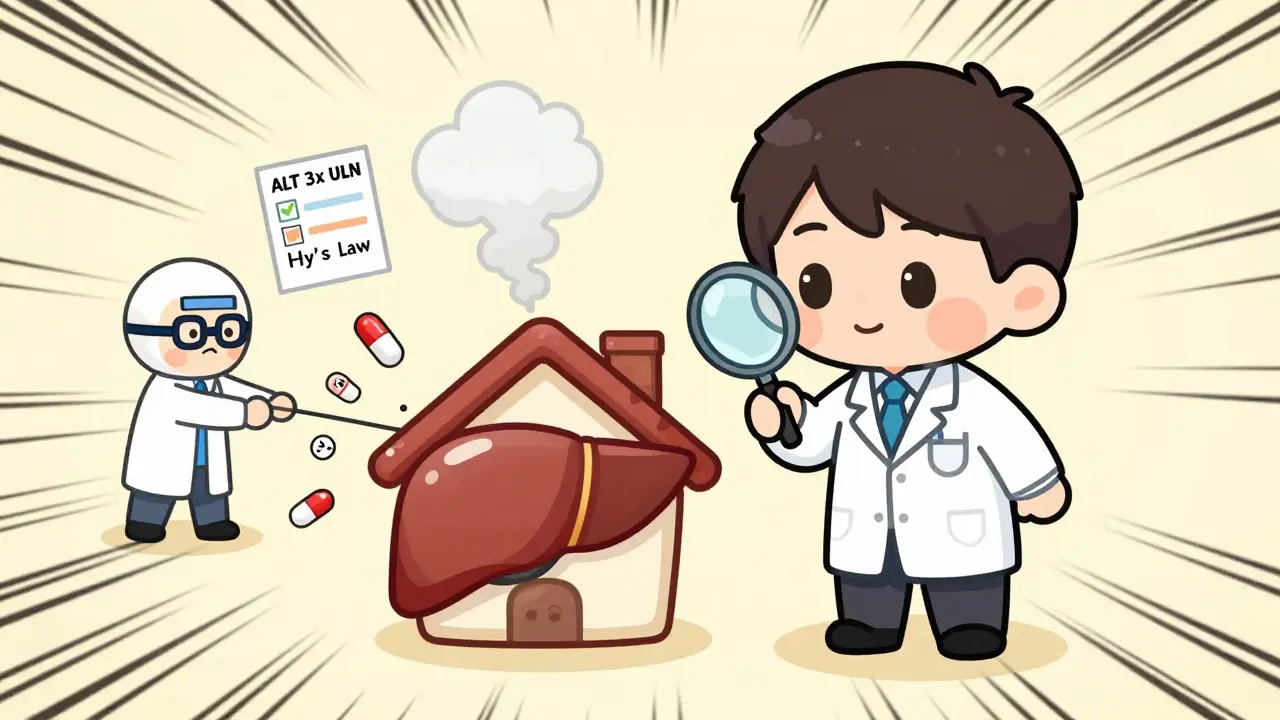
There’s no single test for DILI. It’s a diagnosis of exclusion. That means your doctor must rule out hepatitis, autoimmune disease, alcohol use, or fatty liver first.
The clues come from blood work:
- ALT above 3x the upper limit - This suggests hepatocellular injury (liver cells are dying). Seen with acetaminophen and isoniazid.
- ALP above 2x the upper limit - This points to cholestatic injury (bile flow is blocked). Common with amoxicillin-clavulanate.
- Hy’s Law - If both ALT/AST are over 3x ULN and bilirubin is over 2x ULN, there’s a 10-50% chance of acute liver failure. This is a red flag no doctor can ignore.
The RUCAM scoring system is the gold standard for confirming DILI. It looks at timing, dose, other causes, and how liver enzymes change after stopping the drug. A score of 8 or higher means “highly probable” DILI.
Who’s at Highest Risk?
It’s not random. Certain people are far more likely to develop DILI:
- Women - 63% of all cases occur in women.
- People over 55 - Age reduces liver regenerative capacity.
- Those on multiple medications - Polypharmacy increases the chance of dangerous interactions.
- People with existing liver disease - Even mild fatty liver makes the organ more vulnerable.
- Those with specific genetic markers - HLA-B*57:01 increases risk for flucloxacillin injury. HLA-DRB1*15:01 raises risk for amoxicillin-clavulanate damage.
And here’s the scary part: you can’t predict who it will hit. One person takes the same drug for years with no problem. Another gets sick after one dose. That’s why monitoring matters more than guessing.
How to Monitor for Liver Damage
Prevention isn’t about avoiding medicine. It’s about smart monitoring.
For high-risk drugs like isoniazid:
- Get a baseline liver test before starting.
- Check ALT, AST, and bilirubin every week for the first month.
- Then every two weeks for months 2-3.
- Then monthly after that.
- Stop the drug if ALT rises above 3-5x ULN-or if you develop nausea, fatigue, dark urine, or yellow skin.
For statins:
You don’t need routine liver tests. Severe injury is extremely rare-about 1 in 100,000 users per year. But if you feel unusually tired, lose your appetite, or notice your skin turning yellow, get checked right away.
For acetaminophen:
- Never exceed 3 grams per day if you’re over 65, drink alcohol, or have liver disease.
- Avoid combining it with alcohol.
- Check labels-many cold and pain meds contain it. You might be doubling up without knowing.
Pharmacists play a huge role. Studies show medication therapy management reduces DILI risk by 23% in people taking five or more drugs. A pharmacist can spot dangerous combinations before you even fill the prescription.
What Happens After DILI Is Diagnosed?
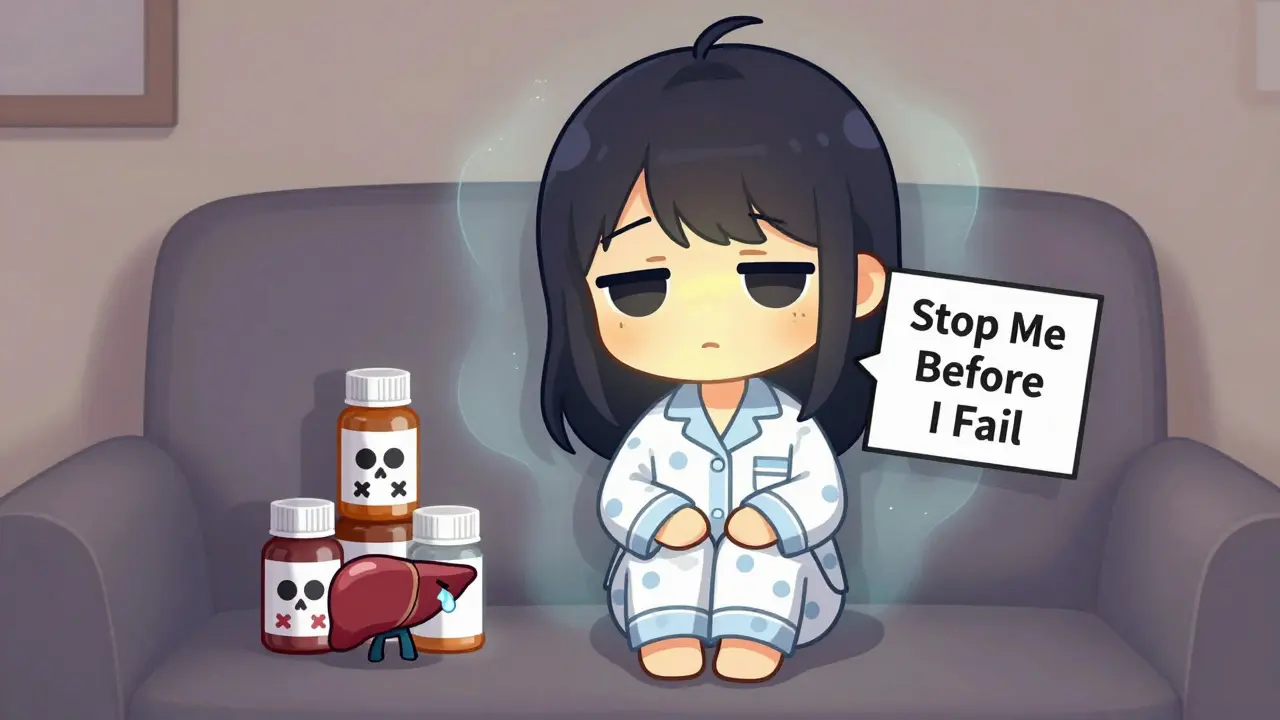
Step one: Stop the drug. That’s it. No magic pill. No special treatment. Just removal of the trigger.
Most people-about 90%-start to recover within 1-2 weeks. Liver enzymes drop. Symptoms fade. Full recovery can take 3-6 months.
But 12% of patients end up with permanent liver damage. A small number need a transplant. In the U.S., DILI causes about 13% of all liver transplants.
For acetaminophen overdose, there’s one lifesaving treatment: N-acetylcysteine (NAC). If given within 8 hours, it’s 100% effective. After 16 hours, effectiveness drops to 40%. Time is liver tissue.
Real Stories Behind the Numbers
A 45-year-old woman in Manchester took amoxicillin-clavulanate for a sinus infection. Three weeks later, her eyes turned yellow. Her skin itched constantly. It took three doctors and two months to connect it to the antibiotic. She didn’t fully recover for nine months.
A man on isoniazid for tuberculosis had his ALT spike to 1,200 (normal is under 40). He had no symptoms. His doctor didn’t order follow-up tests. By the time he was hospitalized, his liver was failing. It took six months to recover.
One Reddit user said, “It took four doctors and three months to realize my cholesterol pill was wrecking my liver.”
And then there’s the success story: a pharmacist noticed a patient was taking a new antibiotic and a seizure drug. She flagged the interaction before the first dose. No liver damage. No hospital stay. Just a quick call.
The Future of Prevention
Science is catching up. Researchers now use chemical analysis to predict which drugs are likely to harm the liver. The DILI-similarity score, developed in 2021, predicts risk with 82% accuracy.
New blood tests are coming. MicroRNA-122 rises before ALT does-giving doctors a 12-24 hour head start. Keratin-18 shows if liver cells are dying.
Hospitals are starting to use electronic alerts. If your doctor prescribes a high-risk combo, the system flags it. Early data shows this could prevent 15-20% of severe cases.
Genetic testing is no longer science fiction. If you’re about to take flucloxacillin or amoxicillin-clavulanate, a simple DNA test could tell you if you’re at high risk.
What You Can Do Today
You don’t need to fear medication. But you do need to be smart.
- Know what you’re taking. Check labels for acetaminophen in cold meds.
- Tell your doctor about every supplement, herb, or OTC pill you use.
- Ask: “Could this hurt my liver?” Especially if you’re over 50, female, or on multiple drugs.
- Don’t ignore fatigue, nausea, or yellowing skin. These aren’t “just a virus.”
- See your pharmacist. They’re trained to catch dangerous combinations.
The liver is quiet until it’s too late. Don’t wait for it to scream.



Denise Jordan
March 12, 2026 AT 06:40Kenneth Zieden-Weber
March 14, 2026 AT 00:39Chris Bird
March 14, 2026 AT 13:27Bridgette Pulliam
March 15, 2026 AT 16:36Mike Winter
March 16, 2026 AT 23:25Randall Walker
March 18, 2026 AT 13:17LiV Beau
March 18, 2026 AT 16:58Adam Kleinberg
March 20, 2026 AT 09:24Gene Forte
March 20, 2026 AT 13:00David L. Thomas
March 22, 2026 AT 09:31Miranda Varn-Harper
March 23, 2026 AT 03:03