
You just read a scary headline about a common medication causing heart issues. Before you panic or stop taking your pills, where do you go for the raw truth? You don't want a press release; you want the data. For anyone interested in drug safety, the U.S. Food and Drug Administration (FDA) offers a treasure trove of information through its Adverse Event Reporting System, widely known as FAERS. This is not just a list of complaints; it is the central nervous system of post-market drug surveillance in the United States.
But here is the catch: accessing this data isn't as simple as Googling a symptom. The database contains over 30 million reports, with roughly 2 million new ones added every year. If you dive in without knowing how the water works, you will drown in noise. Whether you are a researcher, a concerned patient, or a healthcare professional, understanding the tools, the transparency limits, and the technical realities of FAERS is crucial. Let’s break down exactly how to access this data, what it can tell you, and-just as importantly-what it cannot.
Understanding the Beast: What Is FAERS?
To use FAERS effectively, you first need to understand what it actually is. It is a computerized database established by the FDA to support safety monitoring for approved drugs and therapeutic biologics. Launched in 1969, it has evolved into a sophisticated electronic system. Its primary job is to identify potential safety signals that might require further investigation, label changes, or even regulatory action.
Think of FAERS as a massive collection of Individual Case Safety Reports (ICSRs). Each report contains specific details: patient demographics (like initials, date of birth, and gender), drug information (name, dose, start/stop dates), and adverse event descriptions coded using the Medical Dictionary for Regulatory Activities (MedDRA). There is also reporter information and outcomes.
Where does this data come from? About 75% of reports come from pharmaceutical manufacturers, who are legally required to submit them following strict standards. The remaining 25% come directly to the FDA through the MedWatch program from healthcare professionals and consumers. To get into the system, a report must have at least four elements: an identifiable reporter, an identifiable patient, one adverse event or outcome, and one suspect or interacting drug.
The Three Ways to Access FAERS Data
You don’t need to be a software engineer to look at FAERS, but your options depend on your technical comfort level. The FDA provides three main avenues for public access, each serving a different purpose.
- The FAERS Public Dashboard: This is the most user-friendly option. Launched recently, it is a highly interactive web-based tool. You can filter and analyze data by drug, adverse event, patient demographics, and time periods without writing a single line of code. It’s perfect for initial exploration. If you want to see if there’s a spike in liver toxicity reports for a specific statin over the last two years, this is your starting point.
- Quarterly Data Extracts: For those who want the raw material, the FDA releases data quarterly in ASCII and XML formats. These files are large-ranging from 1GB to 5GB-and require programming skills to process. They are ideal for researchers who need to perform complex statistical analyses or integrate FAERS data with other datasets.
- The OpenFDA API: If you are a developer or data scientist, the OpenFDA API provides JSON-formatted data. This allows you to build custom applications or dashboards that pull real-time safety data. It’s powerful but requires knowledge of API queries and data handling.
Each method has its place. The dashboard gives you quick visual insights. The extracts give you depth. The API gives you flexibility. Most serious projects start with the dashboard to form hypotheses and then move to the extracts or API to test them.
Navigating the Technical Hurdles: MedDRA and E2B(R3)
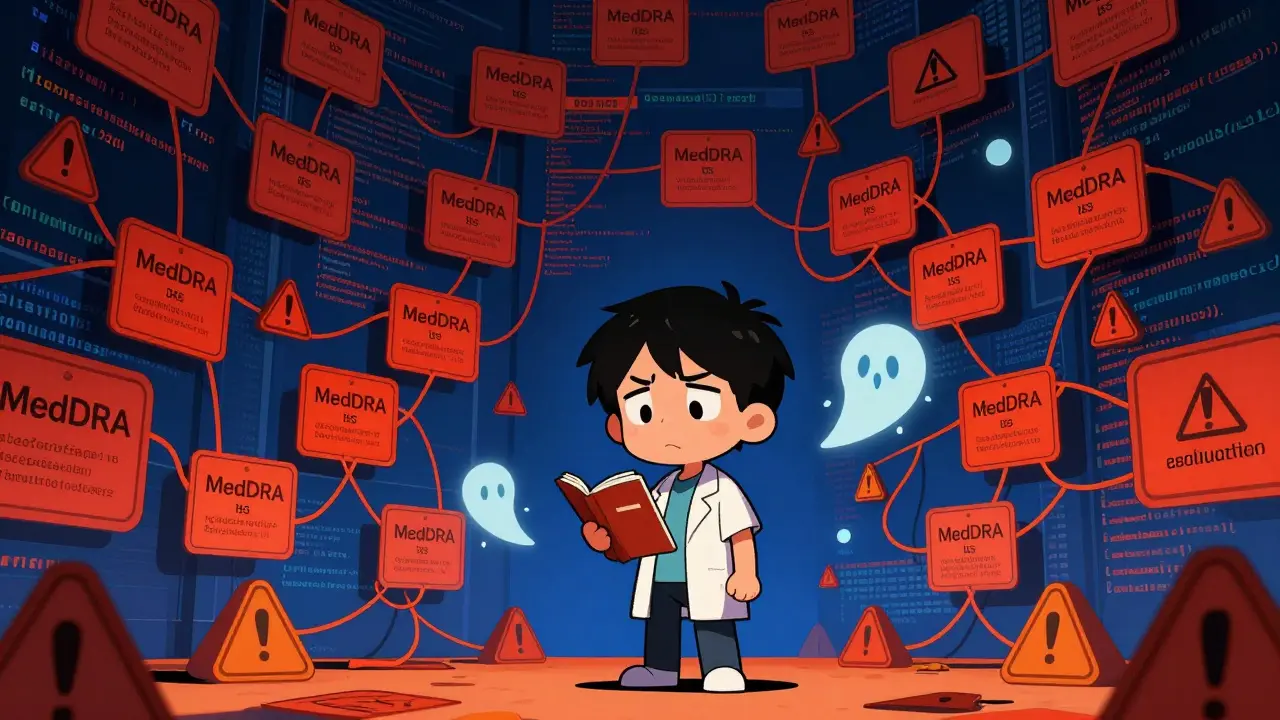
One of the biggest barriers to entry for FAERS is the language it speaks. The adverse events aren’t described in plain English; they are coded using MedDRA (Medical Dictionary for Regulatory Activities). MedDRA is a hierarchical terminology system used globally for regulatory purposes. Learning how to navigate its structure-moving from broad categories like 'Cardiac disorders' down to specific terms like 'Myocardial infarction'-takes time. Surveys suggest it takes users 40-60 hours to become proficient.
Then there is the submission standard. As of January 16, 2024, the FDA began accepting electronic submissions in the ICH E2B(R3) format, replacing the older E2B(R2) standard. This update increases data granularity and semantic interoperability. For industry players submitting data via the FDA Electronic Submission Gateway (ESG) or the Safety Reporting Portal (SRP), this means stricter XML formatting requirements. For public users, it means the data structure in the quarterly extracts may change, requiring updates to any automated parsing scripts you have built.
| Feature | Public Dashboard | Quarterly Extracts | OpenFDA API |
|---|---|---|---|
| Technical Skill Required | None (Web-based) | High (Programming needed) | Medium-High (API knowledge) |
| Data Freshness | Quarterly updates | Quarterly releases | Near real-time (varies) |
| Best For | Initial exploration, trends | Deep statistical analysis | Custom apps, integration |
| File Format | Visualizations | ASCII, XML | JSON |
| Cost | Free | Free | Free (with rate limits) |
The Critical Limitations: Why Correlation Isn’t Causation
This is the most important section for anyone interpreting FAERS data. You must understand that FAERS data alone does not prove that a drug caused an adverse event. The FDA explicitly states this in its documentation. Here is why:
- No Denominator Data: FAERS tells you how many people reported a side effect, but it doesn’t tell you how many people took the drug. If 100 people report nausea for Drug A and 1 person reports it for Drug B, it doesn’t mean Drug A is more dangerous. Drug A might be taken by millions, while Drug B is rare. Without knowing the total number of patients exposed (the denominator), you cannot calculate incidence rates.
- Reporting Bias: Not all events are reported equally. Healthcare professionals are more likely to report serious events. Consumers are more likely to report events for medications they self-administer or those that have been in the news. This creates a skewed picture of reality.
- Variable Data Quality: Approximately 30% of reports contain missing or inconsistent data elements. Some reports are brief notes; others are detailed medical histories. This inconsistency complicates analysis.
- Lack of Verification: The FDA does not verify the accuracy of individual reports before they enter the database. They are spontaneous reports, meaning they are submitted voluntarily without independent confirmation of causality.
Dr. Robert Ball, Deputy Director of the FDA's Office of Surveillance and Epidemiology, emphasizes that data mining generates hypotheses, not proofs. Statistical associations identified in FAERS require further clinical or epidemiological study to confirm causation. Always treat FAERS findings as signals to investigate, not as final verdicts.
Who Uses FAERS and How?
The user base for FAERS is diverse. According to FDA analytics from Q4 2023, academic institutions account for 55% of public data users, pharmaceutical companies for 30%, and patient advocacy groups for 15%. Each group uses the data differently.
Academics and Researchers: They often use FAERS to detect rare adverse events that were not observed during clinical trials. With the rise of real-world evidence studies, academic usage has increased by 35% annually since 2020. They frequently combine FAERS data with other sources to address the denominator problem.
Pharmaceutical Companies: All top 50 global pharma companies use FAERS data as part of their pharmacovigilance systems. However, they rarely use the public tools directly. Instead, they rely on commercial platforms like Oracle Argus Safety or ArisGlobal's LifeSphere, which offer advanced signal detection capabilities and integrate with electronic health records. These platforms cost between $50,000 and $200,000 annually, highlighting the value of FAERS’ free public access for smaller organizations.
Patient Advocacy Groups: These groups use FAERS to identify potential safety concerns affecting their communities. For example, in 2022, a patient advocate group used FAERS data to identify a previously unrecognized interaction between a common antidepressant and a diabetes medication that affected approximately 1 in 10,000 patients. This kind of grassroots surveillance can complement official regulatory efforts.

Future Directions: AI, Integration, and Transparency
The landscape of pharmacovigilance is evolving rapidly. The global market is projected to reach $8.2 billion by 2027. FAERS is adapting to meet these changes. One major development is the transition to ICH E2B(R3) submissions, which improves data quality and interoperability. Looking ahead, the FDA plans to enhance the Public Dashboard with natural language processing capabilities by Q3 2025. This will make searching for specific symptoms or narratives much easier, reducing the reliance on complex MedDRA codes for casual users.
There is also a push toward integrating FAERS with other real-world data sources, such as electronic health records and claims databases. Pilot projects under the FDA's Sentinel Initiative aim to provide more context for adverse event reports, helping to solve the denominator problem. By 2027, experts predict that FAERS will be more deeply integrated with these sources, offering a richer, more contextual view of drug safety.
However, challenges remain. Data privacy is a constant concern, as the system contains personally identifiable information. The HHS Privacy Impact Assessment notes that access to sensitive data is strictly controlled, with administrators granting only the minimal amount of information necessary. As data volumes grow at 15% annually, maintaining data quality and security will be an ongoing priority.
Practical Tips for Getting Started
If you are ready to explore FAERS, here are some practical steps to ensure you get the most out of it:
- Start Simple: Begin with the Public Dashboard. Spend an hour exploring the interface. Try filtering by a drug you know well and look at the top reported adverse events. Get a feel for the data distribution.
- Learn MedDRA Basics: You don’t need to memorize the entire dictionary, but understand the hierarchy. Learn how to search for a term and find its parent and child nodes. This will help you avoid missing relevant reports due to coding variations.
- Check the Date: Always note the quarter of the data extract you are using. Safety profiles can change over time, especially after new warnings are issued. Comparing data across quarters can reveal trends.
- Use Support Resources: The FDA provides comprehensive tooltips and guided tutorials on the dashboard. If you get stuck, email [email protected]. They typically respond within 3-5 business days. Attend the quarterly webinars if possible; they often cover new features and best practices.
- Validate Your Findings: Never draw conclusions based solely on FAERS data. Cross-reference with clinical literature, FDA drug labels, and other pharmacovigilance databases like the European Medicines Agency’s EudraVigilance or WHO’s VigiBase.
Accessing FDA adverse event databases is a powerful way to engage with drug safety transparency. But remember, the data is a tool for hypothesis generation, not proof. Use it wisely, interpret it critically, and always keep the bigger clinical picture in mind.
Is FAERS data free to access?
Yes, the FAERS Public Dashboard, quarterly data extracts, and the OpenFDA API are all free to access for the public. However, commercial platforms that integrate and analyze this data may charge fees.
Can I use FAERS to prove a drug caused my side effect?
No. FAERS data shows associations, not causation. It lacks denominator data (total patients exposed) and verification of individual reports. It is designed to generate safety signals for further investigation, not to diagnose individual cases.
How often is FAERS data updated?
The FDA releases data extracts quarterly. The Public Dashboard reflects these quarterly updates. While reports are submitted continuously, the public-facing data is batched and released every three months.
What is MedDRA and why is it important?
MedDRA (Medical Dictionary for Regulatory Activities) is the standardized terminology used to code adverse events in FAERS. Understanding its hierarchical structure is essential for accurate data retrieval and analysis, as symptoms are categorized into specific terms rather than free-text descriptions.
How does FAERS compare to other global databases?
FAERS offers more comprehensive public access than the European Medicines Agency's EudraVigilance, which restricts direct public access to individual case reports. While the WHO's VigiBase contains data from over 130 countries, FAERS provides more structured public query tools through its dashboard and API.
Do I need programming skills to use FAERS?
Not necessarily. The FAERS Public Dashboard requires no technical skills and can be learned in 1-2 hours. However, analyzing the raw quarterly data extracts or using the OpenFDA API requires programming knowledge in languages like Python or R.
What is the ICH E2B(R3) standard?
ICH E2B(R3) is the updated international standard for electronic transmission of Individual Case Safety Reports. The FDA began accepting submissions in this format in January 2024, replacing E2B(R2). It improves data granularity and interoperability.





Cecilia McGuinness
June 11, 2026 AT 11:56honestly this is such a relief to read because i was so confused about where to even start looking for real data on my meds
the part about the dashboard being user friendly makes me wanna try it out tonight instead of just panicking over headlines like usual
Talilla Bailey
June 12, 2026 AT 08:04It is imperative that we recognize the structural integrity of these reporting mechanisms. The transition to ICH E2B(R3) signifies a rigorous standardization that must be respected by all stakeholders in the pharmacovigilance ecosystem. We cannot allow casual interpretation to undermine the scientific validity of the dataset.
Aditya Singh
June 14, 2026 AT 06:13This is a fantastic breakdown of the FAERS architecture and its utility in post-market surveillance! As someone working in health informatics in India, I often see how critical MedDRA coding proficiency is for accurate signal detection. The shift to E2B(R3) will definitely enhance semantic interoperability across global regulatory bodies, which is huge for cross-border drug safety analysis. Great job highlighting the denominator problem too!
Brett Webster
June 14, 2026 AT 16:10If you are planning to dive into the quarterly extracts, I highly recommend setting up a local SQL database first. Handling 5GB XML files in memory is a nightmare for most consumer laptops. Also, don't sleep on the OpenFDA API rate limits; they can throttle you hard if you aren't careful with your query batching. Happy to share some Python snippets if anyone wants them.
Sherry Wheeler
June 15, 2026 AT 08:26Oh my gosh, reading this feels like uncovering a secret language that big pharma has been hiding from us! It is terrifying to think that 30% of the reports have missing data, but also empowering to know we can dig deeper ourselves. I feel like I need to learn MedDRA immediately because how else can we truly understand what our bodies are going through? This changes everything for patient advocacy!
shreya sinha
June 16, 2026 AT 04:22While the author attempts to present a comprehensive overview of the FDA's Adverse Event Reporting System, one must critically evaluate the inherent biases and limitations that render much of this public data practically useless for individual clinical decision-making. The sheer volume of unverified spontaneous reports, coupled with the lack of denominator data, creates a statistical noise floor that obscures any meaningful signal, thereby leading well-meaning but uninformed individuals to draw erroneous conclusions about drug causality without understanding the complex epidemiological context required to interpret such associations correctly.
Lee Coates
June 16, 2026 AT 07:42Lol another day another government database full of garbage data :P
Like seriously who thinks this proves anything? Just shows how broken the whole system is here in the US while other countries actually care about their people. Typical bureaucratic waste of time.
Miranda River
June 17, 2026 AT 18:07i mean lets be real the meddra thing is total gibberish to normal humans lol
why do they make it so hard to find out if your pills are killing you? seems like a conspiracy to keep us in the dark or maybe they just dont care either way its frustrating af
Brandon Brodsky
June 19, 2026 AT 06:46Oh please, spare me the melodrama. You think learning a medical dictionary is 'gibberish'? Try spending ten years in clinical research before you whine about standardized terminology. The system works fine for those who actually put in the effort to understand it rather than expecting hand-holding.
Ganesh Honikol
June 19, 2026 AT 08:42I would like to gently suggest that perhaps we should approach this topic with a bit more patience and understanding, as the complexity of MedDRA is indeed daunting for laypersons, yet it serves a vital purpose in ensuring precise communication among healthcare professionals worldwide. Emoticons aside, let us remember that every step towards transparency, no matter how technical, is a step forward for public health safety. :)
Callie Skipper
June 19, 2026 AT 15:39just started playing with the dashboard today and wow there is so much stuff there
didnt realize how many reports were coming in every quarter honestly pretty wild
AnneKatherine Stiekes
June 21, 2026 AT 08:36its really interesting how different groups use this data like academics vs patients
maybe we should all just stick to the dashboard for now until we get better at reading the codes