If you’ve been told you’re allergic to penicillin or another antibiotic, you might be carrying around a label that’s not even true. About 10% of people in the U.S. say they’re allergic to penicillin, but when tested properly, fewer than 1% actually are. That’s not just a small mistake-it’s a big health risk. People with unverified penicillin allergies are given stronger, more expensive antibiotics 69% more often, which drives up costs, increases side effects, and fuels antibiotic resistance. The good news? You can find out for sure with a simple, safe, and highly accurate allergy test.
Why Testing Matters More Than You Think
A penicillin allergy label sticks with you for life-even if it’s wrong. That means doctors avoid the best, safest, and cheapest antibiotics for you. Instead, they reach for alternatives like vancomycin, clindamycin, or daptomycin. These drugs aren’t just pricier-they’re more likely to cause diarrhea, kidney damage, or dangerous infections like C. diff. One patient in a 2023 study switched from daptomycin ($1,850 per dose) to penicillin ($12 per dose) after testing. Their annual antibiotic cost dropped from $67,525 to just $4,380. That’s not just savings-it’s better care.Testing doesn’t just save money. It saves lives. People who get the right antibiotic for their infection recover faster, spend fewer days in the hospital, and have fewer complications. Studies show that after testing, patients are 87% more likely to get the first-choice antibiotic, and infection-related complications drop by 32%. Each confirmed non-allergy prevents about 670 extra days of broad-spectrum antibiotic use over a person’s lifetime.
What You Need to Stop Taking Before the Test
The most important step in preparing for antibiotic allergy testing is stopping certain medications. If you don’t, the test won’t work. Antihistamines block the allergic response, so they can hide a real allergy-even if you’re truly allergic.You need to stop:
- First-generation antihistamines like diphenhydramine (Benadryl) and hydroxyzine at least 72 hours before testing.
- Second-generation antihistamines like cetirizine (Zyrtec), loratadine (Claritin), fexofenadine (Allegra), and levocetirizine (Xyzal) for a full 7 days.
- Tricyclic antidepressants like doxepin-these have strong antihistamine effects-14 days before the test.
You can keep taking your regular medications for blood pressure, diabetes, or thyroid issues. But tell your allergist about every pill, patch, or supplement you use. Some blood pressure drugs, like ACE inhibitors, can make an allergic reaction harder to treat if one happens. Beta-blockers can mask early warning signs of anaphylaxis, so your doctor will watch you extra closely if you’re on them.
What Happens During the Test
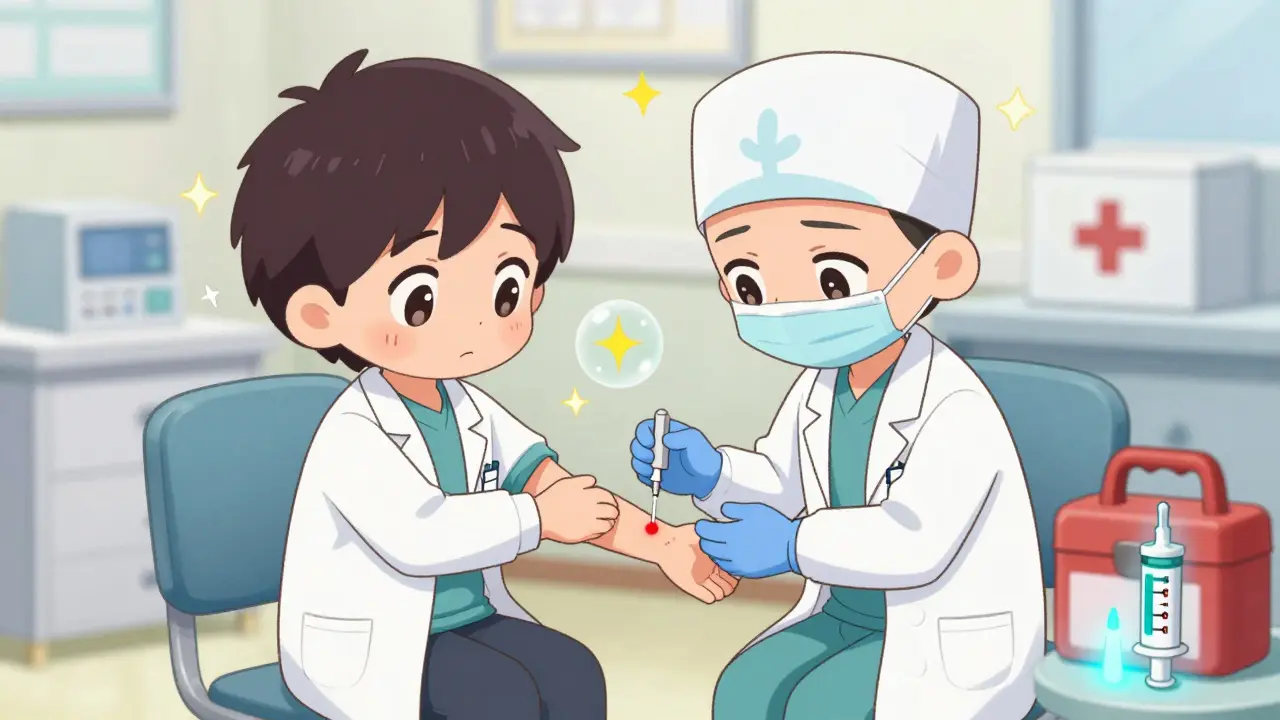
Antibiotic allergy testing is done in three steps, all in a medical setting where emergency tools are ready. It’s not scary, but it’s not something you do at home.Step 1: Skin Prick Test
A tiny drop of penicillin solution is placed on your skin-usually your forearm or back. A small plastic device gently pricks the skin through the drop. It doesn’t hurt much-most people say it feels like a light mosquito bite. If you’re allergic, a red, itchy bump will show up within 15 to 20 minutes. The risk of a serious reaction here is less than 0.01%.
Step 2: Intradermal Test
If the skin prick is negative, the next step is a tiny injection under the skin with more concentrated penicillin. This forms a small bubble (called a bleb). Again, if you’re allergic, you’ll see redness or swelling bigger than 3mm. This step is more sensitive than the skin prick and catches allergies the first test might miss.
Step 3: Oral Challenge
If both skin tests are negative, you’ll get an oral challenge. You’ll swallow a small dose-10% of a normal antibiotic pill. You’ll be watched for 30 minutes. If nothing happens, you’ll take the full dose and be monitored for another 60 minutes. Most people feel nothing. Some report mild stomach upset or itching, but these aren’t always signs of allergy. In fact, about 5-7% of people have these symptoms even when they’re not allergic.
The chance of a severe reaction during the whole process is about 0.06%. That’s less than 1 in 1,000. Epinephrine, oxygen, and other emergency tools are always right there.
What a Positive or Negative Result Means
A positive skin test means you likely have a true allergy. That’s confirmed with a 95-98% accuracy rate. But a negative result? That’s even more powerful. It means you’re not allergic. You can safely take penicillin and similar antibiotics like amoxicillin, cephalexin, and aztreonam.
And here’s something most people don’t know: allergies fade over time. About half of people who had a serious reaction to penicillin as a child lose the allergy within five years. Eighty percent lose it within ten. If you were told you were allergic as a kid, it’s worth getting tested again-even if it’s been decades.
Some people get delayed reactions-itchy, red skin at the test site 4 to 8 hours later. That happens in about 15% of cases. It’s not dangerous. Just use an over-the-counter hydrocortisone cream and it’ll go away.
What to Expect After the Test
Most people feel fine after testing. You might have slight redness or itching where the skin was pricked. That fades in a few hours. You can go back to your normal activities right away. You can also restart your antihistamines the day after the test.
If the test is negative, your allergist will give you a letter or card confirming you’re not allergic. Keep it with your medical records. Tell every doctor you see-from your dentist to your ER provider. That way, you’ll get the right antibiotic next time you’re sick.
Some patients say the hardest part wasn’t the test-it was the waiting. Stopping your allergy meds for a week feels like a hassle. One patient on Reddit said, “I had to go back to sneezing and itchy eyes for a week. But when I got the results, I realized I’d been avoiding penicillin for 20 years for nothing.”

Who Should Get Tested?
You should consider testing if:
- You were told you’re allergic to penicillin or another antibiotic, but you’re not sure why.
- You had a reaction as a child and haven’t been tested since.
- You’ve been prescribed broad-spectrum antibiotics more than once.
- You’re preparing for surgery or a procedure where penicillin is the best choice.
- Your doctor says you need an antibiotic you’re “allergic” to.
You don’t need testing if you’ve had a confirmed anaphylactic reaction (trouble breathing, throat swelling, low blood pressure) after taking the drug. Those cases are usually real allergies. But even then, retesting after 10 years may be safe and helpful.
What If You Can’t Find an Allergist?
Only 17% of primary care doctors follow testing guidelines, and 63% of rural U.S. counties have no allergist at all. That’s a big barrier. But things are changing. In 2024, a pilot program at UCSF showed that with video supervision, low-risk patients could safely do the oral challenge at home. The success rate was 94.7%. If this expands, testing could become as easy as a telehealth visit.
For now, ask your doctor for a referral. If they don’t know where to send you, call your local hospital’s allergy department. Most academic medical centers have dedicated antibiotic allergy clinics. Don’t wait-your next infection might be the one where the right antibiotic makes all the difference.
What’s Next for Antibiotic Allergy Testing?
Right now, skin testing is the gold standard. Blood tests for penicillin allergy? They’re not reliable. Don’t waste your time on them. But research is moving fast. In 2023, the NIH gave $2.4 million to develop a simple blood test that could replace skin testing within the next five years. That could make testing available in every doctor’s office, not just allergy clinics.
By 2027, the Infectious Diseases Society of America expects 75% of U.S. hospitals to have formal “de-labeling” programs-meaning they’ll actively test patients with old allergy labels. That could prevent 120,000 unnecessary courses of broad-spectrum antibiotics every year.
This isn’t just about one drug. It’s about using antibiotics wisely. Every time we avoid an unnecessary broad-spectrum antibiotic, we slow down the rise of superbugs. That’s good for you. It’s good for your family. It’s good for everyone.
Can I take antihistamines before my antibiotic allergy test?
No. You must stop all antihistamines before testing. First-generation ones like Benadryl need to be stopped 72 hours before. Second-generation ones like Zyrtec and Claritin need 7 full days. Even if you’re not feeling itchy, stopping them is critical-otherwise, the test might miss a real allergy.
Is the skin test painful?
Not really. The skin prick feels like a quick, light scratch-like a mosquito bite. The intradermal injection is a tiny pinch. Most people say it’s much less uncomfortable than they expected. The oral challenge is just swallowing a pill.
How long does the whole test take?
The skin tests take about 30 to 45 minutes total. If you need an oral challenge, plan for 2 to 3 hours. You’ll be monitored closely the whole time. Most people are done by early afternoon.
Can I get tested if I’m pregnant?
Yes. Skin testing and oral challenges are considered safe during pregnancy when done in a controlled medical setting. The benefits of using the right antibiotic often outweigh the risks of avoiding it. Always tell your allergist you’re pregnant so they can adjust monitoring.
What if I react during the test?
Reactions are rare, but the team is ready. If you have a mild reaction-like hives or itching-they’ll give you antihistamines. If it’s more serious, like trouble breathing or swelling, they’ll give you epinephrine right away. All testing centers have emergency equipment on hand. This is a routine procedure with a very low risk.
Will my insurance cover this test?
Most insurance plans cover allergy testing for antibiotics, especially if you have a documented history of a reaction. Some require a referral from your primary doctor. Ask your allergist’s office-they’ll help you check coverage before scheduling.
Can I be tested for other antibiotics besides penicillin?
Penicillin is the only antibiotic with a standardized, reliable test. For other drugs like sulfa, vancomycin, or cephalosporins, testing is less reliable and often done only in special cases. If you think you’re allergic to another antibiotic, talk to your allergist-they’ll help determine if testing is appropriate.




Jay Powers
January 11, 2026 AT 19:52Been told I'm allergic to penicillin since I was 12 after a rash that probably was just heat
Turns out I've been getting clindamycin for every sinus infection for 15 years
Cost me thousands and gave me C. diff twice
Just got tested last month and turned out negative
Now I'm taking amoxicillin like it's candy and my bills dropped by 90%
Alice Elanora Shepherd
January 13, 2026 AT 09:07It's astonishing, isn't it, how many of us carry these labels without ever questioning them? I had a similar experience: diagnosed with penicillin allergy at age eight, based on a vague family history and a single episode of mild hives. I never questioned it-until I needed a course of antibiotics during pregnancy, and my OB insisted on testing. The skin test? Barely a pinch. The result? Negative. I now have a card in my wallet, and I make sure every provider sees it. It's not just about cost-it's about safety, precision, and dignity in care.
Christina Widodo
January 13, 2026 AT 18:09Wait so if I stopped taking Zyrtec last week, does that mean I can get tested next week? I've been avoiding amoxicillin since I was 5 because my mom said I got sick after taking it as a kid. I'm 32 now. I've had like 8 rounds of stronger antibiotics. I just want to know if I can actually take the good stuff without dying lol
Prachi Chauhan
January 13, 2026 AT 21:47Think about this: we treat allergies like tattoos-permanent ink on the soul. But the body forgets. The immune system changes. What was a threat at 5 may be noise at 40. We hold onto fear like it's wisdom. But science says: test. Don't assume. Let your cells decide, not your childhood memory. And if you're scared? Go with someone. Bring a book. Sit in the chair. Breathe. The needle is small. The truth is bigger.
Katherine Carlock
January 15, 2026 AT 10:20I’m telling everyone I know about this. My sister got tested after 25 years of avoiding penicillin-she got a rash once when she was 7 and it stuck. She was on vancomycin for a UTI last year and ended up in the hospital with kidney issues. After the test? She’s now on amoxicillin like it’s water. No side effects. No drama. Just a $12 pill that saved her. Please, if you’ve been labeled, get tested. It’s not a big deal. It’s life-changing.
Cassie Widders
January 17, 2026 AT 09:57My mom had the same thing. Told she was allergic. Never tested. Died of sepsis from an untreated tooth infection because they gave her something that didn’t work. I got tested last year. Negative. I cried in the waiting room. Not from fear. From anger. Why didn’t anyone tell us this was an option?
Amanda Eichstaedt
January 18, 2026 AT 10:20I work in a rural clinic in Kentucky. We see this all the time. Patients come in with a scribbled note in their chart: ‘Penicillin Allergic.’ No details. No history. No documentation. We can’t test them here. No allergist for 70 miles. We’re stuck giving them drugs that cost 100x more and cause more side effects. It’s not just individual-it’s systemic. We need telehealth testing. We need policy change. We need to stop letting outdated labels kill people slowly with bad medicine.
jordan shiyangeni
January 20, 2026 AT 04:29Let me be perfectly clear: if you are one of those people who casually claims a penicillin allergy based on a childhood rash or a vague family anecdote, you are not just misinformed-you are endangering public health. Antibiotic resistance is not a buzzword; it is a global emergency. Every time you avoid penicillin without confirmation, you contribute to the overuse of broad-spectrum agents that select for multidrug-resistant organisms. Your laziness is not a personal choice-it is a biological liability. The fact that you would rather endure a week of antihistamine withdrawal than get a simple skin test reveals a profound disrespect for science, for medicine, and for the lives of others who may one day be infected by the superbugs your ignorance helps breed.
TiM Vince
January 21, 2026 AT 05:37My brother got tested after being told he was allergic for 30 years. Turned out he had a reaction to the dye in the pill, not the antibiotic. He’s now on penicillin for his pneumonia and feels great. The real tragedy? He almost died last year because they gave him something that didn’t work. He didn’t know he could get tested. No one told him. That’s the problem-not the test. The silence.
gary ysturiz
January 23, 2026 AT 05:11You’re not broken. You’re mislabeled. That’s it. You were told you were allergic, and now you’re living in a cage of fear. But the key? You hold it. You can unlock it. One test. One hour. One chance to live better. Don’t wait for your next infection. Don’t wait for your doctor to bring it up. Go. Ask. Demand. Your body deserves the right medicine-not the safe one. The best one. And you’ve earned that right.
Jessica Bnouzalim
January 24, 2026 AT 01:51Okay so I stopped Zyrtec last Monday and now I’m sneezing like a cartoon character 😭 but I’m doing it for science! Got my appointment for next week. I’ve been avoiding amoxicillin since I was 4 because my grandma said I got sick after taking it. I’m 28 and I’ve had 7 rounds of antibiotics in the last 5 years. I’m so ready to be free. Also-why is no one talking about this on TikTok? This needs to be a trend.
laura manning
January 25, 2026 AT 14:32While the data presented in this article is statistically compelling, the methodological limitations of skin prick testing and oral challenge protocols remain inadequately addressed. Specifically, the false-negative rate of 2-5% is not sufficiently contextualized, nor is the potential for delayed hypersensitivity reactions-particularly those occurring beyond the 8-hour observation window-adequately accounted for in the clinical recommendations. Furthermore, the article’s casual dismissal of blood-based IgE assays as 'unreliable' is misleading, as newer immunoassays (e.g., basophil activation tests) demonstrate promising sensitivity in specific populations. The omission of these nuances constitutes a disservice to informed patient decision-making.