Vitamin K Intake Calculator for Warfarin Patients
Add Your Daily Vitamin K Sources
Your Daily Vitamin K Intake
Your Current Intake
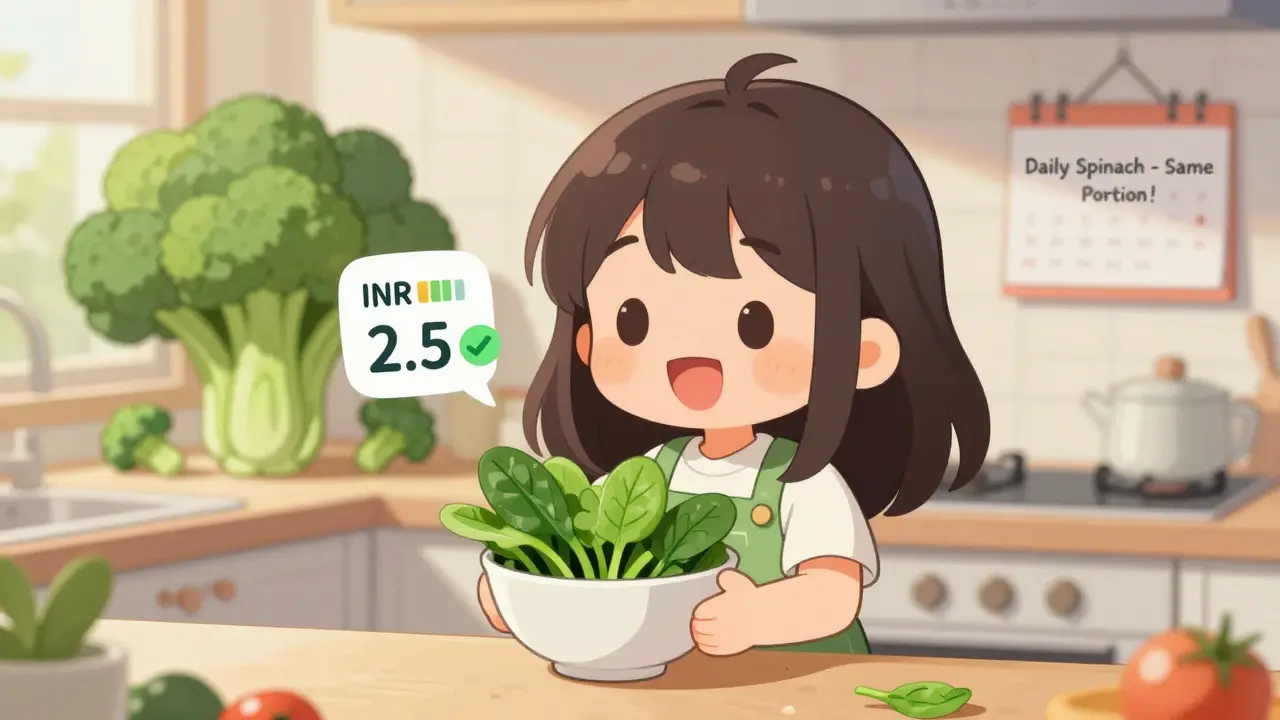
When you're on warfarin, your body is walking a tightrope. Too much blood thinning, and you risk dangerous bleeding. Too little, and clots can form - leading to stroke, heart attack, or pulmonary embolism. The key to staying balanced isn’t avoiding vitamin K. It’s consistency.
Why Vitamin K Matters on Warfarin
Warfarin works by blocking vitamin K from helping your blood clot. That’s how it prevents dangerous clots. But vitamin K doesn’t disappear from your body - it’s in your food. Every time you eat leafy greens, broccoli, or Brussels sprouts, you’re giving your body a dose of vitamin K1 (phylloquinone). If your intake jumps up one day and drops the next, your INR (the measure of how long your blood takes to clot) will swing like a pendulum.Studies show that a 50% increase in daily vitamin K intake can drop your INR by 0.5 to 1.0 points within just 3 to 5 days. That’s enough to push you out of the safe range (usually 2.0-3.0) and into danger. And it’s not just about big changes. Even small, inconsistent shifts - like eating kale one day and salad the next - can make your doctor adjust your dose more often, leading to more blood tests and more stress.
What Foods Are High in Vitamin K?
Not all greens are created equal. Some pack a serious punch. Here’s what you’re really dealing with:- 1 cup cooked spinach: 889 µg of vitamin K
- 1 cup cooked kale: 547 µg
- 1 cup cooked collard greens: 772 µg
- 1 cup cooked broccoli: 220 µg
- 1 cup cooked Brussels sprouts: 219 µg
- 1 cup raw spinach: 145 µg
- ½ cup asparagus: 70 µg
- ½ cup green beans: 14 µg
Notice the difference between raw and cooked spinach? Cooking concentrates vitamin K. That’s why a salad one day and a sautéed spinach side the next can throw your INR off - even if you think you’re eating the same thing.
Forget Restriction. Focus on Consistency
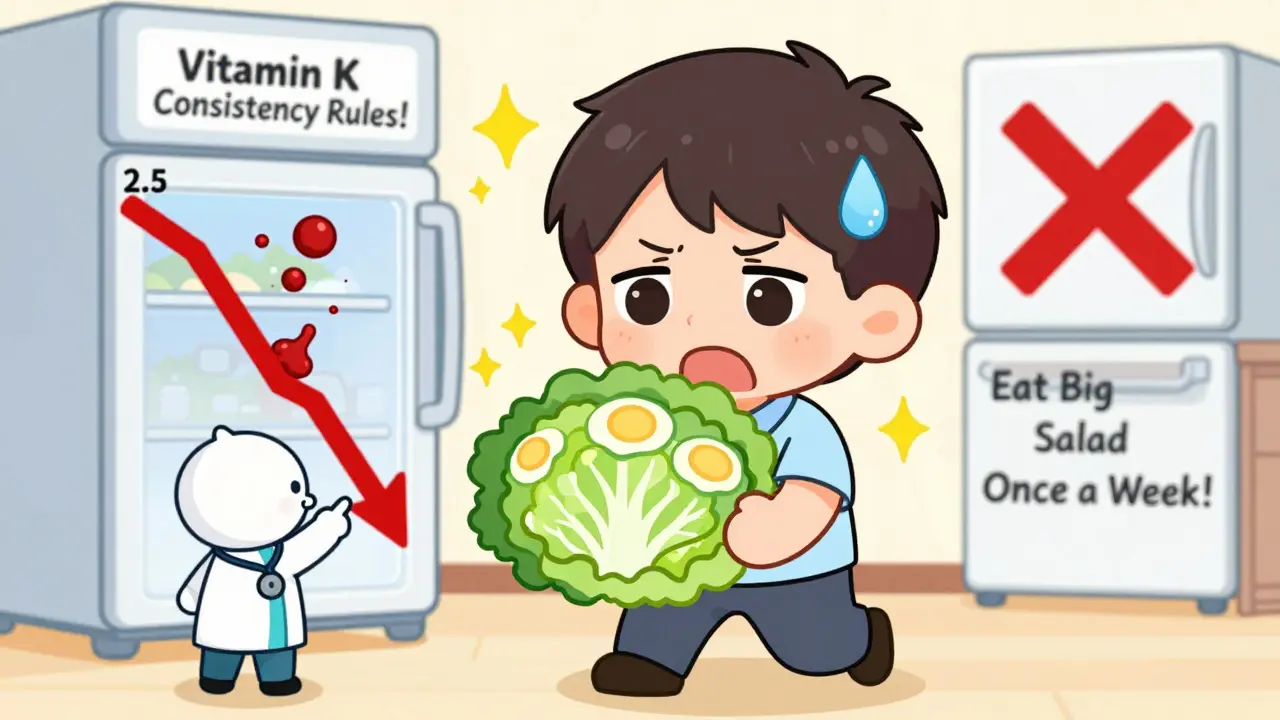
For years, patients were told: “Avoid green vegetables.” That advice is outdated - and dangerous. The American Heart Association, the American College of Cardiology, and the American Society of Hematology all agree: don’t restrict vitamin K. Maintain it.Why? Because if you cut out greens completely, then eat a bowl of kale salad once a week - your INR will crash. Your body gets used to a certain level of vitamin K. When you suddenly give it more or less, your clotting factors react fast. That’s when emergencies happen.
Research from the WARIS II trial shows that patients who ate 90-120 µg of vitamin K every day - with little variation - kept their INR in range 75-80% of the time. Those who ate wildly different amounts each day? Only 55-65%. That’s a huge gap in safety.
How to Build a Consistent Routine
You don’t need to eat the same meal every day. You just need to keep your vitamin K intake steady. Here’s how:- Choose one high-K food to eat daily. Pick one: spinach, broccoli, or kale. Eat the same portion size every day. For example: ½ cup cooked broccoli, or 1 cup raw spinach. That’s about 90-120 µg - right in the target range.
- Don’t swap high-K foods randomly. If you eat kale on Monday, don’t switch to collard greens on Tuesday. They’re both high, but the amounts differ. Stick to one.
- Use a food tracker. Apps like MyFitnessPal or CoumaDiet let you log vitamin K intake. They’re not perfect, but they’re better than guessing. Users who tracked daily saw their INR stability improve by 20-30% in under 3 months.
- Plan meals weekly. Cook a batch of steamed broccoli or sautéed spinach on Sunday. Portion it out. Eat the same amount each day. No surprises.
- Avoid vitamin K supplements. Even “healthy” meal replacements like Ensure® (50 µg) or Boost® (55 µg) can throw off your balance. Check labels.
What About Other Foods and Factors?
Vitamin K isn’t the only thing that affects warfarin. Here’s what else to watch:- Antibiotics: They kill gut bacteria that make vitamin K2. If you’re on antibiotics, your vitamin K levels can drop 70%. That means your INR may rise - even if you’re eating the same food. Tell your doctor if you’re prescribed antibiotics.
- Illness: If you’re sick and eating less, your INR can go up. A study found that during illness, INR increased by 0.3-0.6 units in just 48 hours. Keep eating, even if you’re not hungry. Stick to your usual portion.
- Alcohol: Heavy drinking can increase bleeding risk. Stick to moderate amounts - no more than one drink a day.
- Herbal supplements: Green tea, ginkgo biloba, garlic, and fish oil can all affect clotting. Avoid them unless your doctor says it’s safe.
Real People, Real Results
One woman in Ohio, 71, had been on warfarin for 8 years. Her INR swung between 1.5 and 4.0. She was told to “avoid greens,” so she ate white rice and chicken every day. Then she started eating one cup of raw spinach every morning - same amount, every day. Within six months, her INR stayed between 2.2 and 2.8. Her TTR (time in therapeutic range) jumped from 52% to 81%.On Reddit, a man named u/WarfarinWarrior ate a huge kale salad - 3 servings - after months of eating almost no greens. His INR dropped from 2.5 to 1.8 overnight. He had to go to the ER for a dose adjustment. He said: “I thought I was being healthy. Turns out, being inconsistent was the problem.”
These aren’t rare stories. A 2022 study found that 78% of warfarin users improved their INR stability after switching from restriction to consistency.

What If You’re Still Struggling?
If you’re eating consistently and your INR still swings, talk to your anticoagulation clinic. Some patients benefit from a daily vitamin K supplement of 100-150 µg - yes, a supplement - to stabilize levels. It sounds backwards, but studies show it works. It’s not for everyone, but it’s an option when diet alone isn’t enough.Also, make sure your doctor or pharmacist is giving you up-to-date advice. A 2023 survey found that 41% of primary care doctors still tell patients to avoid vitamin K - even though guidelines changed years ago. Don’t be afraid to ask: “Is this advice based on the latest guidelines?”
What About New Blood Thinners?
Newer drugs like apixaban and rivaroxaban don’t care about vitamin K. You can eat kale, spinach, or broccoli without worrying. But they cost 20 times more than warfarin - $3,500 a year versus $150. For many people, especially older adults or those without good insurance, warfarin is still the only option. That’s why learning to manage vitamin K matters.And here’s the good news: the more consistent you are, the less you need to worry. Once your routine is set, your doses stabilize. You’ll need fewer blood tests. Your doctor will be happier. And you’ll feel more in control.
Final Tip: Keep a Simple Log
You don’t need to track every bite. Just write down one thing each day:- “1 cup raw spinach”
- “½ cup broccoli”
- “no greens today”
That’s it. Do it for two weeks. You’ll start to see patterns. And you’ll know exactly what your body is getting - day after day.
Can I eat spinach while on warfarin?
Yes - but be consistent. Eating 1 cup of raw spinach every day is safer than eating it one day and avoiding it the next. The key isn’t avoiding spinach. It’s keeping your intake steady. One cup of raw spinach has about 145 µg of vitamin K - close to the recommended daily target for warfarin patients. Just stick to the same portion, every day.
Should I avoid all green vegetables on warfarin?
No. Avoiding green vegetables is outdated advice and can actually make your INR less stable. The latest guidelines from the American Heart Association and American College of Cardiology say to maintain consistent vitamin K intake, not restrict it. Cutting out greens entirely and then eating them occasionally causes dangerous spikes and drops in your INR. Eat them - but eat the same amount each day.
What happens if I eat too much vitamin K one day?
If you eat a large amount of vitamin K - like 3 cups of cooked kale - your INR can drop by 0.5 to 1.0 within 3 to 5 days. This means your blood will clot faster, increasing your risk of stroke or clotting. You may need a dose adjustment or even an emergency visit. That’s why consistency matters more than occasional indulgence. If you do overeat, note it in your log and tell your doctor at your next checkup.
Do I need to take a vitamin K supplement?
Usually, no. But if you’re eating consistently and still having unstable INRs, your doctor may recommend a daily 100-150 µg supplement. This sounds backwards, but research shows it helps stabilize levels by giving your body a steady baseline. Don’t start a supplement without talking to your anticoagulation team.
How long does it take to get stable on warfarin with diet changes?
Most people need 8 to 12 weeks to build a consistent routine. During that time, your INR will likely fluctuate as your body adjusts. But with daily consistency, you’ll see improvement - about 5% more time in range each month. After 3 months, many patients report fewer blood tests and more confidence in their daily routine.
Can antibiotics affect my warfarin?
Yes. Antibiotics kill gut bacteria that produce vitamin K2. This can cause your vitamin K levels to drop, making your INR rise - even if you’re eating the same food. If you’re prescribed antibiotics, tell your anticoagulation clinic. You may need more frequent INR checks during and after treatment.
If you’re on warfarin, your diet isn’t the enemy. Inconsistency is. You don’t have to give up your favorite foods. You just need to make them predictable. Eat the same amount of vitamin K every day - and your blood will thank you.





Virginia Seitz
December 16, 2025 AT 15:18Just ate a spinach smoothie and remembered this post 😅 Thanks for the reminder-consistency over chaos!
Nishant Desae
December 18, 2025 AT 04:46As someone who’s been on warfarin for over a decade, I can say this: the moment I stopped fearing greens and started tracking them, my INR stabilized. I used to avoid kale like it was poison-now I eat half a cup every morning with my oatmeal. No more panic calls to the clinic. It’s not about restriction. It’s about rhythm. Your body likes predictability. So do I. And honestly? I sleep better now. No more wondering if my salad will send me to the ER. Just one cup. Every day. That’s the whole secret.
Chris Van Horn
December 20, 2025 AT 03:00One must question the scientific rigor of this piece. While the notion of "consistency" is superficially appealing, the underlying assumption-that dietary vitamin K intake is linearly correlated with INR fluctuations-is grossly oversimplified. The pharmacokinetics of warfarin involve CYP2C9 polymorphisms, hepatic metabolism, gut microbiome variability, and protein binding dynamics. To reduce this complex interplay to "eat the same spinach every day" is not medical advice-it is nutritional reductionism masquerading as science. Furthermore, the cited WARIS II trial is observational, and the sample size for the "consistent" cohort was statistically underpowered. I would recommend consulting a clinical pharmacologist before adopting such a protocol.
Salome Perez
December 20, 2025 AT 20:44Chris, I hear your concern-and you’re right that warfarin is complex. But here’s the thing: even the most complex systems respond to steady inputs. The goal isn’t to explain every enzyme pathway-it’s to help people stay out of the ER. Most patients aren’t pharmacologists. They’re teachers, grandparents, truck drivers. They need clear, doable rules. And the data? It’s solid. Patients who tracked their vitamin K intake had a 30% improvement in time in range. That’s not magic. That’s medicine. You can debate the science all day, but for real people? This works. And that’s what matters.
Evelyn Vélez Mejía
December 22, 2025 AT 13:02There’s a deeper philosophical truth here, beyond INR numbers and spinach portions. We live in a culture obsessed with extremes: detoxes, keto, intermittent fasting, zero-carb, all-or-nothing. But warfarin therapy, in its quiet, daily insistence on balance, offers a quiet rebellion against that chaos. To eat the same amount of broccoli every day isn’t about compliance-it’s about reclaiming agency through discipline. It’s the antithesis of the influencer-driven wellness industrial complex. It’s not about being healthy. It’s about being *steady*. And in a world that’s always screaming for more, more, more-staying the same is revolutionary.
Victoria Rogers
December 23, 2025 AT 03:24So now we're telling people to eat spinach because some study says so? What's next? Mandatory kale in public schools? This is why America's healthcare is a joke. You want stable INR? Take the pill. Don't turn your kitchen into a lab. I eat what I want. My INR's fine. Stop micromanaging people's diets.
Meghan O'Shaughnessy
December 24, 2025 AT 11:37I’ve been on warfarin for 12 years. I used to eat kale salads on weekends and nothing else. My INR was all over the place. Then I started eating 1 cup raw spinach every morning. No more panic. No more missed work for blood draws. I don’t even track it anymore-it’s just part of my routine, like brushing my teeth. It’s not glamorous. But it works.
Patrick A. Ck. Trip
December 25, 2025 AT 09:03This is one of the clearest, most compassionate explanations of warfarin and diet I’ve ever read. Thank you for not just listing facts, but for honoring the human experience behind them. So many people feel scared, confused, or even guilty about their diet. This post doesn’t shame-it empowers. And the anecdote about the Ohio woman? That’s the kind of story that saves lives. I’ve shared this with my mother, who’s been on warfarin since 2018. She’s already started her daily spinach.
Sam Clark
December 26, 2025 AT 16:25For anyone reading this and thinking "I can’t do this every day"-start small. One day this week, eat your usual spinach. The next day, eat the same amount again. That’s it. You don’t need to be perfect. You just need to be predictable. And if you slip? Don’t beat yourself up. Just reset the next day. This isn’t a diet. It’s a lifestyle tweak. And it’s one of the few things in medicine that actually gives you control.
Kaylee Esdale
December 27, 2025 AT 10:551 cup spinach every day. Done. No more guessing. My INR hasn’t been this stable in 5 years. Thank you.
Jody Patrick
December 28, 2025 AT 21:10China eats way more greens and has lower stroke rates. Maybe we should just stop giving warfarin and start giving broccoli.
Erik J
December 29, 2025 AT 13:55I’m curious-has anyone tried the vitamin K supplement approach? I’ve been consistent with my diet for 6 months, but my INR still swings 0.5-1.0 points weekly. My clinic mentioned it as a last resort, but I’m hesitant. Any real-world data beyond the studies?
BETH VON KAUFFMANN
December 30, 2025 AT 19:26While the author correctly identifies the need for consistency, the piece suffers from confirmation bias and selective citation. The WARIS II trial was not designed to assess dietary consistency as a primary endpoint. The 78% improvement statistic lacks a control group. And the recommendation to use MyFitnessPal for vitamin K tracking? The database is notoriously inaccurate for leafy greens-variations of ±40% are common. This is not evidence-based medicine. It’s anecdotal storytelling dressed in medical jargon. For those seeking real stability: consider switching to DOACs. The cost is high, but the cognitive load is zero.