
Why Taking Your Medication Feels So Hard
You know you need to take your pills. You’ve been told it’s important. But somehow, by Wednesday, you’re skipping doses. Or you forget entirely. Or you take them at 3 a.m. because that’s when you finally remembered. You’re not lazy. You’re not failing. You’re just human.
More than half of people with chronic conditions don’t take their meds as prescribed. That’s not because they don’t care. It’s because remembering to take pills every day is a mental burden. Your brain doesn’t naturally treat medication like brushing your teeth-it feels like a chore, not a habit. And habits don’t form from willpower. They form from behavioral tricks.
Science shows that when you turn medication-taking into an automatic behavior, adherence jumps. Not by 5%. Not by 10%. By up to 30%. That’s the difference between staying healthy and ending up in the hospital. The good news? You don’t need to be perfect. You just need to be consistent. And that’s where behavioral science comes in.
Pair Your Pills with an Existing Habit
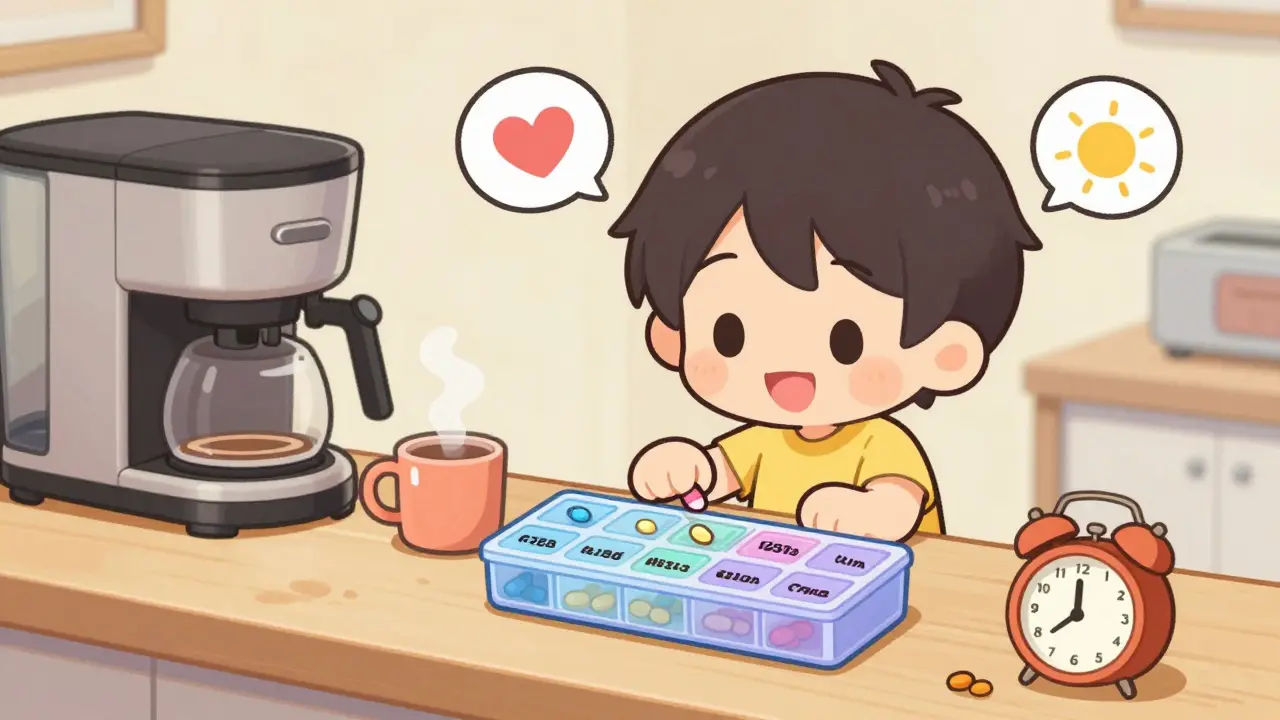
Think about your morning. You brush your teeth. You make coffee. You check your phone. These routines are automatic. You don’t think about them. You just do them.
Now, attach your medication to one of those habits. Take your pill right after you brush your teeth. Or right before you pour your first cup of coffee. This is called habit stacking, and it’s one of the most powerful tools in behavioral psychology.
A 2020 study in Patient Preference and Adherence found that people who paired their meds with a daily routine improved adherence by 15.8%. Why? Because your brain doesn’t have to remember a new task-it just links it to something you already do. No decision-making. No effort. Just action.
Try this: Write down your top three morning or evening routines. Pick one. Put your pill bottle next to the sink, the coffee maker, or your bed. Do it every single day. After a week, your brain will start expecting it. That’s when the habit clicks.
Use a Pill Organizer-But Make It Visible
Pill organizers aren’t magic. A 2021 study in the Journal of the American Geriatrics Society showed they only help if they’re used correctly. Most people buy them, fill them once, then forget about them.
Here’s how to make them work: Get a weekly organizer with clear compartments. Fill it every Sunday, right after you take your meds. Then put it somewhere you can’t miss-on your kitchen counter, next to your toothbrush, or on your nightstand.
Visibility matters. If you have to dig through a drawer to find it, you won’t. But if it’s sitting right in front of you, your brain notices it. That’s called a cue. Cues trigger habits. And cues are the secret behind why people who use visible pill organizers reduce missed doses by 27%.
Pro tip: Use a marker to write the time next to each compartment. “7 a.m.”, “7 p.m.”. It removes any guesswork.
Set Smart Phone Reminders (Not Just Any Reminder)
Phone alarms are everywhere. But most people set them, ignore them, then blame themselves for forgetting.
The key isn’t having a reminder-it’s having the right kind. Generic alarms like “Take meds” don’t work. Personalized, timed, and repeated reminders do.
A 2021 meta-analysis in JMIR mHealth and uHealth found that smartphone apps with customizable reminders improved adherence by 28.7%. But here’s the catch: The most effective ones let you set the exact time you’re most likely to remember. If you always eat breakfast at 8 a.m., set the alarm for 7:55 a.m. If you watch TV at 7 p.m., set it for 6:50 p.m.
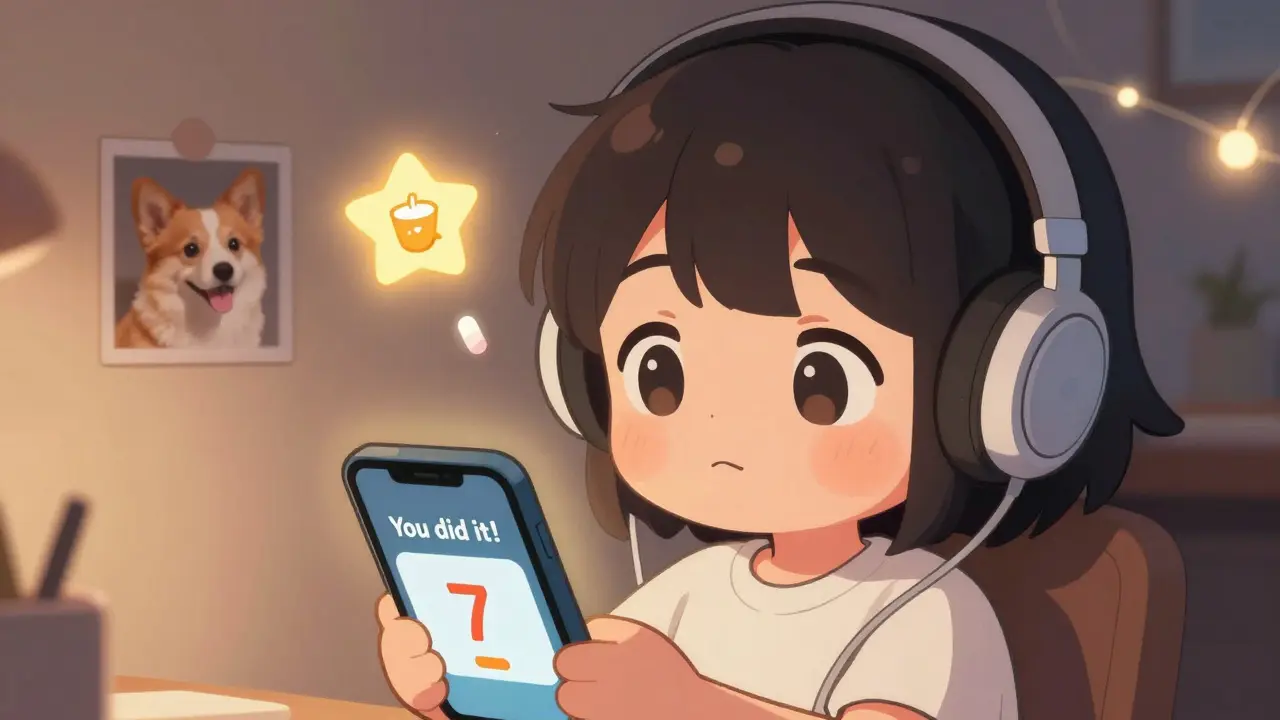
Use apps that track your progress. Seeing a streak of 7 days in a row? That’s motivation. Seeing a missed day? That’s a signal to adjust. Some apps even sync with your doctor’s records. That’s not just a reminder-it’s accountability.
Simplify Your Regimen
Do you take five different pills at three different times a day? That’s a lot to remember. And your brain hates complexity.
A 2011 meta-analysis of over 21,000 patients showed that switching to a single-pill combination increased adherence by 26%. Why? Fewer pills = fewer decisions = fewer chances to mess up.
If you’re on multiple meds, ask your doctor or pharmacist: “Can any of these be combined? Can I take fewer doses?”
Even small changes help. If you’re supposed to take a pill twice a day, can you switch to once? If you’re taking a morning and night pill, can one be extended-release? Every reduction in complexity lowers the barrier to sticking with it.
One patient I spoke with was taking eight pills daily. After working with her pharmacist, she switched to four combined pills, taken just twice a day. Her adherence went from 52% to 89% in three months.
Use Rewards-But Make Them Immediate
Your brain rewards behavior that feels good. Right now. Not tomorrow. Not next week.
Most people wait for the long-term benefit-“If I take this, I won’t have a stroke in five years.” But that’s too far away to motivate daily action.
Instead, create a small, immediate reward. After you take your pill, do something you enjoy for 30 seconds. Listen to your favorite song. Take a deep breath. Look at a photo of your dog. Sip your coffee slowly.
This is called positive reinforcement. A 2022 study in Health Affairs found that financial incentives improved adherence by 34.2%-but you don’t need cash. You just need a tiny, pleasurable moment tied to the action.
Try this: Make a “medication reward list.” Pick five small things you love. Use one each day. Rotate them. Keep it fresh. Your brain will start looking forward to taking your pill-not just tolerating it.
Track Your Progress-Out Loud
What gets measured gets improved. That’s true for weight loss, exercise, and yes-medication.
Write down every time you take your pill. Use a calendar. Use a sticky note. Use a simple app. Just write it down.
A 2005 study showed that bipolar patients who kept daily medication charts improved adherence by 19.3%. Why? Because writing it down creates awareness. You see the pattern. You notice the gaps. You feel the momentum.
And here’s the kicker: Say it out loud. When you take your pill, say, “I’m taking my blood pressure pill. I’m doing this for me.” It sounds silly, but self-talk reinforces identity. You’re not just taking a pill-you’re becoming someone who takes care of themselves.
Get Help-Don’t Go It Alone
Medication adherence isn’t just your problem. It’s a system problem. And systems need support.
Pharmacies offer auto-refill programs. They’ll send you your meds before you run out. A 2022 study found this improved continuity by 33.4%. That’s huge.
Ask your doctor about a care team approach. When doctors, pharmacists, and nurses all give you the same message, adherence jumps to 68%. That’s not luck. That’s coordination.
If cost is the issue, ask about patient assistance programs. Many drug makers offer free or low-cost meds. If you’re struggling mentally, talk to a counselor. Motivational interviewing-a style of conversation that helps you find your own reasons to stick with treatment-has been shown to improve adherence by 22.1%.
You don’t have to fix this alone. Ask for help. It’s not weakness. It’s strategy.
What If You Still Miss a Dose?
Everyone misses a dose. Even the best. The question isn’t whether you’ll slip up. It’s how you respond.
Don’t punish yourself. Don’t think, “I ruined it.” That mindset kills progress.
Instead, ask: “What made me miss it?” Was it a change in routine? Were you stressed? Did you run out? Did you forget because you didn’t have a cue?
Then adjust. Move your pill bottle. Change your alarm. Ask your pharmacist for a bigger bottle with a reminder label. Fix the system, not your willpower.
Behavioral science teaches us: Failure isn’t the opposite of success. It’s part of the process.
Long-Term Solutions: When Behavior Isn’t Enough
Some people need more than tricks. Sometimes, the system needs to change.
Long-Acting Injectable (LAI) medications are given once a month-or even once every few months. They bypass daily pills entirely. A 2022 study in Schizophrenia Bulletin found LAIs reduced non-adherence by 57% in patients with serious mental illness.
There are also new “smart” pills with tiny sensors that tell your doctor when you’ve taken your dose. These aren’t sci-fi anymore-they’re FDA-approved and available for heart failure, epilepsy, and psychiatric conditions.
If you’ve tried everything and still struggle, talk to your doctor about these options. They’re not a last resort. They’re a smart next step.
Start Small. Stay Consistent.
You don’t need to overhaul your life to build a medication habit. You just need to pick one trick. One cue. One small win.
Start today. Pick one habit to stack with your pill. Set one reminder. Put your pill organizer where you’ll see it. That’s it.
Behavioral science doesn’t promise perfection. It promises progress. And progress, over time, saves lives.





Ed Di Cristofaro
January 31, 2026 AT 22:17vivian papadatu
February 2, 2026 AT 01:39Melissa Melville
February 4, 2026 AT 01:27Deep Rank
February 4, 2026 AT 19:04Naomi Walsh
February 5, 2026 AT 07:20Bryan Coleman
February 7, 2026 AT 01:09Donna Macaranas
February 8, 2026 AT 15:32Jamie Allan Brown
February 9, 2026 AT 04:54Lisa Rodriguez
February 9, 2026 AT 15:58Nicki Aries
February 9, 2026 AT 16:51Lilliana Lowe
February 10, 2026 AT 02:07Naresh L
February 11, 2026 AT 03:40Sami Sahil
February 11, 2026 AT 17:40