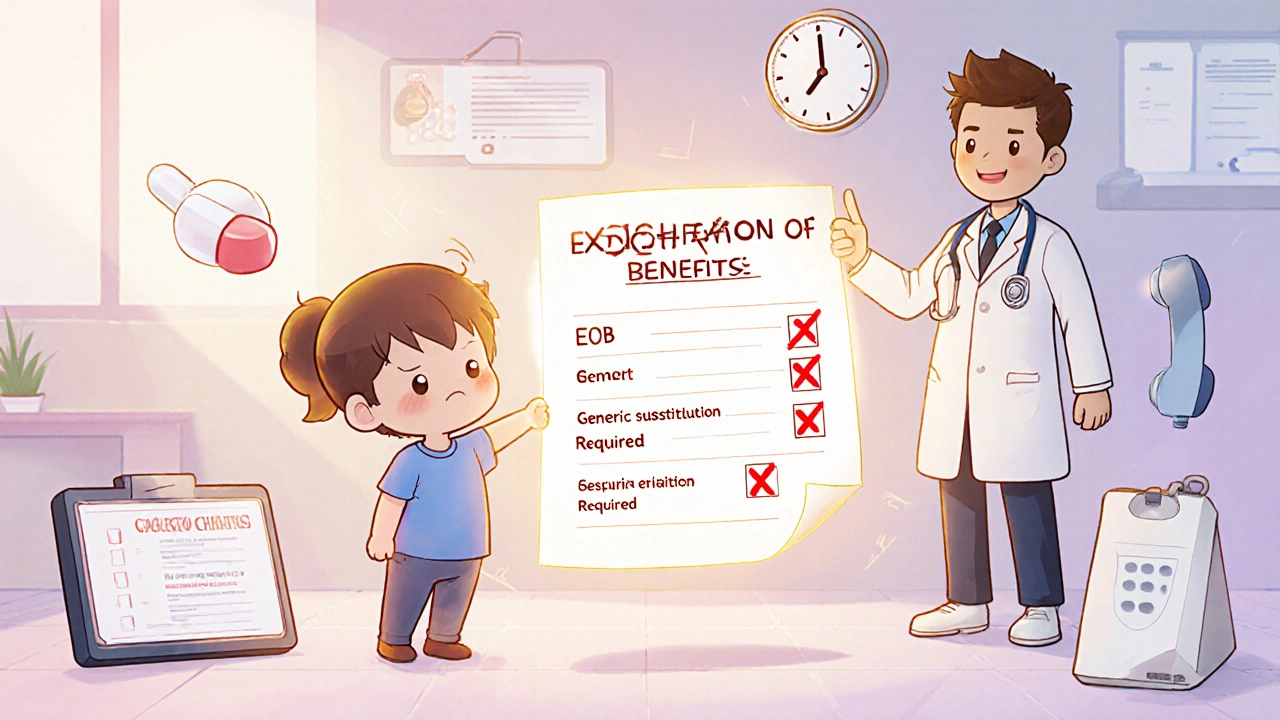
When your doctor prescribes a brand-name medication, but your insurance says you must switch to a cheaper generic version - and you know that won’t work for you - you’re not alone. Thousands of people face this every year. The good news? You have the right to fight back. Insurance companies can’t just force a switch if it’s medically unsafe. And with the right steps, you can get your prescribed medication covered - even if they say no at first.
Understand Why the Denial Happened
Your first step isn’t to call your doctor or file a form. It’s to read your Explanation of Benefits (EOB). This document, sent by your insurer, explains why your claim was denied. Look for phrases like:- “Generic substitution required”
- “Step therapy not completed”
- “Prior authorization denied”
Gather the Right Documentation
The biggest reason appeals fail? Missing or weak documentation. Insurance companies don’t care what you think. They care what your doctor says - in writing. Your doctor needs to provide a letter of medical necessity. This isn’t a quick note. It needs to include:- Why the brand-name drug is medically necessary - not just preferred
- Proof that you tried and failed the generic or other alternatives (include dates and symptoms)
- References to clinical guidelines (like those from the American College of Physicians or specialty societies)
- Any past adverse reactions to generics - like rashes, severe nausea, or loss of effectiveness
File the Internal Appeal
Once you have your doctor’s letter, it’s time to file. Every insurance plan has an internal appeals process - and you have 180 days from the denial date to start it (120 days for Medicare Part D). You’ll need:- Your full name and policy number
- Date of denial
- Name of the medication denied
- Copy of the EOB
- Physician’s letter of medical necessity
Request a Peer-to-Peer Review
This is where most appeals succeed. If your initial request is denied, ask for a peer-to-peer review. That means your doctor talks directly to the insurance company’s medical director. This isn’t a formality. It’s a real conversation - usually over the phone. And it’s powerful. According to Dr. Scott Glovsky, a healthcare attorney in California, peer-to-peer reviews have a success rate over 75% when the physician is prepared. Your doctor should be ready to explain:- Why the generic won’t work for your specific condition
- How your symptoms improved or worsened with past attempts
- Why the prescribed drug aligns with national treatment guidelines
Know Your Timelines
Time matters - especially if you’re running out of medication.- Standard appeals: Insurers must respond within 30 days if you haven’t started the drug yet, or 60 days if you’re already taking it.
- Expedited appeals: If your condition could seriously worsen without the drug, request an expedited review. They must respond within 4 business days.
- Medicare Part D: Has five appeal levels. The second level - handled by an independent reviewer - overturns denials 63% of the time.
Move to External Review If Needed
If your internal appeal is denied, you can ask for an external review. This is where an independent third party - not your insurer - looks at your case. This step is available for all commercial plans and Medicare Part D. Medicaid rules vary by state, but 45 states offer it. You must request this within 60 days of the internal denial. The external reviewer will examine your medical records, your doctor’s letter, and the insurer’s reasoning. They’re required to make a decision within 60 days (or 72 hours for urgent cases). In California, the Department of Insurance reports a 92% resolution rate for formal complaints filed through this channel. That’s not luck - it’s because they’re unbiased.What If You Still Get Denied?
Even after all this, you might still get a “no.” But you’re not out of options.- Ask your doctor about patient assistance programs. Many drug manufacturers offer free or low-cost meds to those who qualify.
- Check with nonprofits like the Crohn’s & Colitis Foundation or T1D Exchange - they help patients navigate appeals and provide templates.
- Contact your state’s insurance commissioner. All 50 states have one. They don’t override insurers, but they can investigate unfair practices. Average response time? Under a week.
Real Examples That Worked
- A Type 1 diabetic in Ohio was denied semaglutide because the insurer wanted her to try metformin first. She provided lab results showing repeated hypoglycemic episodes with metformin. Her appeal was approved in 11 days after a peer-to-peer call. - A patient with rheumatoid arthritis in Texas was told to use a generic TNF inhibitor. He had developed antibodies to two generics already. His doctor cited the American College of Rheumatology guidelines. The insurer approved the brand-name drug on the first appeal. - A woman in Florida with severe depression was denied her prescribed antidepressant because it wasn’t on the formulary. She submitted her history of failed SSRIs, plus a letter from her psychiatrist citing the APA’s treatment guidelines. The external review overturned the denial. These aren’t rare cases. They’re common - if you do the work.What to Avoid
Don’t make these mistakes:- Waiting until your prescription runs out - delays hurt your case.
- Letting your doctor write a vague letter like “this drug is better.” Be specific.
- Only calling customer service - get everything in writing.
- Assuming your plan will explain the process. They won’t. You have to ask.
Final Thoughts
Insurance companies aren’t trying to hurt you. They’re following rules designed to cut costs. But those rules don’t always match real medical needs. That’s why the appeal system exists - to protect patients when the system gets it wrong. You don’t need a lawyer. You don’t need to be an expert. You just need to be prepared. Get your doctor on board. Document everything. Know the deadlines. Push when you need to. The data is clear: appeals work - if you do them right. And your health is worth fighting for.Can I appeal if my insurance says I must use a generic medication?
Yes. If your doctor believes a generic drug won’t work for you due to medical reasons - like past adverse reactions, lack of effectiveness, or specific health conditions - you have the right to appeal. Insurers can’t force substitutions if they’re clinically inappropriate. You’ll need a letter from your doctor explaining why the brand-name drug is necessary, along with evidence of failed alternatives.
How long does an insurance appeal take?
For standard appeals, insurers must respond within 30 days if you haven’t started the medication, or 60 days if you’re already taking it. For urgent cases - where your health could worsen - you can request an expedited review, which requires a decision within 4 business days. Medicare Part D appeals have longer timelines, with up to five levels of review.
Do I need a lawyer to appeal a drug denial?
No. Most appeals are handled successfully without legal help. The key is strong documentation from your doctor and following the insurer’s process exactly. Many patients win by requesting a peer-to-peer review, where your doctor speaks directly to the insurer’s medical director. This has a success rate over 75% when done correctly.
What if my doctor won’t help me with the appeal?
If your doctor refuses to write a letter or participate in a peer-to-peer review, ask to speak with their office manager or medical director. Many practices have staff trained to handle these requests. If they still won’t help, consider switching to a provider who supports patient advocacy. You can also contact patient advocacy groups like the Patient Advocate Foundation for templates and guidance.
Can I get my medication while waiting for an appeal decision?
Sometimes. If your case is urgent, ask your doctor to request a temporary exception or short-term supply while your appeal is pending. Some insurers offer bridge programs for patients in need. You can also ask the drug manufacturer about free samples or patient assistance programs - many offer them for approved conditions.
What percentage of appeals are successful?
About 56% to 78% of properly documented appeals are approved, according to studies in the Journal of Managed Care & Specialty Pharmacy. Success rates are higher for specialty drugs like those used in cancer or autoimmune conditions - up to 82% - and lower for psychiatric medications, around 47%. The biggest factor? Detailed clinical documentation from your doctor.
How do I know if my insurance plan follows federal appeal rules?
All commercial insurance plans and Medicare Part D must follow federal appeal rules under the Affordable Care Act. Your Explanation of Benefits (EOB) must include instructions on how to appeal. If it doesn’t, contact your state’s insurance commissioner. They can confirm whether your plan is compliant and help you file a complaint if needed.

Josh Evans
November 29, 2025 AT 21:00Just went through this last month with my antidepressant. Docs were useless at first, but once I printed out the AMA guidelines and had my psychiatrist call the insurer, they approved it in 2 days. Seriously, don’t give up. It’s a pain, but it works.
Allison Reed
November 30, 2025 AT 19:48This is such an important guide. I wish more people knew how powerful a peer-to-peer review can be. My mom got her rheumatoid arthritis drug approved after three denials-just by having her rheumatologist talk to the med director. You’re not just fighting insurance. You’re fighting for your life.
Jacob Keil
December 1, 2025 AT 09:11INSURANCE COMPANIES ARE JUST CORPORATE VAMPIRES. THEY DON'T CARE IF YOU DIE, THEY CARE IF YOUR PRESCRIPTION COSTS MORE THAN $5. WE NEED TO BURN THE SYSTEM DOWN. WHY DO WE LET THEM CONTROL OUR HEALTH?!
Ady Young
December 2, 2025 AT 04:53My sister got denied for her MS med last year. She did everything in this guide-letter from neurologist, peer review, documented every failed generic. Took 4 weeks, but they approved it. The key is persistence. And don’t let your doctor off the hook. They’re your best ally.
Sean Slevin
December 2, 2025 AT 22:40...and yet, we live in a world where a pill’s price tag matters more than a human being’s neurological stability... the irony is that we’ve outsourced compassion to algorithms... who decided that a $2 generic is equivalent to a $400 branded drug? Not science. Not medicine. Just capitalism… and it’s broken.
DENIS GOLD
December 3, 2025 AT 14:01Wow. Another ‘poor me’ cry for help from the entitlement generation. If you can’t afford your meds, get a job. Or move to Canada. We don’t owe you free drugs because you’re too lazy to deal with generics. Grow up.
Ifeoma Ezeokoli
December 3, 2025 AT 23:17My cousin in Lagos just paid $200 for a month’s supply of a generic that’s supposed to be free here. I cried reading this. You guys have systems-even if they’re broken. We have nothing. Please don’t take this for granted. Fight hard.
Daniel Rod
December 4, 2025 AT 15:06Thank you for this. 🙏 I’ve been through this with my anxiety med. The peer-to-peer call was the game-changer. My doctor sounded like a boss when he talked to the insurer. I was crying on the phone. He didn’t even know I was listening. 🥲
gina rodriguez
December 5, 2025 AT 17:18Just a quick tip: if your doctor’s office says they don’t do letters, ask for the billing department. They usually have templates and can help you get it done. I’ve seen them do it in under an hour when they know it matters.
Sue Barnes
December 7, 2025 AT 10:30People who can’t handle generics shouldn’t be on expensive meds. If you can’t tolerate a generic, maybe your diagnosis is wrong. Stop wasting insurance money. This isn’t a luxury.
jobin joshua
December 8, 2025 AT 20:00Bro, I'm from India and we pay $1 for generics. You guys are so spoiled. Just take the generic and stop complaining. 🤦♂️
Sachin Agnihotri
December 9, 2025 AT 23:01Wait-so you’re telling me that if I have a history of rashes with generic metformin, and my doctor says it’s dangerous, and I submit all the guidelines… they STILL might say no? That’s insane… I mean, really… what’s the point of medicine if it’s not about health?
Diana Askew
December 10, 2025 AT 22:01THEY'RE DOING THIS ON PURPOSE. THE PHARMA COMPANIES OWN THE INSURERS. THEY WANT YOU TO USE THE CHEAP ONES SO THEY CAN SELL MORE OF THE BRANDS LATER. IT'S A SCAM. I SAW A DOCUMENT ON THE DARK WEB THAT PROVES IT.
King Property
December 11, 2025 AT 09:17You people don’t even know what step therapy is. It’s not about cost-it’s about clinical pathways. Your doctor’s just lazy. If you can’t follow protocol, you shouldn’t be on a specialty drug. I’ve worked in pharmacy for 12 years. I know what I’m talking about.
Yash Hemrajani
December 13, 2025 AT 01:48Oh, you want your brand-name drug? Cool. Now go tell your doctor to write a letter that’s actually useful-not just ‘I think it’s better.’ I’ve seen 100 of these. Half the letters say ‘patient prefers.’ That’s not medical necessity. That’s laziness.