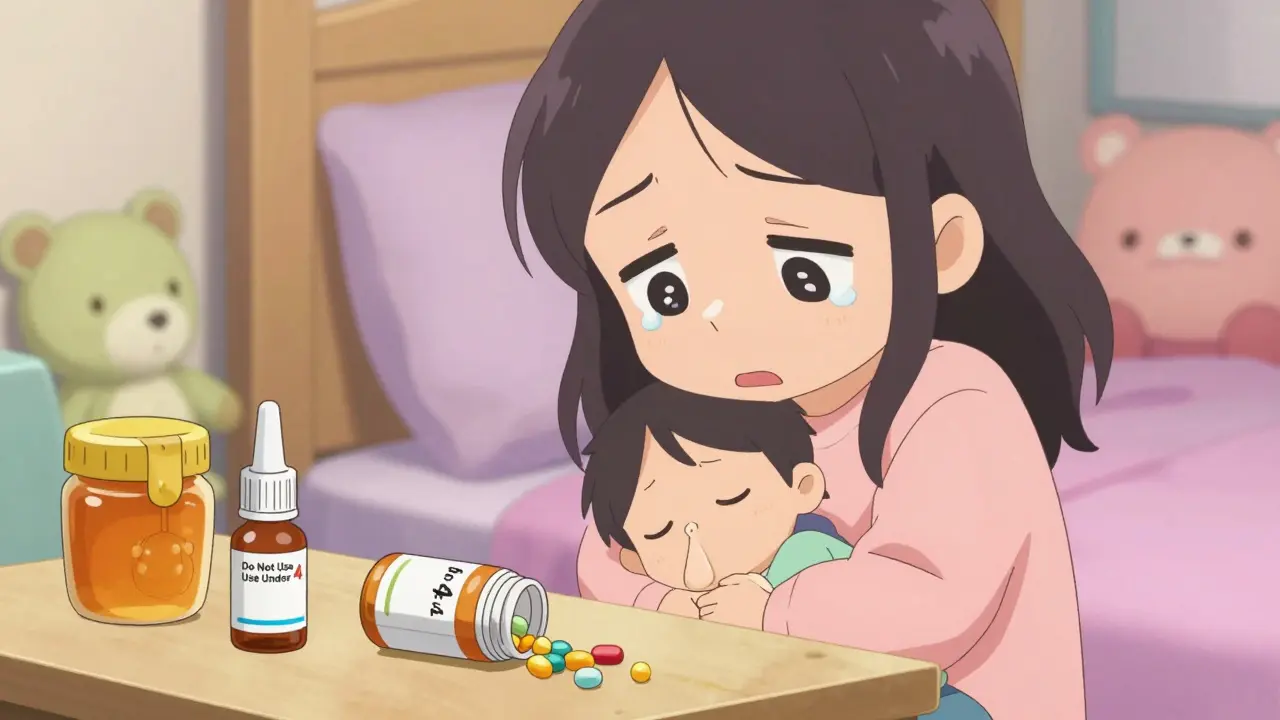
Every winter, parents face the same dilemma: their child is coughing, congested, and can’t sleep. They reach for the bottle of Children’s Robitussin or Dimetapp sitting in the cabinet-same as last year. But what they don’t realize is that OTC cold medicine for kids under 4 is no longer just discouraged-it’s dangerous. And even for older kids, the risks often outweigh the benefits.
Why OTC Cold Medicines Don’t Work for Young Kids
These medicines were never proven to actually help children feel better. In 2008, after reviewing dozens of studies, the FDA found no solid evidence that cough suppressants, decongestants, or antihistamines improved symptoms in kids under 12. Not even a little. Meanwhile, the risks were clear: seizures, rapid heart rate, coma, and even death.
Manufacturers like Johnson & Johnson, GlaxoSmithKline, and Reckitt Benckiser voluntarily pulled products meant for kids under 4. Today, every box says: Do not use in children under 4 years. Some brands extend that warning to under 6 or even 12. Why? Because the data didn’t lie. A 2019 study in Pediatrics looked at over 1,500 emergency cases linked to these meds. Two-thirds involved kids under 2. Over 70% ended up in the hospital.
The Hidden Dangers: Multiple Ingredients and Dosing Errors
Most OTC cold medicines for kids aren’t just one drug-they’re cocktails. A single bottle might contain an antihistamine, a decongestant, a cough suppressant, and an expectorant. That’s four active ingredients in one tiny cup. And that’s where things go wrong.
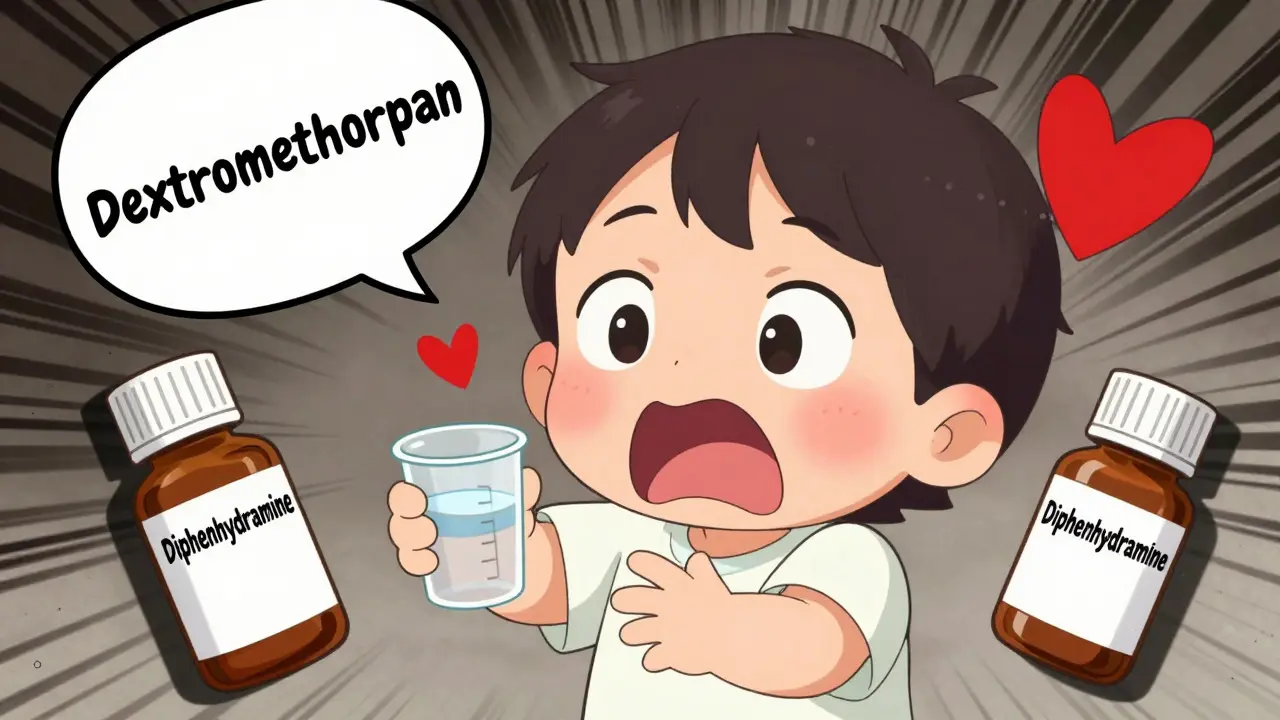
Parents often give more than one product because they think, “My child has a cough AND a runny nose-I need to treat both.” But if both products contain dextromethorphan or diphenhydramine, they’re doubling the dose. That’s how overdoses happen. In fact, 68% of dosing errors involve multi-ingredient products, according to a 2020 study in Pediatric Emergency Care.
And dosing isn’t even consistent. Many bottles still say “for ages 2-3” or “4-6.” But kids that age vary wildly in weight. A 2-year-old weighing 25 pounds gets the same dose as one weighing 35 pounds. That’s a 40% difference in body mass. The American Academy of Pediatrics has been pushing for weight-based dosing since 2014, but it hasn’t happened yet. So age-based labels are misleading-and dangerous.
What Happens When Kids Take Too Much?
Children’s bodies react differently to these drugs than adults’. Their livers aren’t fully developed. Their nervous systems are more sensitive. A single teaspoon too much can trigger:
- Rapid heartbeat (tachycardia) - seen in 38% of overdose cases
- Extreme agitation or drowsiness - 32% of cases
- Difficulty breathing - 28%
- Seizures or loss of consciousness - rare, but fatal
Poison Control received over 12,000 calls between 2019 and 2022 about kids accidentally ingesting cold medicine. Over 40% of those were kids aged 1-2. Most happened because the bottle was left within reach, or a caregiver misread the dose. One parent told a reporter: “I gave my 2-year-old half a teaspoon because I thought it was just a little cough.” That half-teaspoon was enough to send him to the ER.
Why Do Parents Still Use Them?
Even with clear warnings, 38% of parents still give OTC cold meds to kids under 4, according to a 2021 AAP survey. Why? Because they’re desperate. The cough won’t stop. The child can’t sleep. The parent feels helpless.
Many believe their pediatrician recommended it. But when researchers checked medical records, only 17% of those parents had actually asked a doctor. The rest were following old habits, advice from friends, or misleading ads. Reddit threads are full of parents saying, “I gave it anyway because nothing else worked.”
On Drugs.com, parents rate these products 1.8 out of 5 for kids under 6. The top complaints? “Didn’t help.” “Made my kid hyper.” “Woke him up more.”
But here’s the twist: parents of kids aged 7-11 give them better reviews. About 68% say it helped their child sleep through the night. That’s not because the medicine works better-it’s because older kids metabolize these drugs more like adults. But even then, experts say the benefit is small and not worth the risk.
What Actually Works? Safe Alternatives for Cough and Congestion
If you can’t use OTC meds, what do you do?
For nasal congestion: Use saline nasal drops (0.9% sodium chloride) - two to three drops in each nostril, up to four times a day. Then gently suction with a bulb syringe or nasal aspirator. It’s messy, but it’s safe. Works for babies as young as a few weeks old.
For cough: For kids over 1 year old, give one teaspoon (5 mL) of honey before bed. A 2018 Cochrane review found honey reduced cough frequency and severity by 36% compared to no treatment. It’s better than dextromethorphan and has zero risk of overdose.
For fever or discomfort: Use acetaminophen (10-15 mg per kg of body weight every 4-6 hours) or ibuprofen (5-10 mg per kg every 6-8 hours). These are proven, safe, and effective. Just make sure you’re using the right dose based on weight-not age.
For overall comfort: Keep the air moist. Run a cool-mist humidifier in the room. Keep your child well-hydrated. Offer extra fluids-about 50 mL per kg of body weight each day. Warm liquids like broth or tea (without caffeine) can soothe a sore throat.
What About Newer Products or “Natural” Options?
Some brands now sell “natural” cold remedies for kids-essential oil diffusers, herbal syrups, or homeopathic drops. But these aren’t regulated like FDA-approved drugs. There’s no proof they work. And some, like eucalyptus oil, can be toxic if ingested or applied directly to skin.
The FDA has cracked down on unapproved products. In 2022, they warned against several herbal cough syrups sold online that contained undeclared antihistamines. So “natural” doesn’t mean safe.
Even the “safe” products-like saline sprays or nasal aspirators-are becoming more advanced. New dosing cups now come with flow restrictors that limit delivery to 5 mL per squeeze. That’s a small change, but research shows it could cut overdose risk by 82%.
What’s Next? Regulatory Changes Coming
The FDA is moving toward stricter rules. In 2023, they released draft guidance requiring all OTC pediatric meds to go through clinical trials before being sold to kids. Final rules are expected by mid-2025. The American Academy of Pediatrics is pushing to extend the age restriction to under 6, not just under 4. And the European Medicines Agency has already banned these products for kids under 6 since 2009.
Switzerland went even further-banning all cough medicines with dextromethorphan for kids under 12 as of January 2022. The message is clear: the science says these drugs don’t help, and they hurt.
Meanwhile, the market is shrinking. U.S. sales of pediatric cold meds dropped from $1.2 billion in 2007 to $840 million in 2022. Companies are shifting focus to adult products or non-drug solutions. Saline nasal spray sales are projected to grow nearly 10% a year through 2028.
Bottom Line: When in Doubt, Skip the Medicine
OTC cold medicines aren’t harmless. They’re not magic. They’re not even effective for most kids. And for children under 4, they’re outright dangerous.
There’s no quick fix for a cold. But there are safe, proven ways to help your child feel better: saline drops, honey, fluids, humidity, and rest. If your child is under 4, don’t give them any OTC cold medicine-not even “just a little.” If they’re older, talk to your doctor first. Don’t assume it’s safe just because it’s on the shelf.
Your child’s health isn’t worth the risk of a dosing error, an overdose, or a trip to the ER. Sometimes, the most powerful thing you can do is nothing at all-and wait it out.
Can I give my 3-year-old children’s cough medicine if I cut the dose in half?
No. Even half a dose can be dangerous for a 3-year-old. These medicines were never tested for safety in young children, and their bodies process the drugs differently than adults. There’s no safe lower dose-just risk. The FDA and AAP strongly advise against using any OTC cough or cold medicine in children under 4, regardless of how much you give.
Is honey really safe for toddlers?
Yes, but only for children over 1 year old. Honey can contain spores of botulism bacteria, which can cause infant botulism in babies under 12 months. After age 1, their digestive systems are mature enough to handle it safely. One teaspoon before bed has been shown to reduce nighttime coughing better than many OTC cough syrups.
What should I do if my child accidentally takes too much cold medicine?
Call Poison Control immediately at 1-800-222-1222. Do not wait for symptoms to appear. Even if your child seems fine, the effects can be delayed. Keep the medicine bottle handy-you’ll need to tell them what was taken and how much. Do not try to make your child vomit. Follow their instructions exactly.
Are nasal sprays safe for babies?
Yes, saline nasal sprays or drops (0.9% sodium chloride) are safe for babies of any age. They help loosen mucus without any drugs. Use a bulb syringe to gently suction out the mucus after applying the drops. This is the gold standard for relieving congestion in infants.
Why do some doctors still recommend OTC cold meds?
Some doctors may recommend them out of habit, or because parents pressure them to do something. But major medical groups like the AAP, CDC, and American College of Chest Physicians no longer endorse them for children under 12. If your doctor recommends one, ask: “Is there evidence this will help my child?” and “What are the risks?”
Can I use adult cold medicine for my child if I give a smaller dose?
Never. Adult formulations contain higher concentrations of active ingredients and often include chemicals not approved for children. Even a small amount can be toxic. Always use products labeled specifically for children-and only if they’re age-appropriate. If in doubt, skip it.
What to Do Next
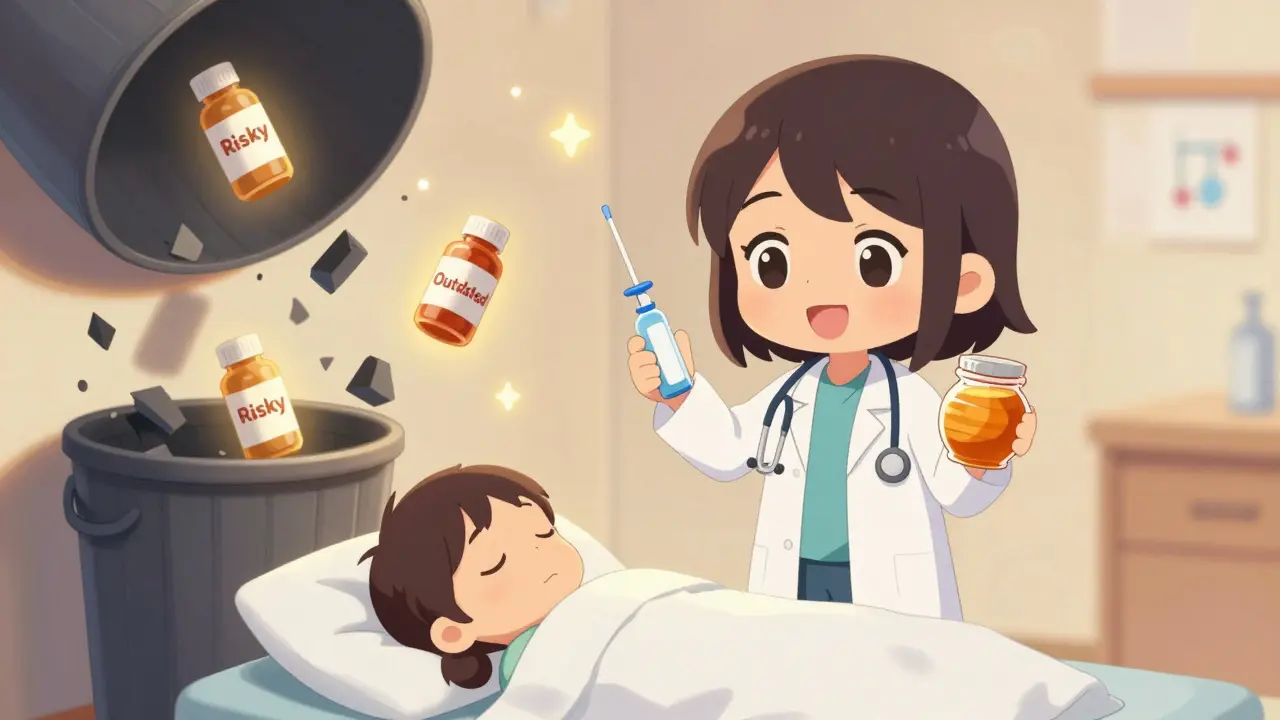
Check your medicine cabinet right now. Look at every bottle labeled for children. If it’s a cough or cold product, check the age warning. If it says “under 4” or “under 6,” and you have a child in that range, throw it out-or better yet, take it to a drug take-back location.
Replace it with saline drops, a humidifier, and a small jar of honey (for kids over 1). Keep a dosing syringe in your drawer-not a spoon. Write down your child’s weight and keep it taped to the fridge. That way, when you need to give acetaminophen or ibuprofen, you know exactly how much to use.
And next time your child has a cold, remember: you don’t need a medicine to show you care. You just need patience, comfort, and the right tools.
Nilesh Khedekar
January 15, 2026 AT 03:26Oh wow, so we're just supposed to watch our kids suffer because Big Pharma doesn't want to be sued? That's rich. I gave my 3-year-old half a teaspoon of Robitussin last winter and he slept 8 hours straight-something no amount of honey or saline drops ever achieved. Now I'm supposed to feel guilty? No thanks. The FDA didn't ban it because it's dangerous-they banned it because they're scared of lawsuits. And now we're paying the price with sleep-deprived parents and crying toddlers.
Gloria Montero Puertas
January 17, 2026 AT 03:06How is it possible that anyone still believes in this ‘honey for cough’ nonsense? It’s a sugar syrup with trace pollen-barely a placebo effect. Meanwhile, we’ve got peer-reviewed studies from the Cochrane Collaboration showing efficacy, and yet you’d rather trust folk medicine from the 18th century? The fact that this post even lists honey as a ‘solution’ is embarrassing. If you can’t afford real medicine, perhaps you shouldn’t be parenting?
Dan Mack
January 17, 2026 AT 21:52They’re hiding the truth. You think this is about safety? Nah. The FDA, AAP, and Big Pharma are all in bed together. They want you dependent on saline sprays and humidifiers because those don’t make them money. But what about the 200,000 kids who’ve been secretly dosed with dextromethorphan since 2010? They’re all being tracked. Your kid’s cough? That’s a data point. The real danger isn’t the medicine-it’s the surveillance.
Sarah Mailloux
January 19, 2026 AT 04:43I’m a nurse and I’ve seen too many ER visits from parents panicking because their kid won’t sleep. I get it. But you know what actually helps? Humidifiers, fluids, and staying calm. Your kid doesn’t need a chemical fix-they need you. I keep saline drops and a bulb syringe in my diaper bag. Simple. Safe. Effective. And no, I don’t feel guilty for not giving my 2-year-old syrup that could put him in a coma.
Diane Hendriks
January 20, 2026 AT 14:51It is not merely irresponsible-it is a national disgrace-that parents continue to administer unapproved pharmaceuticals to minors under the guise of ‘relief.’ The American healthcare system has been corrupted by commodified fear. We have replaced wisdom with convenience, and now our children pay the price in cardiac arrhythmias and neurological trauma. This is not parenting. This is negligence dressed in retail packaging.
ellen adamina
January 22, 2026 AT 08:37I’m curious-has anyone here tried the honey method with a toddler who hates the taste? My kid spits it out like it’s poison. Any tips on how to get them to swallow it without a battle?
Annie Choi
January 24, 2026 AT 04:06As a pediatric respiratory therapist, I can tell you-saline + suction is the gold standard. No debate. The science is rock-solid. Honey? Works for nocturnal cough, but only if the kid’s over 12 months. And yes, it’s better than dextromethorphan. But the real win? The humidifier. Cool mist, not warm. Keeps the airways moist, reduces inflammation, and doesn’t require a pharmacy trip. My patients’ parents who use this combo? They’re sleeping. And so are their kids. Simple. No magic. Just physiology.
Nat Young
January 24, 2026 AT 17:26So the FDA says it’s dangerous. But in 2015, there were zero deaths from OTC cold meds in kids under 4. Zero. Meanwhile, acetaminophen overdoses kill 100 kids a year. Why isn’t that the headline? Why are we demonizing cough syrup but ignoring the real killer in the cabinet? This is fearmongering with a side of virtue signaling. You want to save kids? Ban Tylenol. Then we’ll talk.
Iona Jane
January 26, 2026 AT 12:49My sister gave her 2-year-old Dimetapp because the pediatrician ‘didn’t have time to explain alternatives.’ Two hours later, he was shaking, eyes rolled back. They rushed him to the ER. He’s fine now. But I’ll never forgive that doctor. Or the company that made the bottle look like candy. It’s not an accident-it’s a design flaw. And they knew. They’ve known for decades. This isn’t negligence. It’s malice.
Jaspreet Kaur Chana
January 26, 2026 AT 13:20Back in Mumbai, my aunt used to give her kids a mix of ginger, black pepper, and honey in warm water. No medicine. No hospital. Just warmth and patience. We don’t need Western pills to fix a cold. We need tradition, not toxicology. The problem isn’t the medicine-it’s that we’ve forgotten how to care. We’re too busy scrolling to sit with our kids, wipe their noses, and sing them lullabies. The syrup is just a distraction from our own guilt.
Haley Graves
January 26, 2026 AT 13:34Throw out the bottles. Buy saline drops. Get a humidifier. Tape your child’s weight to the fridge. Do it now. Don’t wait until it’s too late. This isn’t optional. It’s basic parenting. And if you’re still reading this and haven’t checked your cabinet yet? You’re one mistake away from a nightmare. Do better.
Jami Reynolds
January 27, 2026 AT 21:15It’s not just about dosage. The entire regulatory framework is broken. These products are grandfathered in under the 1938 Food, Drug, and Cosmetic Act. No clinical trials required. No pediatric safety data. And yet they’re sold on every pharmacy shelf like vitamins. This isn’t an oversight-it’s a systemic failure. The FDA is a toothless agency, and we’re all paying for it with our children’s health.
Amy Ehinger
January 27, 2026 AT 22:56I used to be one of those parents who reached for the bottle. Then my son got a fever, cough, and a rash after a dose of Children’s NyQuil. We thought it was just a virus. Turns out, it was an allergic reaction to diphenhydramine. We spent three days in the hospital. Now I keep a log: what he ate, when he slept, how much fluid he took. No meds. Just care. And guess what? He’s healthier now. Not because of science-but because I finally listened.
RUTH DE OLIVEIRA ALVES
January 28, 2026 AT 17:20It is imperative that the public be apprised of the fact that the administration of non-prescription pharmaceutical agents to pediatric populations constitutes a violation of the principle of beneficence when no clinically validated benefit exists. The continued proliferation of such practices reflects a profound epistemological deficit in contemporary parenting culture. One must, therefore, advocate for the elevation of evidence-based pediatric care above convenience-driven consumerism.