Imagine you just started a new prescription. You feel fine for the first week, but then a strange rash appears. Is it the medicine? An allergy? Or something else entirely? For millions of people, this uncertainty is a daily reality. The gap between taking a pill and knowing if it’s truly safe for your specific body is often filled with guesswork. But you don’t have to guess.
Staying informed about global medication safety isn't just for doctors or pharmacists. It’s a vital skill for anyone who takes medication. With less than 10% of side effects currently reported globally, the system relies on us-the patients-to speak up. This guide cuts through the noise to show you exactly where to look, what to ignore, and how to use international safety networks to protect your health in 2026.
The Global Network: Who Actually Watches Your Medicine?
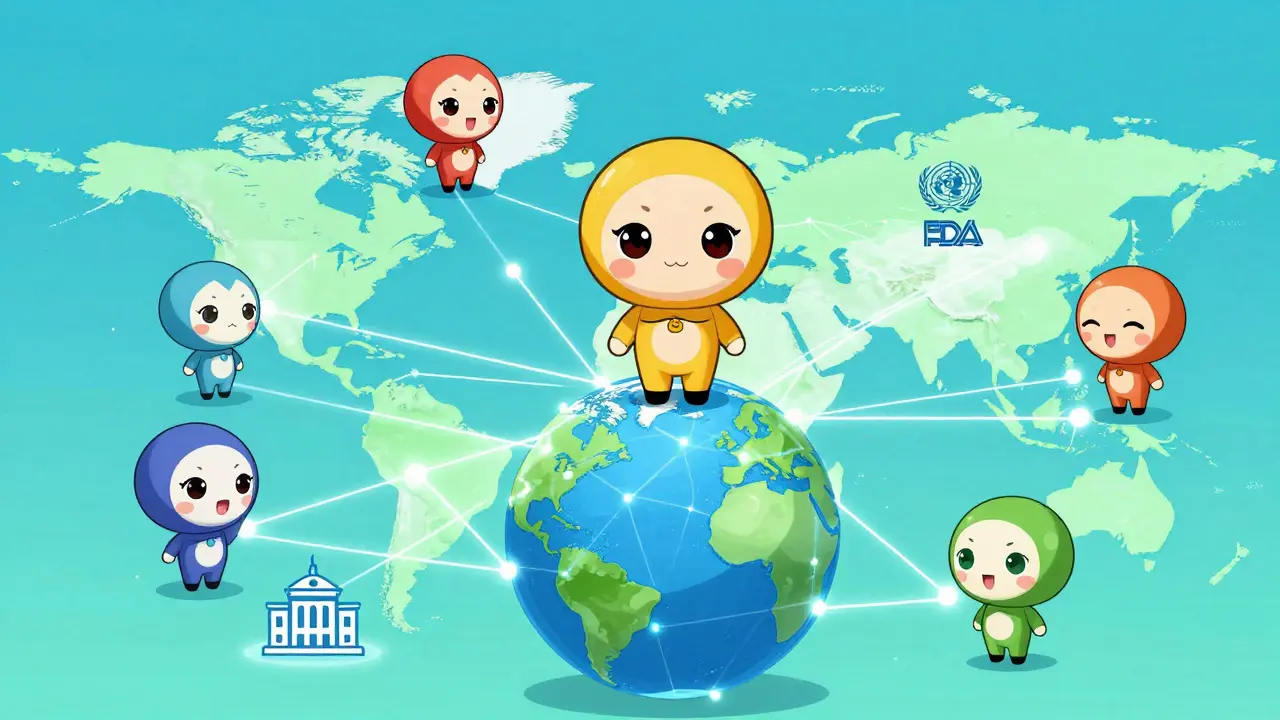
When we talk about "global medication safety," it might sound like a single organization watching over every pill produced. In reality, it’s a massive, interconnected web of agencies. Understanding who does what helps you know where to find reliable information.
At the top of this hierarchy sits the World Health Organization (WHO). The WHO acts as the primary global authority, setting standards that countries follow. In May 2025, they released comprehensive guidelines on balanced national policies for controlled medicines. Dr. Yukiko Nakatani, the WHO Assistant Director-General for Access to Medicines, emphasized that suffering caused by lack of safe access is preventable. These guidelines aren't just bureaucratic paperwork; they dictate how countries manage essential drugs like opioids and benzodiazepines, ensuring they are available for pain relief but not misused.
Below the WHO, you have regional powerhouses. In Europe, the European Medicines Agency (EMA) enforces strict reporting rates. Their 2024 Pharmacovigilance Directive mandates that member states report at least 500 adverse events per million people annually. In the United States, the Food and Drug Administration (FDA) uses the Sentinel Initiative, which connects 300 million patient records to actively monitor safety signals before they become widespread crises.
Then there are the coordinators. The Uppsala Monitoring Centre (UMC) in Sweden is crucial here. They coordinate the WHO Programme for International Drug Monitoring, linking 150 countries together. If a side effect spikes in Brazil, the UMC helps ensure that data reaches regulators in Japan or Canada. This cross-border sharing is why you hear about a drug recall weeks after it happens elsewhere.
| Organization | Primary Role | Key Recent Action (2024-2025) |
|---|---|---|
| WHO | Global policy & standards | Released controlled medicines guidelines (May 2025) |
| UMC | Data coordination & campaigns | Coordinated #MedSafetyWeek 2025 |
| FDA | US regulation & active monitoring | Sentinel Initiative expansion |
| MHRA | UK regulation & public reporting | Promoted Yellow Card scheme updates |
Annual Campaigns: When to Pay Attention
You don’t need to monitor safety alerts 24/7. However, there are specific windows when the global community focuses intensely on medication safety. Marking these dates on your calendar can keep you ahead of the curve.
The biggest event is #MedSafetyWeek. Organized by the UMC, this annual campaign runs during the first week of November. The 2025 campaign, running from November 3-9, marked its 10th anniversary with the theme "we can all help make medicines safer." During this week, 117 countries and 131 organizations mobilize to educate the public. Why does this matter to you? Because during this week, regulatory bodies release simplified guides on how to report side effects. It’s also when hospitals and pharmacies display posters encouraging you to speak up. If you see social media posts with hashtags like #ReportSideEffects or #MHRAYellowCard, pay attention. That’s when the infrastructure is most visible and accessible.
Another critical date is World Patient Safety Day, observed annually on September 17. In 2025, the theme was "ensuring safe care for every newborn," but the day always highlights broader systemic issues. The WHO’s Global Patient Safety Report 2024, released around this time, tracks progress across 108 countries. Reading the executive summary of this report gives you a high-level view of whether safety systems in your region are improving or lagging behind.
Digital Tools: Reporting Side Effects Like a Pro
Knowing *when* to look is half the battle. Knowing *how* to act is the other half. The old way of reporting a bad reaction-calling a doctor who calls a pharmacist who calls a regulator-is slow and error-prone. Today, digital tools bridge this gap instantly.
In the UK, the Yellow Card Scheme is the gold standard. Managed by the Medicines and Healthcare products Regulatory Agency (MHRA), it allows you to report adverse reactions to medicines, vaccines, herbal remedies, and even e-cigarettes. The best part? There’s an app. Downloading the Yellow Card app means you can log symptoms directly from your phone while you’re still at the pharmacy or hospital. Digital posters in waiting rooms often feature QR codes that link straight to this submission form. Make sure to scan them next time you’re waiting for a consultation.
For healthcare professionals, the stakes are higher, but the tools are similar. The Institute for Safe Medication Practices (ISMP) releases biennial "Targeted Medication Safety Best Practices." The 2025-2026 edition, released in March 2025, focused heavily on weight-based dosing verification and vaccine administration protocols. While these are aimed at pharmacies, understanding these trends helps patients ask better questions. For instance, if you are giving medication to a child, you now know that weight-based verification is a critical safety step that should be double-checked by your provider.
Even more advanced tools are emerging. Clinical decision support databases like Medi-Span are being used in places like Saudi Arabia to reduce medication errors by 40%. By 2027, these systems are expected to integrate machine learning algorithms that predict potential interactions before a prescription is even written. As a patient, this means your electronic health record will soon be smarter at catching mistakes than ever before.
Navigating Misinformation and AI Risks
Here is the tricky part: not all "news" about medication safety is good news. In fact, some of it is dangerous. The ECRI Institute and ISMP jointly publish the annual "Top 10 Patient Safety Issues." The 2025 edition identified three major threats that affect how you consume safety information:
- Medical Misinformation on Social Media: This is ranked as a top critical challenge. Vaccine-related misinformation alone has been linked to an 18% increase in adverse event reports in regions with high social media penetration. Why? Because fear drives people to stop treatments abruptly or seek unverified alternatives. Always check the source. If a TikTok video claims a common drug causes cancer without citing a peer-reviewed study, treat it with extreme skepticism.
- AI in Clinical Settings: Artificial intelligence is great for predicting risks, but it can also hallucinate. As AI tools become more integrated into hospital workflows, there is a risk of automated errors going unnoticed. Patients should remain vigilant about verifying their treatment plans with human clinicians, not just trusting a computer-generated summary.
- Cyberattacks on Health Data: When hospital systems are hacked, safety monitoring can be disrupted. If your local clinic experiences a cyber incident, assume that real-time safety alerts might be delayed. Have a backup plan for contacting your doctor.
A community pharmacist on Reddit noted in October 2024 that specific protocols from the ISMP’s 2025-2026 Best Practices prevented a fatal pediatric dosing error in their practice. This anecdote highlights a key point: actionable, verified guidance saves lives. Vague internet rumors do not.
Step-by-Step: Building Your Personal Safety Protocol
You don’t need a degree in pharmacology to stay safe. You just need a routine. Here is a simple checklist to integrate medication safety into your daily life.
- Subscribe to Official Alerts: Sign up for email updates from your national regulatory body. In the US, that’s the FDA MedWatch. In the UK, it’s the MHRA. In the EU, check your country’s health agency site. These emails contain recalls and urgent safety communications that mainstream news might miss.
- Download Reporting Apps: Install the Yellow Card app (if in the UK) or your country’s equivalent. Keep it ready. If you experience a new symptom within hours or days of starting a med, log it immediately. Memory fades; data doesn’t.
- Follow the Campaigns: Set a reminder for early November for #MedSafetyWeek. Use this time to review your current medications with your pharmacist. Ask them: "Are there any new safety warnings for my drugs since I last checked?"
- Verify Sources: When you read a scary headline about a drug, check if the WHO, EMA, or FDA has issued a statement. If they haven’t, it’s likely speculation. Look for the official guideline documents, not opinion pieces.
- Check for Interactions: Use reputable clinical decision support tools available to consumers, such as those provided by major pharmacies or hospital networks. Don’t rely solely on memory. Enter all your supplements and prescriptions to check for conflicts.
The Future of Medication Safety: What’s Next?
We are standing on the brink of a significant shift in how medication safety is managed. The disparity between high-income and low-income countries remains stark. High-income nations average 350-400 adverse event reports per million people, while low-income countries struggle with just 5-10. This gap means that safety data from diverse populations is often missing, potentially hiding side effects that only appear in certain genetic groups.
To address this, the WHO aims to increase pharmacovigilance capacity in 50 additional low- and middle-income countries by 2030. For you, this means that global safety data will become more representative and accurate over the next five years. Additionally, the integration of AI-powered symptom checkers into national reporting systems, beta-tested in 15 countries in 2024, will make reporting easier. Imagine typing "I have a headache and nausea" into an app, and it automatically suggests which recent medication might be the culprit and pre-fills a report for your doctor.
The cost of medication errors is estimated at $42 billion annually. Reducing this number isn't just about saving money; it's about restoring dignity to care, as Dr. Nakatani stated. By staying informed, reporting accurately, and demanding transparency, you contribute to a safer global healthcare system. The next time you take a pill, remember: you are part of the safety net.
What is the best way to report a side effect to a medication?
The best method depends on your location. In the UK, use the Yellow Card Scheme via their website or mobile app. In the US, submit a report to the FDA MedWatch program. Globally, many countries participate in the WHO Programme for International Drug Monitoring, so checking your national health agency's website for a direct reporting portal is the fastest route. Always include the name of the drug, dosage, and a description of the side effect.
When is World Patient Safety Day celebrated?
World Patient Safety Day is celebrated annually on September 17. On this day, the WHO and partner organizations highlight specific themes related to patient safety, such as newborn care or medication reconciliation. It is an excellent time to check for new global safety reports and educational materials.
What is #MedSafetyWeek and why should I care?
#MedSafetyWeek is an annual global campaign organized by the Uppsala Monitoring Centre (UMC), typically held in the first week of November. It aims to raise awareness about the importance of reporting side effects. Since less than 10% of side effects are reported, this campaign encourages patients and professionals to speak up. Participating helps improve drug safety data worldwide.
How can I distinguish between medical misinformation and real safety alerts?
Real safety alerts come from authoritative sources like the WHO, FDA, EMA, or your national health agency. They usually provide specific details, reference scientific studies, and offer clear guidance. Misinformation often spreads via social media, uses emotional language, lacks citations, and may claim "secret" cures or dangers. Always verify alarming claims against official government health websites.
What are the Top 10 Patient Safety Issues for 2025?
The 2025 report by ECRI and ISMP highlights critical challenges including AI in clinical settings, cyberattacks on health data, and medical misinformation on social media. Other persistent issues include missed diagnoses, healthcare-associated infections, and medication errors. These reports help prioritize where safety efforts should be focused.
Does the WHO regulate medicines directly?
The WHO does not approve individual medicines for sale in specific countries; that is done by national regulators like the FDA or EMA. Instead, the WHO sets global standards, provides guidelines (such as the 2025 controlled medicines policy), and coordinates international data sharing through programs like the International Drug Monitoring programme managed by the UMC.
How much training do healthcare professionals need to use reporting systems effectively?
According to ECRI's implementation study, pharmacists typically require 2-3 hours of training to fully utilize reporting systems, while physicians need approximately 1.5 hours to integrate reporting into their workflow. This highlights that effective reporting requires dedicated education, not just access to technology.