
Metformin & Contrast Dye Safety Calculator
Risk Assessment
Determine if you should continue or stop metformin before a contrast dye procedure based on your kidney function and medical factors.
When you’re on metformin for type 2 diabetes and need a CT scan or angiogram, a simple question can cause real anxiety: Should I stop my metformin? For years, the answer was a hard yes-stop it before and after any contrast procedure. But that’s no longer the rule. The truth is more nuanced, and the risk of lactic acidosis from combining metformin with contrast dye is far lower than most people think. Let’s cut through the confusion with clear facts, real-world guidelines, and what actually happens in your body.
How Metformin Works (and Why It’s So Common)
Metformin isn’t just another diabetes pill. It’s the first-line treatment for type 2 diabetes worldwide, prescribed to over 150 million people annually in the U.S. alone. It works by lowering blood sugar in two main ways: it reduces how much glucose your liver releases and helps your muscles absorb sugar better. Unlike some other diabetes drugs, it doesn’t cause weight gain or low blood sugar on its own. It’s cheap, effective, and has been used safely for decades.
But here’s the catch: metformin leaves your body through your kidneys. A healthy kidney clears about 500 milliliters of metformin per minute. That’s fast. If your kidneys slow down-even a little-metformin can build up. And when it builds up, it can interfere with how your cells use oxygen, pushing them to produce lactic acid instead. That’s the core of the concern: metformin-associated lactic acidosis (MALA).
What Is Lactic Acidosis? (And Why It Sounds Scary)
Lactic acidosis isn’t a common condition. In fact, studies estimate only 1 to 9 cases per 100,000 people taking metformin each year. But when it happens, it’s serious. It’s not just high lactate levels-it’s a dangerous drop in blood pH, making your blood too acidic. Your body tries to compensate by making you breathe fast and deep. You might feel nauseous, dizzy, or weak. In severe cases, your blood pressure drops, your heart struggles, and organs start to fail.
The mechanism is surprisingly specific. Metformin binds to the mitochondria-the energy factories in your cells-especially at Complex I of the electron transport chain. This disrupts normal oxygen-based energy production. Your cells switch to anaerobic metabolism, which produces lactate as a byproduct. Normally, your liver and kidneys clear lactate quickly. But if your kidneys are already struggling, or if you’re dehydrated, sick, or have heart failure, lactate piles up. That’s when things turn dangerous.
Contrast Dye and Kidneys: The Real Risk
Contrast dye-iodinated fluid used in CT scans and angiograms-can cause a temporary drop in kidney function called contrast-induced acute kidney injury (CI-AKI). This usually happens in people who already have kidney problems, are dehydrated, or have other risk factors like heart failure or diabetes. But here’s the key point: CI-AKI is often mild and reversible. Most people’s kidneys bounce back within 48 hours.
The old fear was that contrast dye would cause kidney damage, which would trap metformin in the body, leading to lactic acidosis. But large studies since 2010 have shown this chain of events is extremely rare. A 2017 review of over 30,000 patients found no increase in lactic acidosis in those who kept metformin during IV contrast procedures-even if their kidney function was mildly reduced.
The risk isn’t zero. But it’s not caused by the dye alone. It’s caused by a perfect storm: poor kidney function (eGFR below 60), heart failure, sepsis, liver disease, or alcohol abuse. If you don’t have any of these, your risk is essentially the same as if you never took metformin.
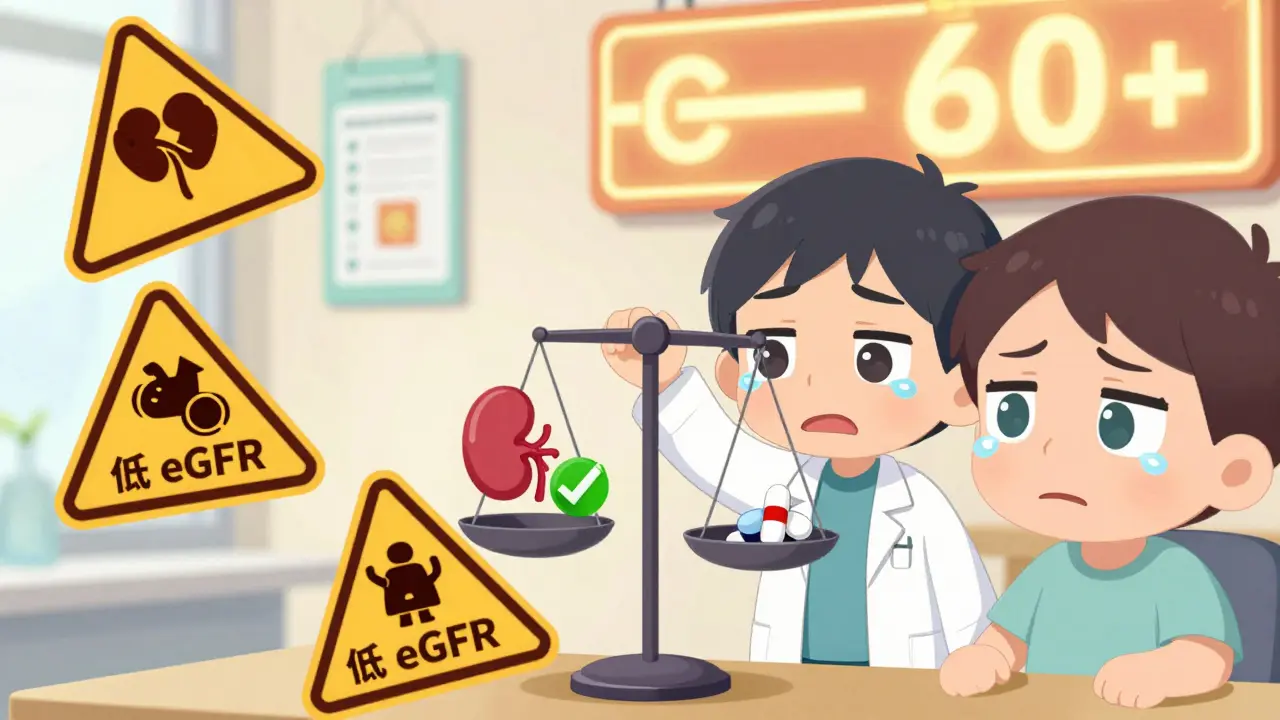
Guidelines Have Changed-Here’s What You Should Do Now
The FDA updated its label for metformin in 2016. The old rule-stop metformin 48 hours before and after any contrast scan-is outdated. The new guidelines are based on your kidney function and the type of contrast you’re getting.
- If your eGFR is above 60 mL/min/1.73m² and you have no other risk factors (no heart failure, no liver disease, not an alcoholic), you can keep taking metformin before and after the scan. No interruption needed.
- If your eGFR is between 30 and 60, or you have heart failure, liver disease, or drink heavily, stop metformin at the time of the scan. Restart it only after 48 hours, and only if your kidney function hasn’t worsened.
- If you’re getting contrast through an artery (like during a heart catheterization or angiogram), stop metformin regardless of kidney function. Intraarterial contrast carries higher risk of kidney stress.
The American College of Radiology (ACR) and the National Kidney Foundation (NKF) both support this approach. The American Diabetes Association (ADA) agrees. The goal isn’t to avoid risk-it’s to avoid unnecessary disruption. Stopping metformin can cause blood sugar spikes, which are risky for diabetics. For many, the harm of stopping outweighs the tiny risk of lactic acidosis.
What About Dialysis? Can It Help?
If lactic acidosis does happen, it’s a medical emergency. The good news? It’s treatable. Hemodialysis is the most effective tool. It removes both metformin and excess lactate from the blood. Studies show that patients who get dialysis quickly have much better survival rates. One study found that patients who received dialysis within 12 hours of diagnosis had a 70% survival rate-compared to under 30% without it.
For people on dialysis already, metformin is usually avoided entirely. But for those who aren’t, dialysis isn’t a routine precaution. It’s a rescue. That’s why the focus now is on prevention: identifying high-risk patients, checking kidney function before the scan, and avoiding contrast if possible in those with severe kidney disease.

Why Did We Overreact for So Long?
For decades, doctors were taught to treat metformin like a ticking time bomb around contrast dye. That was based on a few tragic cases from the 1970s and 80s, when metformin was less studied and kidney monitoring was poor. Back then, lactic acidosis was more common-partly because other, riskier diabetes drugs were still in use.
But modern data tells a different story. The incidence of MALA is now estimated at fewer than 10 cases per 100,000 patient-years. That’s rarer than being struck by lightning. The FDA’s 2016 revision wasn’t a gamble-it was a correction. And since then, reports of MALA haven’t increased. In fact, they’ve stayed flat, even as more patients are now keeping metformin during scans.
One study from Newcastle Hospitals NHS Foundation Trust showed that after switching to the new guidelines in 2019, they saw no cases of lactic acidosis in over 2,000 patients who kept metformin during contrast procedures. Not one.
What If You’re Not Sure?
Don’t guess. Talk to your doctor. Ask for your eGFR number-it’s calculated from your blood test and tells you how well your kidneys are working. If it’s above 60, you’re likely fine to continue metformin. If it’s below 60, ask if the scan is urgent. Sometimes, alternatives like ultrasound or MRI (which don’t need contrast) can be used.
Also, make sure you’re well-hydrated before and after the scan. Dehydration is one of the biggest risk factors for both CI-AKI and lactic acidosis. Drink water. Avoid alcohol. Don’t skip your insulin or other diabetes meds.
And remember: if you feel unusually sick after a scan-vomiting, confusion, rapid breathing, chest pain-go to the ER. Lactic acidosis is rare, but it’s treatable if caught early.
Can contrast dye damage my kidneys if I’m on metformin?
Contrast dye can cause temporary kidney stress, especially in people with existing kidney disease (eGFR below 60), diabetes, or heart failure. But in healthy kidneys, the effect is mild and usually resolves in 48 hours. The real danger comes only if metformin builds up because your kidneys can’t clear it-and even then, this requires multiple risk factors. For most people, the dye itself isn’t the problem.
Should I stop metformin before a CT scan with contrast?
Only if your kidney function is reduced (eGFR 30-60) or you have heart failure, liver disease, alcoholism, or are getting contrast through an artery (like a heart cath). If your eGFR is above 60 and you have no other risks, you can safely keep taking metformin. Always check with your doctor, but don’t assume you need to stop.
How long should I wait to restart metformin after contrast?
Wait at least 48 hours, and only restart if your kidney function is stable. Your doctor will check your creatinine or eGFR level after the scan. If it’s the same or better than before, you can resume. If it’s worse, they may delay restarting and investigate why.
Is lactic acidosis common with metformin?
No. It’s extremely rare. Studies show fewer than 10 cases per 100,000 people taking metformin each year. Most cases occur in people with multiple risk factors-like severe kidney disease, infection, or heart failure-not in healthy individuals getting a routine scan.
Can I take metformin if I have mild kidney disease?
Yes, but with caution. If your eGFR is between 30 and 60, your doctor may lower your dose or monitor you more closely. You should avoid contrast dye unless absolutely necessary. If contrast is needed, stop metformin before the scan and restart only after kidney function is confirmed stable.
Bottom Line: Risk Is Real, But Very Low
The fear around metformin and contrast dye has been blown out of proportion. The science is clear: for most people, there’s no need to stop metformin. The real risk lies in ignoring your overall health-not in the dye itself. If your kidneys are working well, keep taking your pill. If they’re not, work with your doctor to manage the risk. You don’t have to choose between good imaging and good diabetes control. With today’s guidelines, you can have both.





Melissa Starks
March 19, 2026 AT 06:13Okay, I’ve been on metformin for 12 years and just had a CT with contrast last month. No issues. No stopping. No panic. My doc checked my eGFR before and after - still at 78. I’ve seen so many people freak out over this like it’s nuclear waste or something. It’s not. The science says you’re fine if your kidneys aren’t trash. Why are we still scared of a pill that’s saved millions from heart attacks and weight gain? The old rules were based on fear, not data. Time to update our mental software.
Also, hydration. Just drink water. It’s not rocket science. I drank a liter before, a liter after. Felt fine. My blood sugar stayed stable. No spikes. No crashes. No drama. Stop overcomplicating it.
Lauren Volpi
March 20, 2026 AT 20:57Wow. Another one of those ‘trust the science’ posts. But let’s be real - science changed its mind about cholesterol too. And then again about salt. And now we’re supposed to just roll over because some FDA memo says it’s okay? What about the guy in 2018 who died after his contrast scan? His name was Mark. His kidneys were borderline. He kept metformin. He didn’t make it. So yeah, maybe the stats are low. But one life matters more than a statistic. I’m not risking it. Not anymore.
Michelle Jackson
March 21, 2026 AT 04:19Oh sweet jesus. Another doctor who thinks their guidelines are gospel. You know what’s worse than lactic acidosis? People who think they’re smarter than their own bodies. You don’t get to decide what’s ‘safe’ for me just because you read a study. My grandma had diabetes, kidney issues, and she drank whiskey daily. She lived to 92. She never stopped metformin. She never even knew what an eGFR was. And she’s still here. So maybe, just maybe, your algorithm doesn’t know my body better than I do.
Alexander Pitt
March 21, 2026 AT 20:55Let’s cut through the noise. The data is solid. Multiple large cohort studies - including one from Johns Hopkins with over 12,000 patients - show no increased risk of lactic acidosis in patients who continued metformin during contrast procedures with eGFR > 45. The old 48-hour hold was never evidence-based. It was born from textbook fear, not clinical experience. The ACR, ADA, and NKF all updated guidelines for a reason. You’re not being reckless if you follow them. You’re being informed. And if you’re unsure? Ask for a creatinine test before and 48 hours after. That’s all it takes.
jared baker
March 22, 2026 AT 08:44My doc told me to stop metformin before my CT. I did. My blood sugar went nuts. Had to use insulin twice that day. Felt awful. Next time I’m just keeping it. My kidneys are fine. My doctor didn’t even check my eGFR before telling me to stop. Guess what? I did my own research. Now I know better. Don’t let someone who’s busy tell you what to do. Know your numbers.
Suchi G.
March 22, 2026 AT 09:46As someone from India where diabetes is everywhere and access to healthcare is patchy, I’ve seen too many people die because they were told to stop metformin and then got hyperglycemia. We don’t have the luxury of 48-hour waits or repeat kidney tests. In rural clinics, they don’t even have eGFR machines. So what do we do? We rely on common sense. If you’re not sick, not dehydrated, not in heart failure - keep taking it. The fear is manufactured. The real danger is poor glucose control. That’s what kills people. Not contrast dye. Not metformin. Ignorance. And yes, I’ve seen patients die from uncontrolled sugar more than once. That’s the real epidemic.
becca roberts
March 24, 2026 AT 04:23So let me get this straight - we’ve been scaring people for decades with a risk that’s rarer than winning the lottery… while ignoring the actual risk: the chaos of uncontrolled diabetes? That’s like banning cars because someone once got hit by lightning. I love how medicine loves to overcomplicate the obvious. You want to be safe? Stay hydrated. Know your eGFR. Don’t be an idiot. And for god’s sake, stop treating a common medication like it’s radioactive. I’ve been on metformin since 2010. I’ve had three contrast scans. No issues. No drama. Just a pill and a glass of water. Why is this even a conversation?
Andrew Muchmore
March 25, 2026 AT 11:55My father had a heart cath last year. They told him to stop metformin. He did. Blood sugar spiked to 380. He ended up in the ER. They restarted metformin 72 hours later. He’s fine now. But that whole episode was avoidable. The guidelines are clear. If your eGFR is above 60 and no heart failure - keep it. Why do doctors still cling to old rules? Because it’s easier than thinking. Don’t be passive. Ask for the numbers. Push back. You’re your own best advocate.
Paul Ratliff
March 26, 2026 AT 04:43Just keep taking it. Seriously. My doc told me to stop. I didn’t. No problem. My eGFR is 72. I drink water. I don’t drink booze. I’m not sick. I’m not dying. Why would I risk high sugar for a 0.001% chance of something that’s been proven to be almost nonexistent? Stop overthinking. Your body knows what it’s doing.
SNEHA GUPTA
March 26, 2026 AT 14:17There’s a deeper philosophical layer here. We fear what we don’t understand. Metformin is a molecule. Contrast dye is a chemical. Lactic acidosis is a physiological cascade. But we reduce all of this to a binary: stop or don’t stop. We forget that biology is not a checklist. It’s a dance between organ systems, hydration, inflammation, genetics. The guidelines are a starting point, not a scripture. A person with eGFR 58 and no other risks isn’t the same as a person with eGFR 58 and sepsis. We need nuance, not rules. The system rewards simplicity. But health? Health demands complexity.
Gaurav Kumar
March 26, 2026 AT 20:22Wow. Americans still think their guidelines are global truth. In India, we’ve been managing metformin with contrast for years. No one stops it unless eGFR < 30. And even then, we monitor. We don’t panic. We don’t overtest. We don’t make patients jump through hoops. Your healthcare system is broken. You fear a pill because you’ve been told to fear everything. Meanwhile, in Delhi, a diabetic gets a CT scan, keeps metformin, drinks water, and goes home. No drama. No paperwork. Just medicine. Maybe we’re doing it right.
Melissa Stansbury
March 28, 2026 AT 12:21My sister’s a nurse in a busy ER. She told me last week about a guy who came in with lactic acidosis after a CT. He had eGFR 42, heart failure, and had been drinking heavily. He also kept metformin. He survived because they caught it fast and dialyzed him. But here’s the thing - he was already in a high-risk group. He didn’t have ‘mild kidney issues.’ He had multiple comorbidities. The problem wasn’t the contrast. It was the whole mess. So why are we generalizing? We need to stop treating all diabetics the same. Some are low risk. Some are high. The guidelines reflect that. If you’re healthy, you’re fine. If you’re not? Talk to your doctor. Don’t self-diagnose based on Reddit posts.
David Robinson
March 28, 2026 AT 19:18Stop. Just stop. You think you’re being smart by keeping metformin? What if you’re the one in 100,000? You’re not special. You’re not immune. Your kidneys might seem fine now. But what if they’re declining? You won’t know until it’s too late. I’ve seen too many people think they’re invincible. Then they end up in ICU. The guidelines exist for a reason. Don’t be the guy who thinks he knows better than decades of clinical caution. Play it safe. Stop the pill. You’re not losing anything. Except risk.